Department of General Surgery, Faculty of Medicine, Ilam University of Medical Sciences, Ilam, Iran.
Faculty of Medicine, Ilam University of Medical Sciences, Ilam, Iran.
BMC Gastroenterol. 2020 May 6;20(1):138. doi: 10.1186/s12876-020-01267-2.
The relationship between metabolic syndrome (MetS) and Barrett's esophagus (BE) is still a challenging issue, and inconsistent results have been reported in different studies. Therefore, this study was conducted to determine the relationship between MetS and BE.
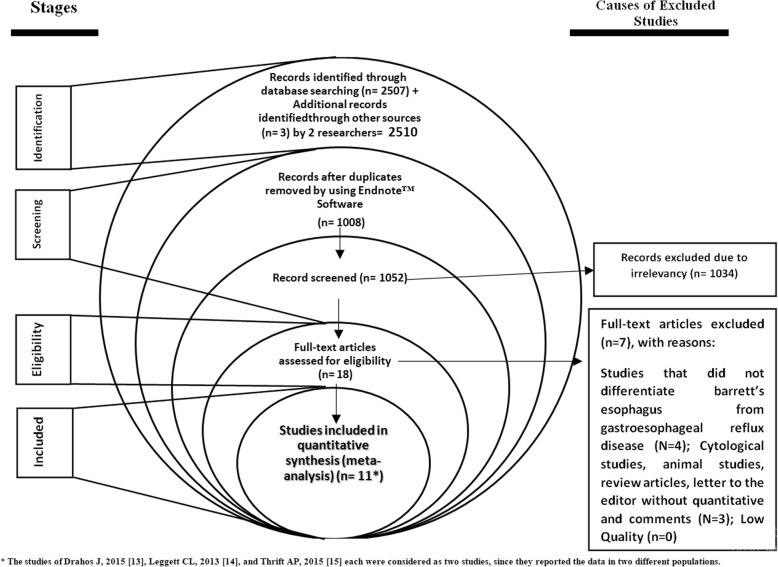
In this study, we followed the MOOSE protocol and results were reported according to the PRISMA guidelines. All study steps were performed independently by two authors. If necessary, the dispute was resolved by consultation with a third author. The search strategy is designed to find published studies. Comprehensive search was done in the following databases until July 2019: Cochrane Library, PubMed/Medline, Web of Science, Science Direct, EMBASE, Scopus, CINAHL, EBSCO, and Google Scholar search engine. All analyses were performed using Comprehensive Meta-Analysis Software Ver.2, while p-value lower than 0.05 was considered significant.
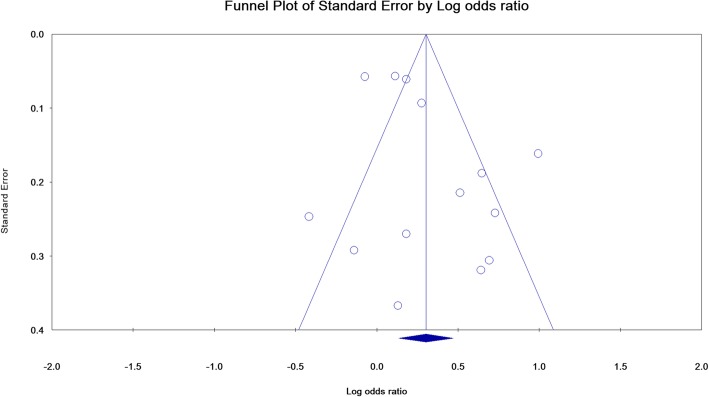
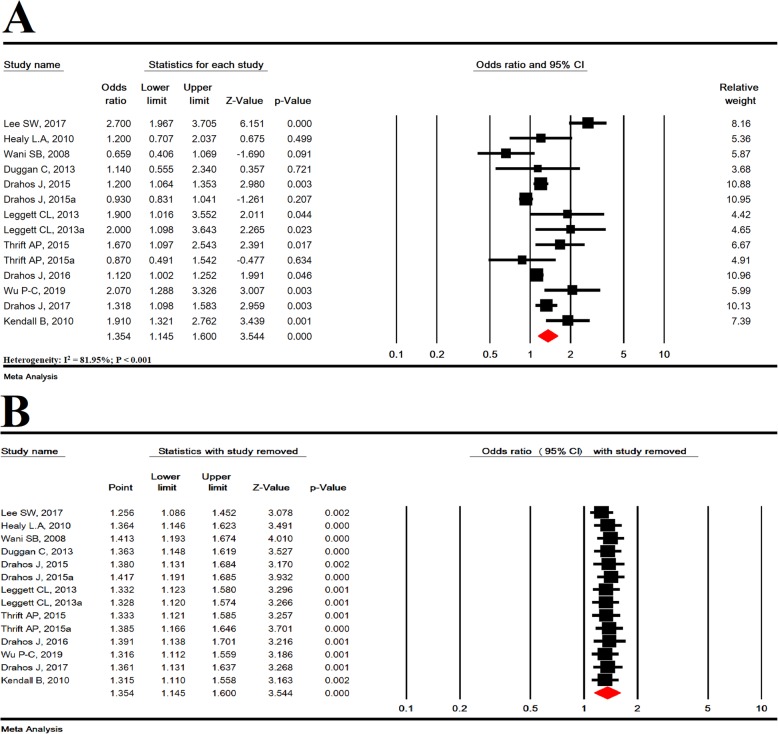
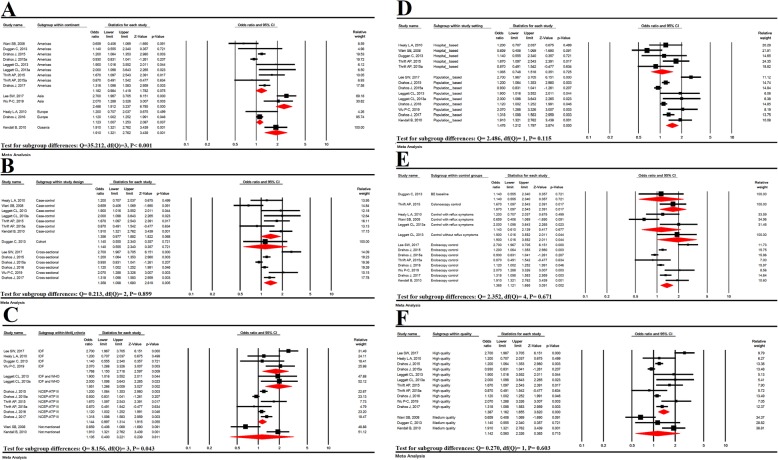
In 14 studies with a sample size of 108,416, MetS significantly increased the risk of BE (OR = 1.354; 95% CI: 1.145-1.600; P < 0.001; Heterogeneity: I = 81.95%; P < 0.001). Sensitivity analysis by omitting one study showed that overall estimates are still robust. Subgroup analysis was significant for continent (P < 0.001) and MetS diagnostic criteria (P = 0.043), but was not significant for variables of study type (P = 0.899), study setting (P = 0.115), control groups (P = 0.671) and quality of studies (P = 0.603). The Begg (P = 0.912) and Egger's (P = 0.094) tests were not significant; therefore, the publication bias did not play a role in the results.
MetS increases the risk of BE compared to control groups. The results of this study can help health practitioners by identifying a treatable risk factor for the most important risk factor for esophageal carcinoma (ie, BE). Future studies should examine whether treatment for MetS reduces the risk of BE.
代谢综合征(MetS)与巴雷特食管(BE)之间的关系仍然是一个具有挑战性的问题,不同的研究结果并不一致。因此,本研究旨在确定 MetS 与 BE 之间的关系。
本研究遵循 MOOSE 方案,并根据 PRISMA 指南报告结果。所有研究步骤均由两位作者独立完成。如有必要,通过与第三位作者协商解决争议。搜索策略旨在寻找已发表的研究。全面搜索以下数据库,直到 2019 年 7 月:Cochrane 图书馆、PubMed/Medline、Web of Science、Science Direct、EMBASE、Scopus、CINAHL、EBSCO 和 Google Scholar 搜索引擎。所有分析均使用 Comprehensive Meta-Analysis Software Ver.2 进行,p 值小于 0.05 被认为具有统计学意义。
在纳入的 14 项研究中,共纳入 108416 例样本,MetS 显著增加了 BE 的患病风险(OR=1.354;95%CI:1.145-1.600;P<0.001;异质性:I=81.95%;P<0.001)。敏感性分析排除一项研究后,总体估计仍较为稳健。亚组分析按大陆(P<0.001)和 MetS 诊断标准(P=0.043)有统计学意义,但按研究类型(P=0.899)、研究地点(P=0.115)、对照组(P=0.671)和研究质量(P=0.603)变量无统计学意义。Begg(P=0.912)和 Egger(P=0.094)检验无统计学意义;因此,发表偏倚在结果中未起作用。
与对照组相比,MetS 增加了 BE 的患病风险。本研究结果可以帮助卫生保健人员通过确定一种可治疗的危险因素来识别食管癌最重要的危险因素(即 BE)。未来的研究应检查 MetS 的治疗是否降低了 BE 的患病风险。