Department of Geography, Florida State University, Tallahassee, FL, USA.
Department of Public Health, University of Tennessee, Knoxville, TN, USA.
BMC Public Health. 2020 May 6;20(1):632. doi: 10.1186/s12889-020-08754-x.
Social determinants of health (SDOH) contribute to unequal life expectancy (LE). Only a handful of papers have analyzed these relationships at the neighborhood level as opposed to the county level. This study draws on both the SDOH and social vulnerability literature to identify relevant factors affecting LE.
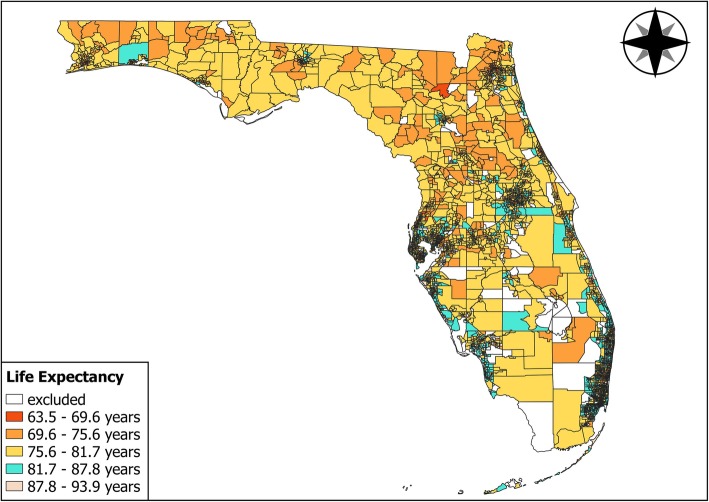
LE was calculated from mortality records for Florida from 2009 to 2013 for 3640 census tracts with reliable estimates. A spatial Durbin error model (SDEM) quantified the direction and magnitude of the factors to LE. The SDEM contains a spatial error term and jointly estimates both local and neighborhood associations. This methodology controls for non-independence between census tracts to provide unbiased statistical estimates.
Factors significantly related to an increase in LE, include percentage (%) of the population who identify as Hispanic (beta coefficient [β]: 0.06, p-value [P] < 0.001) and % of age dependent populations (% population < 5 years old and % population > 65) (β: 0.13, P < 0.001). Conversely, the following factors exhibited significant negative LE associations, % of households with no automobile (β: -0.05, P < 0.001), % of mobile homes (β: -0.02, P < 0.001), and % of female headed households (β: -0.11, P < 0.001).
Results from the SDEM demonstrate social vulnerability indicators account for additional geographic LE variability beyond commonly studied SDOH. Empirical findings from this analysis can help local health departments identify drivers of spatial health disparities at the local level.
健康的社会决定因素(SDOH)导致预期寿命(LE)不平等。只有少数几篇论文分析了社区层面而非县一级的这些关系。本研究借鉴了 SDOH 和社会脆弱性文献,以确定影响 LE 的相关因素。
从 2009 年至 2013 年佛罗里达州的死亡率记录中计算了 3640 个具有可靠估计值的普查区的 LE。空间 Durbin 误差模型(SDEM)量化了影响 LE 的因素的方向和大小。SDEM 包含空间误差项,并联合估计局部和邻里关联。该方法控制了普查区之间的非独立性,以提供无偏的统计估计。
与 LE 增加显著相关的因素包括:人口中自认为是西班牙裔的百分比(β系数[β]:0.06,P 值[P] < 0.001)和年龄依赖人口的百分比(人口<5 岁和人口>65 岁)(β:0.13,P < 0.001)。相反,以下因素与 LE 呈显著负相关,即没有汽车的家庭的百分比(β:-0.05,P < 0.001)、移动房屋的百分比(β:-0.02,P < 0.001)和女性户主家庭的百分比(β:-0.11,P < 0.001)。
SDEM 的结果表明,社会脆弱性指标除了通常研究的 SDOH 之外,还可以解释 LE 空间变异性的额外因素。本分析的实证结果可以帮助地方卫生部门确定地方一级空间健康差距的驱动因素。