Odden Michelle C, Li Yongmei, Thorpe Roland J, Tan Annabel, Sims Kendra D, Ratcliff Jourdan, Abdel Magid Hoda S, Sims Mario
Department of Epidemiology and Population Health, Stanford University School of Medicine, Stanford, CA, United States.
Hopkins Center for Health Disparities Solutions, Bloomberg School of Public Health, Johns Hopkins University, Baltimore, MD, United States.
Prev Med Rep. 2023 Aug 2;35:102360. doi: 10.1016/j.pmedr.2023.102360. eCollection 2023 Oct.
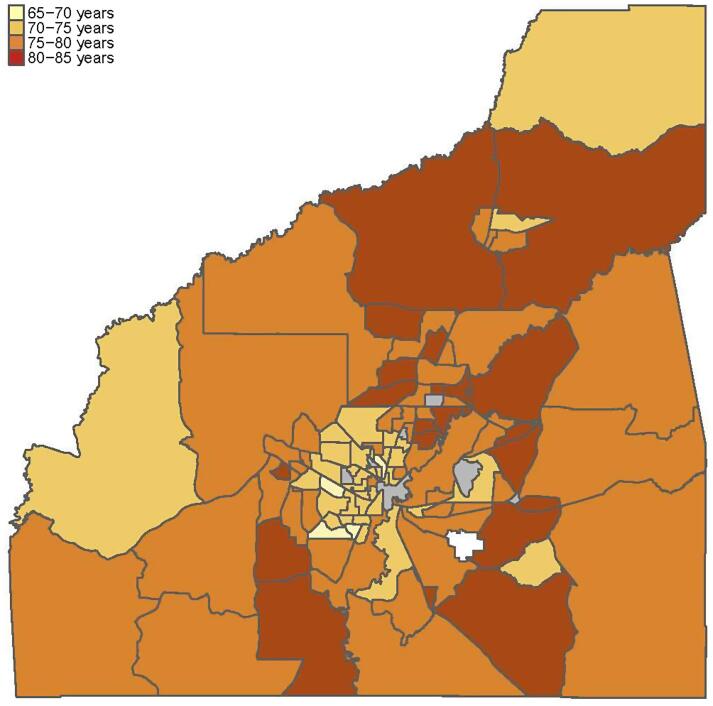
Few studies have evaluated environmental factors that predict survival to old age. Our study included 913 African American participants in the Jackson Heart Study (JHS) who resided in the tri-county area of the Jackson, MS metropolitan area and were 65-80 years at baseline. Participants were followed from 2000 through 2019 for the outcome of survival to 85 years old. We evaluated each of the following census tract-level measures of the social/physical environment as exposures: socioeconomic status, cohesion, violence, disorder, healthy food stores, residential land use, and walkability. We assessed mediation by physical activity and chronic conditions. As a complementary ecologic analysis, we used census-tract data to examine factors associated with a greater life expectancy. A total of 501 (55%) JHS participants survived to age 85 years or older. Higher social cohesion and greater residential land use were modestly associated with survival to old age (risk difference = 25%, 95% CI: 0-49%; and 4%, 95% CI: 1-7%, respectively). These neighborhood effects were modestly mediated through leisure time physical activity; additionally, social cohesion was mediated through home and yard activity. In our ecologic analysis, a greater percentage of homeowners and a greater proportion of people living in partnered families were associated with higher census-tract level life expectancy. African American older adults living in residential neighborhoods or neighborhoods with high social cohesion were more likely to survive to old age.
很少有研究评估预测老年生存的环境因素。我们的研究纳入了杰克逊心脏研究(JHS)中的913名非裔美国参与者,他们居住在密西西比州杰克逊市大都市区的三县地区,基线年龄为65 - 80岁。从2000年到2019年对参与者进行随访,观察活到85岁的结局。我们将社会/物理环境的以下每个普查区层面的指标作为暴露因素进行评估:社会经济地位、凝聚力、暴力、无序、健康食品店、居住用地和步行便利性。我们评估了身体活动和慢性病的中介作用。作为一项补充性生态分析,我们使用普查区数据来研究与更高预期寿命相关的因素。共有501名(55%)JHS参与者活到了85岁及以上。较高的社会凝聚力和更多的居住用地与老年生存呈适度相关(风险差异分别为25%,95%CI:0 - 49%;以及4%,95%CI:1 - 7%)。这些邻里效应通过休闲时间身体活动得到适度中介;此外,社会凝聚力通过家庭和庭院活动得到中介。在我们的生态分析中,较高比例的房主和较高比例的生活在伴侣家庭中的人与普查区层面较高的预期寿命相关。生活在具有高社会凝聚力的居民区或社区中的非裔美国老年人更有可能活到老年。