Department of Entomology and Plant Pathology, North Carolina State University, Raleigh, NC, 27695-7630, USA.
Department of Entomology and Plant Pathology, 301 Funchess Hall, Auburn University, Auburn, AL, 36849, USA.
Sci Rep. 2020 May 6;10(1):7649. doi: 10.1038/s41598-020-64507-1.
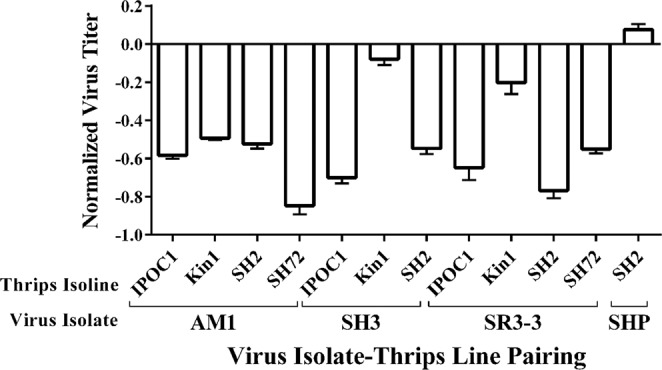
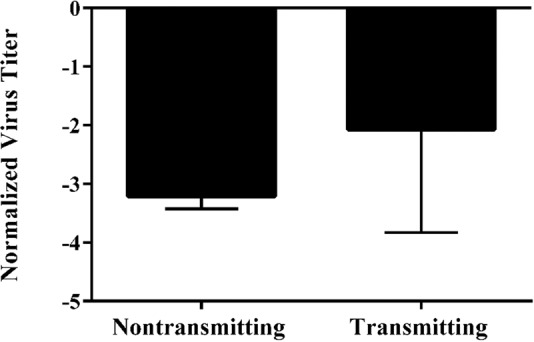
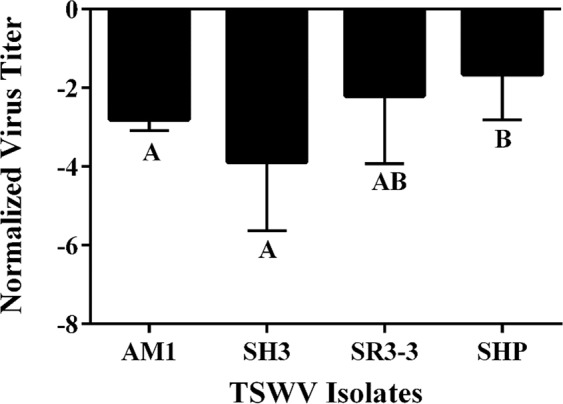
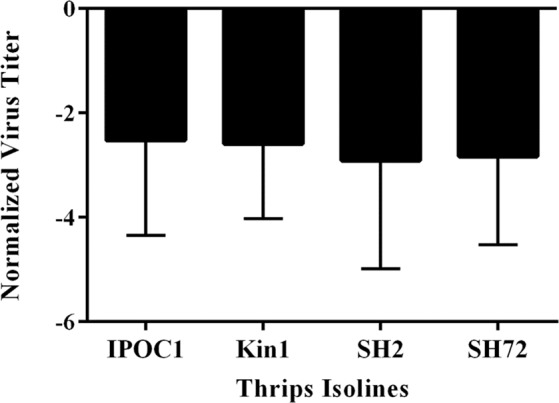
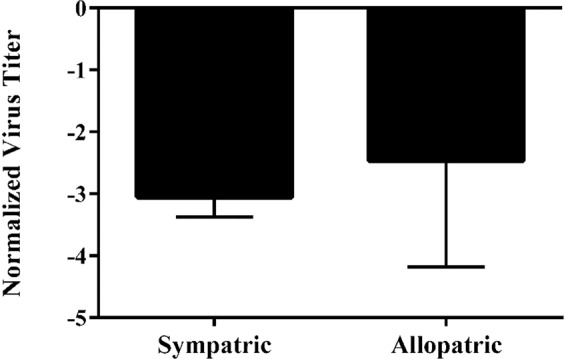
Plant viruses rely on insect vectors for transmission among plant hosts, but many of the specifics of virus-vector interactions are not fully understood. Thrips tabaci, which transmits Tomato spotted wilt virus (TSWV) in a persistent and propagative manner, varies greatly in its ability to transmit different isolates of TSWV. Similarly, TSWV isolates are transmitted at different efficiencies by different populations of T. tabaci. This study characterizes differences in virus titers in the vector among TSWV isolate-T. tabaci isoline pairings in relation to differences in transmission rates, and demonstrates that although transmission rates were higher for sympatric than allopatric TSWV isolate-T. tabaci isoline pairings, virus titers in the thrips vector were significantly lower in the sympatric pairings. Results further demonstrate that TSWV titers in the vector were unrelated to virus titers in the leaf tissue from which they acquired the virus and provide evidence for the importance of specific vector-virus interactions and local adaptation in determining transmission efficiency of TSWV by T. tabaci.
植物病毒依靠昆虫介体在植物宿主间传播,但病毒-介体相互作用的许多细节尚未完全了解。以持久和增殖方式传播番茄斑萎病毒(TSWV)的烟粉虱在其传播不同 TSWV 分离株的能力上存在很大差异。同样,不同种群的烟粉虱以不同的效率传播 TSWV 分离株。本研究描述了与传播率差异相关的 TSWV 分离株-烟粉虱分离系组合中介体内病毒滴度的差异,并表明尽管同域 TSWV 分离株-烟粉虱分离系组合的传播率高于异域组合,但在同域组合中,介体内的病毒滴度显著降低。结果进一步表明,介体内的 TSWV 滴度与它们获得病毒的叶片组织中的病毒滴度无关,并为特定的介体-病毒相互作用和局部适应在决定烟粉虱传播 TSWV 的效率方面的重要性提供了证据。