Janssen, Beerse, Belgium.
Biogen, Cambridge, Massachusetts, USA.
Nucleic Acid Ther. 2020 Aug;30(4):189-197. doi: 10.1089/nat.2020.0846. Epub 2020 May 6.
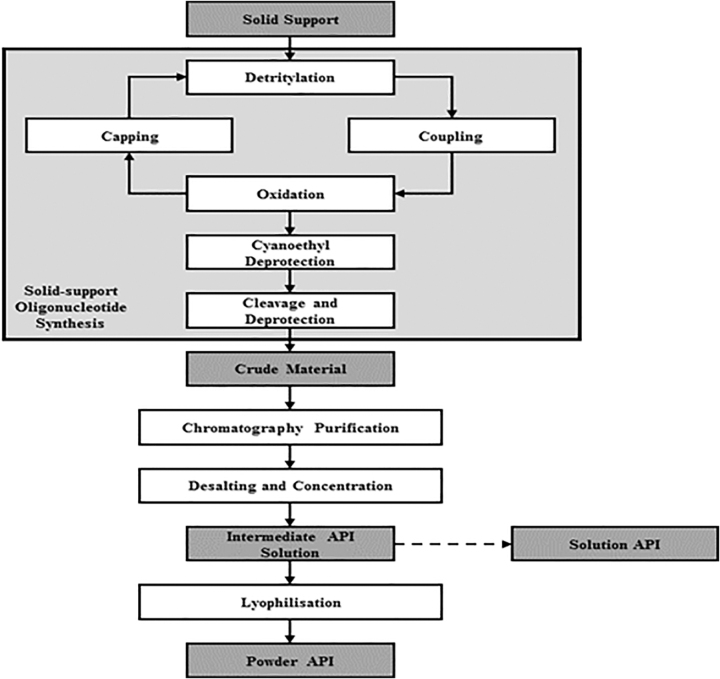
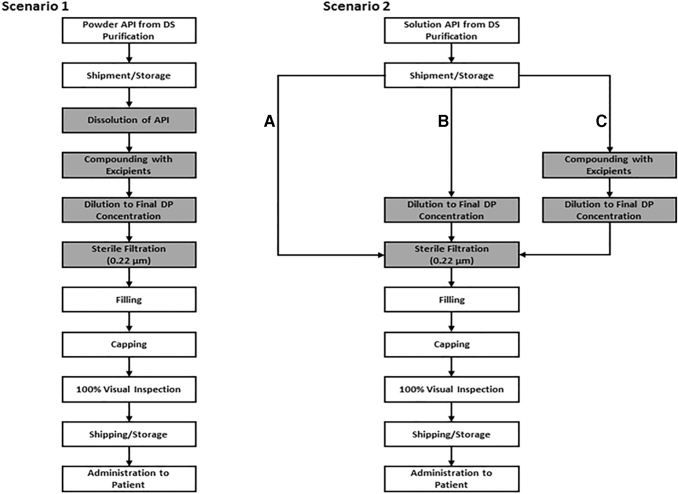
The most common approach for the manufacture of oligonucleotides includes isolation of the active pharmaceutical ingredient (API) via lyophilization to provide a solid product, which is then dissolved to provide an aqueous formulation. It is well known from the development and manufacture of large molecules ("biologics") that API production does not always require isolation of solid API before drug product formulation, and this article provides technical considerations for the analogous use of oligonucleotide API in solution. The primary factor considered is solution stability, and additional factors such as viscosity, concentration, end-to-end manufacturing, microbiological control, packaging, and storage are also discussed. The technical considerations discussed in this article will aid the careful evaluation of the relative advantages and disadvantages of solution versus powder API for a given oligonucleotide drug substance.
最常见的寡核苷酸制造方法包括通过冻干来分离活性药物成分 (API) 以提供固体产品,然后将其溶解以提供水性制剂。从大分子(“生物制剂”)的开发和制造中可知,API 生产并不总是需要在药物产品制剂之前分离固体 API,本文提供了在溶液中使用寡核苷酸 API 的类似技术考虑因素。主要考虑因素是溶液稳定性,此外还讨论了其他因素,如粘度、浓度、端到端制造、微生物控制、包装和储存。本文讨论的技术考虑因素将有助于仔细评估给定寡核苷酸药物物质的溶液 API 与粉末 API 的相对优缺点。