Laboratoire MESuRS, Conservatoire National des Arts et Métiers, Paris, France.
Unité PACRI, Institut Pasteur, Conservatoire National des Arts et Métiers, Paris, France.
PLoS Negl Trop Dis. 2020 May 7;14(5):e0008304. doi: 10.1371/journal.pntd.0008304. eCollection 2020 May.
To counter the increasing global risk of Yellow fever (YF), the World Health Organisation initiated the Eliminate Yellow fever Epidemics (EYE) strategy. Estimating YF burden, as well as vaccine impact, while accounting for the features of urban YF transmission such as indirect benefits of vaccination, is key to informing this strategy.
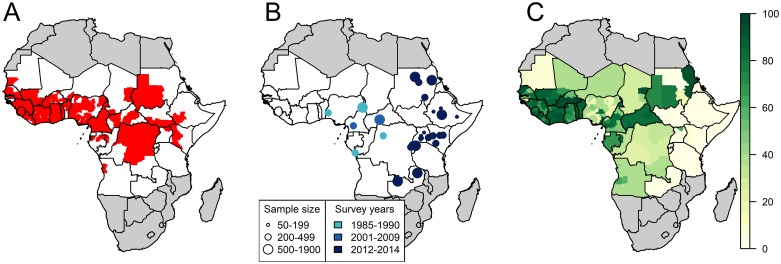
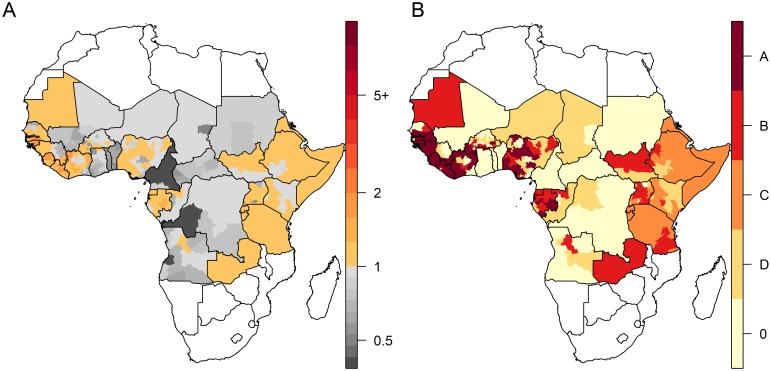
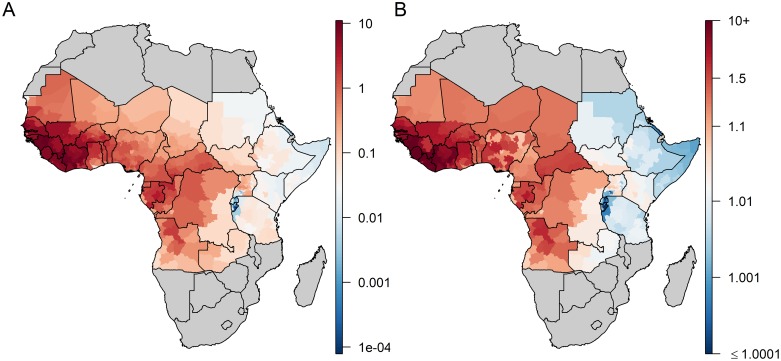
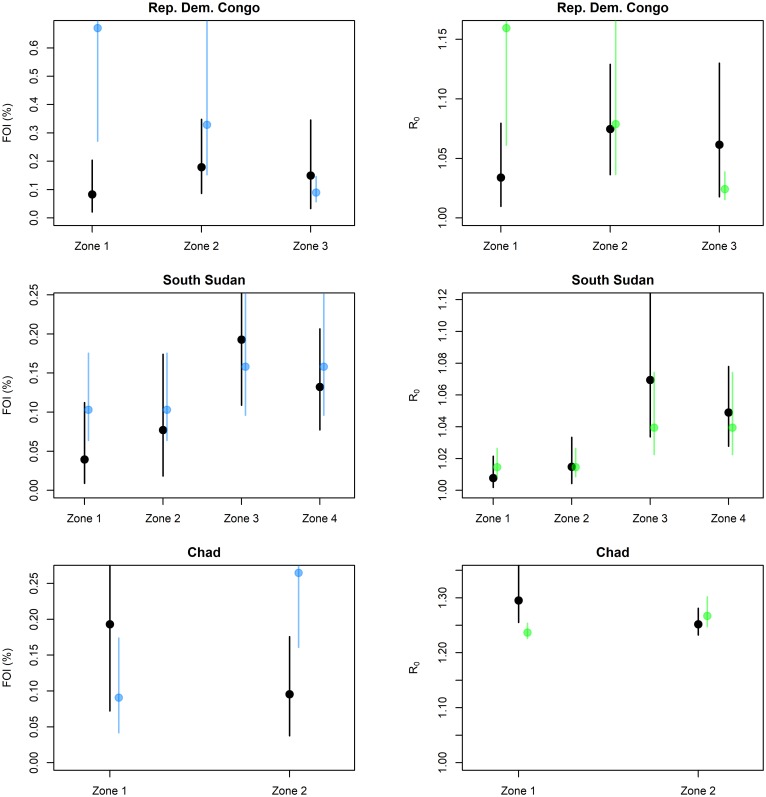
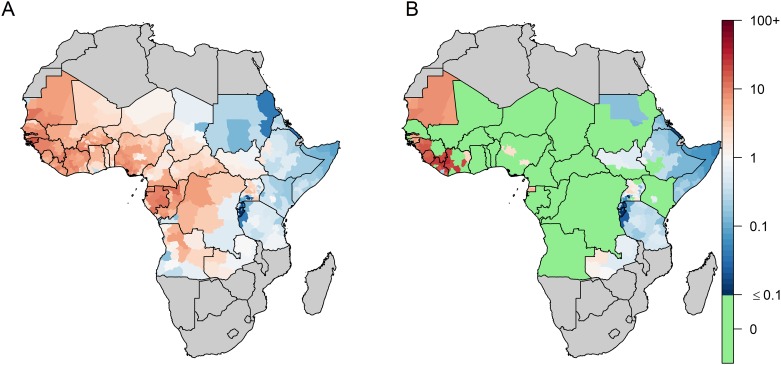
We developed two model variants to estimate YF burden in sub-Saharan Africa, assuming all infections stem from either the sylvatic or the urban cycle of the disease. Both relied on an ecological niche model fitted to the local presence of any YF reported event in 34 African countries. We calibrated under-reporting using independent estimates of transmission intensity provided by 12 serological surveys performed in 11 countries. We calculated local numbers of YF infections, deaths and disability-adjusted life years (DALYs) lost based on estimated transmission intensity while accounting for time-varying vaccination coverage. We estimated vaccine demand and impact of future preventive mass vaccination campaigns (PMVCs) according to various vaccination scenarios. Vaccination activities conducted in Africa between 2005 and 2017 were estimated to prevent from 3.3 (95% CI 1.2-7.7) to 6.1 (95% CI 2.4-13.2) millions of deaths over the lifetime of vaccinees, representing extreme scenarios of none or maximal herd effects, respectively. By prioritizing provinces based on the risk of urban YF transmission in future PMVCs, an average of 37.7 million annual doses for PMVCs over eight years would avert an estimated 9,900,000 (95% CI 7,000,000-13,400,000) infections and 480,000 (180,000-1,140,000) deaths over the lifetime of vaccinees, corresponding to 1.7 (0.7-4.1) deaths averted per 1,000 vaccine doses.
By estimating YF burden and vaccine impact over a range of spatial and temporal scales, while accounting for the specificity of urban transmission, our model can be used to inform the current EYE strategy.
为应对黄热病(YF)在全球不断增加的风险,世界卫生组织启动了消灭黄热病疫情(EYE)战略。估计黄热病负担,以及疫苗的影响,同时考虑城市黄热病传播的特征,如疫苗接种的间接效益,是为该战略提供信息的关键。
我们开发了两种模型变体,以估计撒哈拉以南非洲的黄热病负担,假设所有感染均源自疾病的森林或城市循环。两者都依赖于对 34 个非洲国家报告的任何黄热病事件的局部存在进行拟合的生态位模型。我们使用 11 个国家的 12 项血清学调查提供的独立传播强度估计值来校准漏报率。我们根据估计的传播强度计算当地的黄热病感染、死亡和伤残调整生命年(DALY)损失数,同时考虑时间变化的疫苗接种覆盖率。我们根据各种疫苗接种方案估算未来预防性大规模疫苗接种活动(PMVC)的疫苗需求和影响。2005 年至 2017 年在非洲开展的疫苗接种活动估计可预防疫苗接种者一生中 330 万人(95%CI,120 万-770 万)至 610 万人(95%CI,240 万-1320 万)死亡,分别代表无群体效应或最大群体效应的极端情况。通过根据未来 PMVC 中城市黄热病传播的风险对省份进行优先级排序,在 8 年内每年平均进行 3770 万剂 PMVC,可预防估计的 990 万人(95%CI,700 万-1340 万)感染和 48 万人(18 万-114 万)死亡,疫苗接种者一生中每 1000 剂疫苗可预防 1.7 人(0.7-4.1)死亡。
通过在一系列时空尺度上估计黄热病负担和疫苗影响,同时考虑城市传播的特殊性,我们的模型可用于为当前的 EYE 战略提供信息。