Eugene McDermott Center for Human Growth and Development, University of Texas Southwestern Medical Center, Dallas, TX, United States of America.
Department of Surgery, University of Texas Southwestern Medical Center, Dallas, TX, United States of America.
PLoS One. 2020 May 7;15(5):e0232575. doi: 10.1371/journal.pone.0232575. eCollection 2020.
Pectus excavatum is the most common chest wall skeletal deformity. Although commonly evaluated in adolescence, its prevalence in adults is unknown.
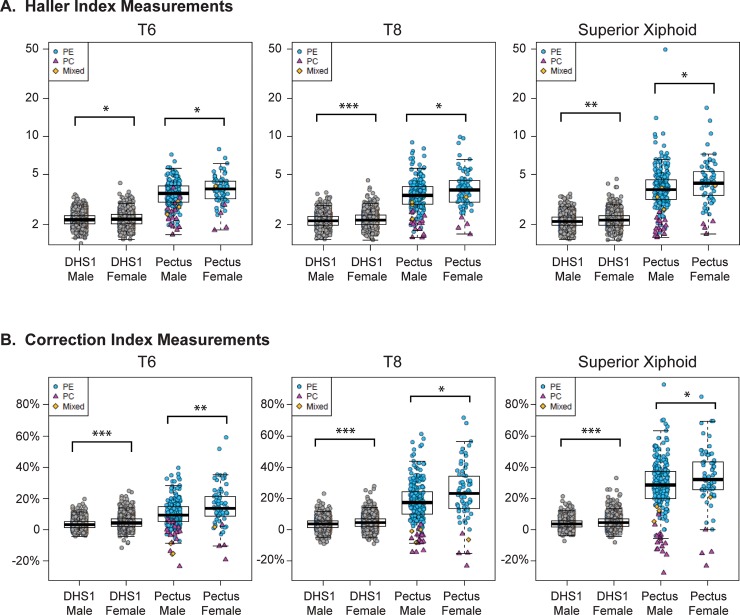
Radiographic indices of chest wall shape were analyzed for participants of the first (n = 2687) and second (n = 1780) phases of the population-based Dallas Heart Study and compared to clinical cases of pectus (n = 297). Thoracic computed tomography imaging studies were examined to calculate the Haller index, a measure of thoracic axial shape, and the Correction index, which quantitates the posterior displacement of the sternum relative to the ribs. At the level of the superior xiphoid, 0.5%, 5% and 0.4% of adult Dallas Heart Study subjects have evidence of pectus excavatum using thresholds of Haller index >3.25, Correction index >10%, or both, respectively. Radiographic measures of pectus are more common in females than males and there is a greater prevalence of pectus in women than men. In the general population, the Haller and Correction indices are associated with height and weight, independent of age, gender, and ethnicity. Repeat imaging of a subset of subjects (n = 992) demonstrated decreases in the mean Haller and Correction indices over seven years, suggesting change to a more circular axial thorax, with less sternal depression, over time.
To our knowledge, this is the first study estimating the prevalence of pectus in an unselected adult population. Despite the higher reported prevalence of pectus cases in adolescent boys, this study demonstrates a higher prevalence of radiographic indices of pectus in adult females.
漏斗胸是最常见的胸廓骨骼畸形。虽然通常在青少年时期进行评估,但成年人中的患病率尚不清楚。
分析了基于人群的达拉斯心脏研究第一阶段(n=2687)和第二阶段(n=1780)参与者的胸廓形状放射学指标,并将其与漏斗胸的临床病例(n=297)进行了比较。检查了胸部计算机断层扫描成像研究,以计算胸廓轴向形状的 Haller 指数和定量胸骨相对于肋骨后向位移的校正指数。在剑突上 0.5%、5%和 0.4%的达拉斯心脏研究成年受试者中,使用 Haller 指数>3.25、校正指数>10%或两者的阈值,有漏斗胸的证据。漏斗胸的放射学测量在女性中比男性更常见,并且女性中的漏斗胸患病率高于男性。在一般人群中,Haller 和校正指数与身高和体重相关,与年龄、性别和种族无关。对一组受试者(n=992)的重复成像显示,七年内平均 Haller 和校正指数下降,表明随着时间的推移,胸廓轴向更圆,胸骨凹陷减少。
据我们所知,这是第一项在未选择的成年人群中估计漏斗胸患病率的研究。尽管报告的青少年男性漏斗胸病例的患病率较高,但本研究表明成年女性的漏斗胸放射学指标患病率更高。