Department of Nephrology, Tokyo Women's Medical University, Tokyo, Japan.
Clinical Research Division for Polycystic Kidney Disease, Department of Nephrology, Tokyo Women's Medical University, Tokyo, Japan.
PLoS One. 2020 May 7;15(5):e0232885. doi: 10.1371/journal.pone.0232885. eCollection 2020.
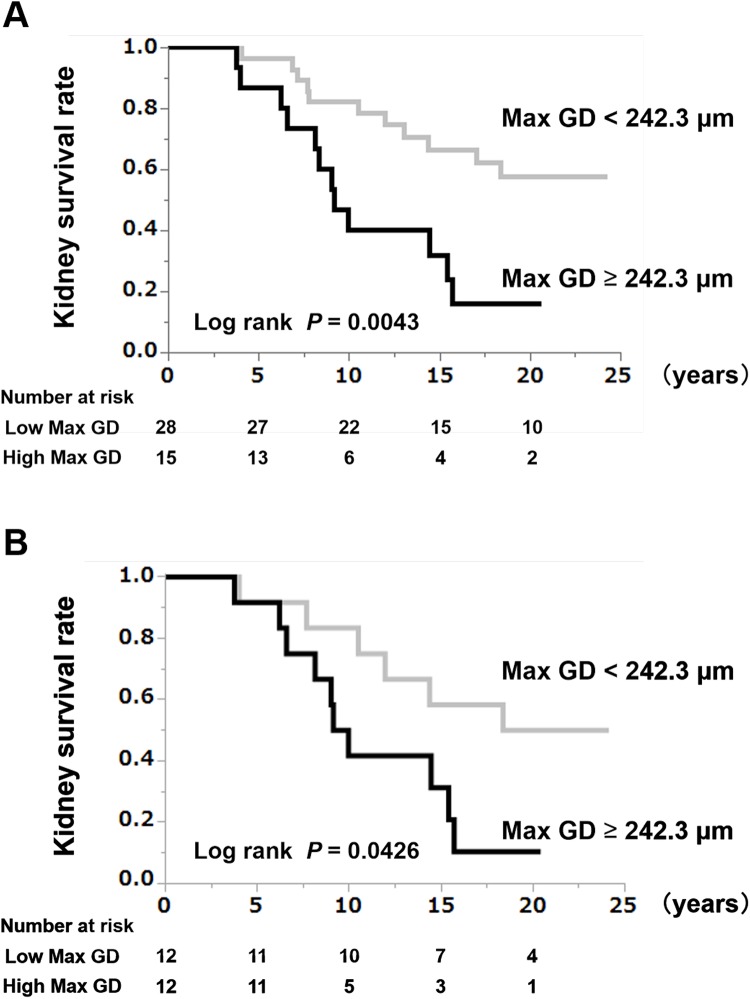
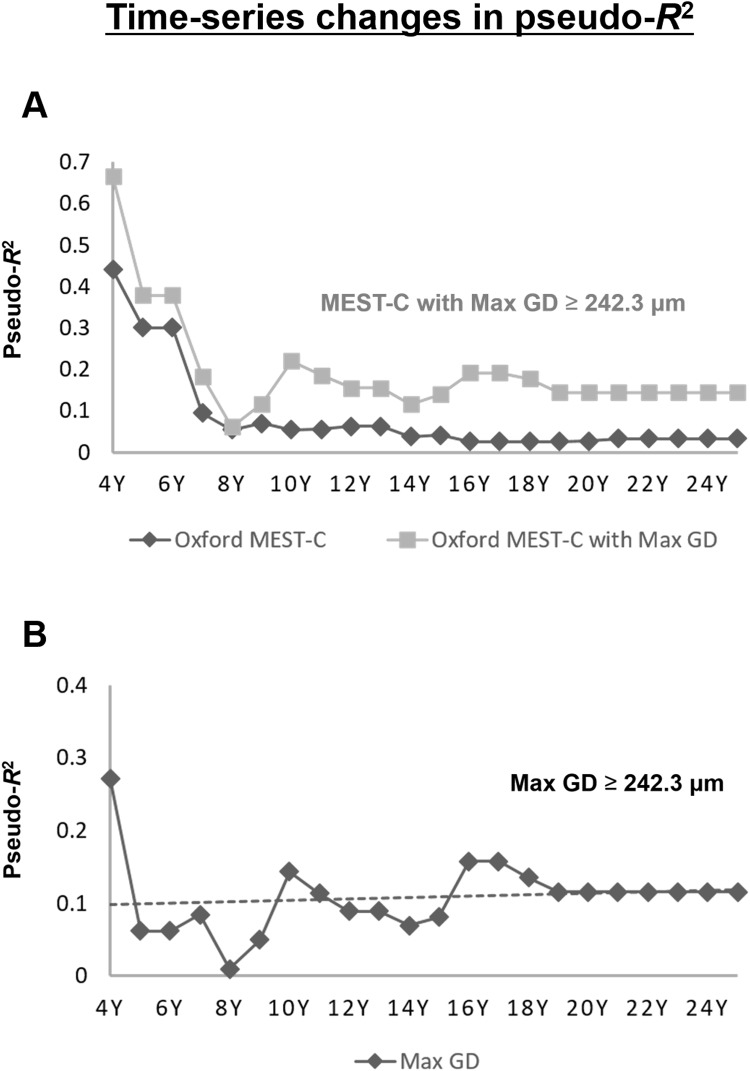
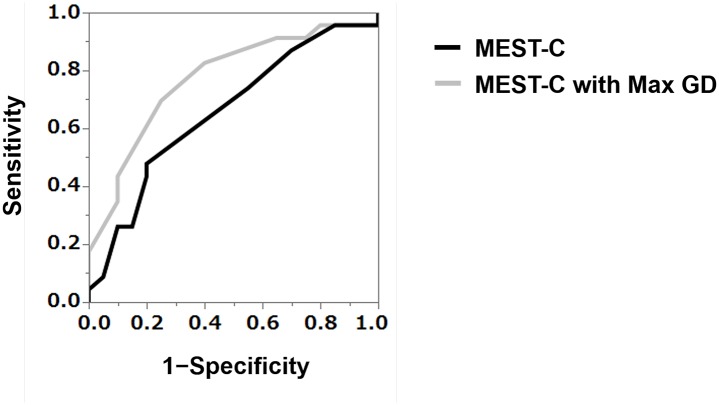
There is no effectual pathological factor to predict the long-term renal prognosis of IgA nephropathy. Glomerular hypertrophy plays a crucial role in kidney disease outcomes in both experimental models and humans. This study aimed to 1) confirm the long-term prognostic significance of a maximal glomerular diameter (Max GD) ≥ 242.3 μm, 2) test a renal prognosis prediction model adding Max GD ≥ 242.3 μm to the Oxford classification (MEST-C), and 3) examine the time series changes in the long-term renal prognosis of patients with IgA nephropathy. The study included 43 patients diagnosed with IgA nephropathy from 1993 to 1998 at Kameda General Hospital. Renal prognosis with the endpoint of a 50% reduction in estimated glomerular filtration rate (eGFR) or the development of end-stage renal disease requiring dialysis was examined using logistic regression analysis, Cox regression analysis, and the Kaplan-Meier method. Pathological evaluation was performed using MEST-C and Max GD, and the validity of the prediction model was evaluated. Patients with Max GD ≥ 242.3 μm had significantly poor renal prognosis with multivariate Cox analysis (P = 0.0293). The results of the Kaplan-Meier analysis showed that kidney survival rates in the high-Max GD group were significantly lower than those in the low-Max GD group (log rank, P = 0.0043), which was confirmed in propensity score-matched models (log rank, P = 0.0426). Adding Max GD ≥ 242.3 μm to MEST-C improved diagnostic power of the renal prognosis prediction model by renal pathology tissue examination (R2: 3.3 to 14.5%, AICc: 71.8 to 68.0, C statistic: 0.657 to 0.772). We confirm that glomerular hypertrophy is useful as a long-term renal prognostic factor.
目前尚无有效的病理因素可预测 IgA 肾病的长期肾脏预后。肾小球肥大在实验模型和人类中均对肾脏疾病结局起着至关重要的作用。本研究旨在:1)证实最大肾小球直径(Max GD)≥242.3μm 的长期预后意义;2)检验将 Max GD≥242.3μm 加入牛津分类(MEST-C)的肾脏预后预测模型;3)检测 IgA 肾病患者的长期肾脏预后的时间序列变化。该研究纳入了 1993 年至 1998 年在神户综合医院诊断为 IgA 肾病的 43 名患者。使用逻辑回归分析、Cox 回归分析和 Kaplan-Meier 方法,以估算肾小球滤过率(eGFR)降低 50%或发展为需要透析的终末期肾病为终点,检查肾脏预后。使用 MEST-C 和 Max GD 进行病理评估,并评估预测模型的有效性。多变量 Cox 分析显示 Max GD≥242.3μm 的患者肾脏预后显著较差(P=0.0293)。Kaplan-Meier 分析结果显示,高 Max GD 组的肾脏生存率明显低于低 Max GD 组(对数秩检验,P=0.0043),在倾向评分匹配模型中也得到了证实(对数秩检验,P=0.0426)。将 Max GD≥242.3μm 添加到 MEST-C 中通过肾病理组织检查提高了肾脏预后预测模型的诊断能力(R2:3.3%至 14.5%,AICc:71.8 至 68.0,C 统计量:0.657 至 0.772)。我们证实肾小球肥大作为长期肾脏预后因素是有用的。