Department of Nephrology, Tokyo Women's Medical University, 8-1 Kawada-Cho, Shinjuku-ku, Tokyo, 1628666, Japan.
Department of Blood Purification, Tokyo Women's Medical University, 8-1 Kawada-Cho, Shinjuku-ku, Tokyo, 1628666, Japan.
Sci Rep. 2021 Feb 11;11(1):3584. doi: 10.1038/s41598-021-82967-x.
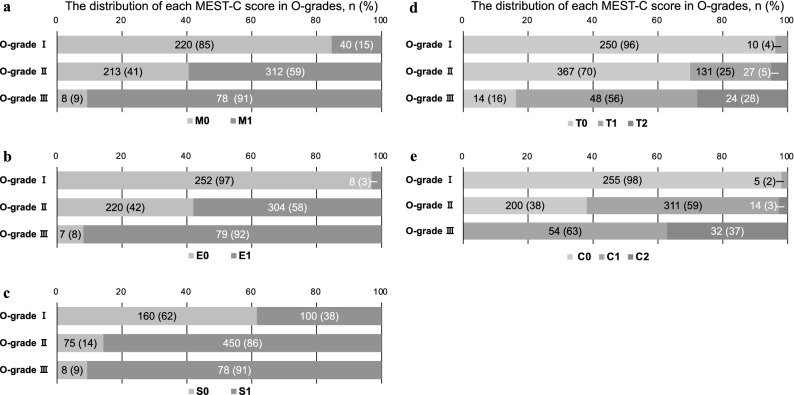
The Oxford classification of IgA nephropathy (IgAN) can evaluate each MEST-C score individually. We analysed a new grading system that utilised the total MEST-C score in predicting renal prognosis. Altogether, 871 IgAN patients were classified into three groups using the new Oxford classification system (O-grade) that utilised the total MEST-C score (O-grade I: 0-1, II: 2-4, and III: 5-7 points), and the 10-year renal prognosis was analysed. The clinical findings became significantly severer with increasing O-grades, and the renal survival rate by the Kaplan-Meier method was 94.1%, 86.9%, and 74.1% for O-grades I, II, and III, respectively. The hazard ratios (HRs) for O-grades II and III with reference to O-grade I were 2.8 (95% confidence interval [CI] 1.3-6.0) and 6.3 (95% CI 2.7-14.5), respectively. In the multivariate analysis, mean arterial pressure and eGFR, proteinuria at the time of biopsy, treatment of corticosteroids/immunosuppressors, and O-grade (HR 1.63; 95% CI 1.11-2.38) were the independent factors predicting renal prognosis. Among the nine groups classified using the O-grade and Japanese clinical-grade, the renal prognosis had an HR of 15.2 (95% CI 3.5-67) in the severest group. The O-grade classified by the total score of the Oxford classification was associated with renal prognosis.
牛津 IgA 肾病分类(IgAN)可以单独评估每个 MEST-C 评分。我们分析了一种新的分级系统,该系统利用总 MEST-C 评分来预测肾脏预后。总共,871 例 IgAN 患者使用新的牛津分类系统(O 级)分为三组,该系统利用总 MEST-C 评分(O 级 I:0-1,II:2-4,III:5-7 分),并分析了 10 年的肾脏预后。临床发现随着 O 级的增加变得越来越严重,Kaplan-Meier 方法的肾脏生存率分别为 O 级 I、II 和 III 的 94.1%、86.9%和 74.1%。O 级 II 和 III 与 O 级 I 相比的风险比(HR)分别为 2.8(95%置信区间 [CI] 1.3-6.0)和 6.3(95%CI 2.7-14.5)。在多变量分析中,平均动脉压和 eGFR、活检时的蛋白尿、皮质类固醇/免疫抑制剂的治疗以及 O 级(HR 1.63;95%CI 1.11-2.38)是预测肾脏预后的独立因素。在使用 O 级和日本临床分级分类的九个组中,在最严重的组中,肾脏预后的 HR 为 15.2(95%CI 3.5-67)。牛津分类总评分分类的 O 级与肾脏预后相关。