Division of Radiation Health, Department of Pharmaceutical Sciences, College of Pharmacy, University of Arkansas for Medical Sciences, Little Rock, AR, USA.
Department of Radiation Oncology, College of Medicine, University of Arkansas for Medical Sciences, Little Rock, AR, USA.
Sci Rep. 2020 May 7;10(1):7734. doi: 10.1038/s41598-020-64672-3.
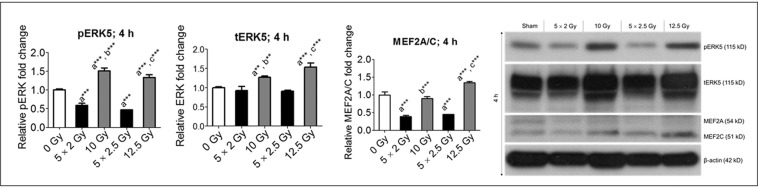
Kruppel-like factor 2 (KLF2) is a positive transcriptional regulator of several endothelial protective molecules, including thrombomodulin (TM), a surface receptor, and endothelial nitric oxide synthase (eNOS), an enzyme that generates nitric oxide (NO). Loss of TM and eNOS causes endothelial dysfunction, which results in suppressed generation of activated protein C (APC) by TM-thrombin complex and in upregulation of intercellular adhesion molecule 1 (ICAM-1). Mechanistic studies revealed that activation of extracellular signal-regulated kinase 5 (ERK5) via upregulation of myocyte enhancer factor 2 (MEF2) induces KLF2 expression. Radiation causes endothelial dysfunction, but no study has investigated radiation's effects on the KLF2 pathway. Because fractionated radiation is routinely used during cancer radiotherapy, we decided to delineate the effects of radiation dose fractionation on the KLF2 signaling cascade at early time points (up to 24 h). We exposed human primary endothelial cells to radiation as a series of fractionated or as a single exposure, with the same total dose delivered to each group. We measured the expression and activity of critical members of the KLF2 pathway at subsequent time points, and determined whether pharmacological upregulation of KLF2 can reverse the radiation effects. Compared to single exposure, fractionated radiation profoundly suppressed KLF2, TM, and eNOS levels, subdued APC generation, declined KLF2 binding ability to TM and eNOS promoters, enhanced ICAM-1 expression, and decreased expression of upstream regulators of KLF2 (ERK5 and MEF2). Pharmacological inhibitors of the mevalonate pathway prevented fractionated-radiation-induced suppression of KLF2, TM, and eNOS expression. Finally, fractionated irradiation to thoracic region more profoundly suppressed KLF2 and enhanced ICAM-1 expression than single exposure in the lung at 24 h. These data clearly indicate that radiation dose fractionation plays a critical role in modulating levels of KLF2, its upstream regulators, and its downstream target molecules in endothelial cells. Our findings will provide important insights for selecting fractionated regimens during radiotherapy and for developing strategies to alleviate radiotherapy-induced toxicity to healthy tissues.
Kruppel 样因子 2(KLF2)是几种内皮保护分子的正转录调节剂,包括血栓调节蛋白(TM),一种表面受体,和内皮型一氧化氮合酶(eNOS),一种产生一氧化氮(NO)的酶。TM 和 eNOS 的缺失导致内皮功能障碍,导致 TM-凝血酶复合物激活蛋白 C(APC)生成减少,细胞间黏附分子 1(ICAM-1)上调。机制研究表明,通过上调肌细胞增强因子 2(MEF2)激活细胞外信号调节激酶 5(ERK5)诱导 KLF2 表达。辐射会导致内皮功能障碍,但尚无研究探讨辐射对 KLF2 途径的影响。由于分次放疗常规用于癌症放疗,我们决定在早期(最多 24 小时)研究辐射剂量分次对 KLF2 信号级联的影响。我们将人原代内皮细胞暴露于辐射中,采用分次或单次照射,每组给予相同的总剂量。我们在随后的时间点测量 KLF2 途径关键成员的表达和活性,并确定 KLF2 的药理学上调是否可以逆转辐射的影响。与单次照射相比,分次照射可显著抑制 KLF2、TM 和 eNOS 水平,减弱 APC 生成,降低 KLF2 与 TM 和 eNOS 启动子的结合能力,增强 ICAM-1 表达,降低 KLF2 的上游调节剂(ERK5 和 MEF2)的表达。甲羟戊酸途径的药理学抑制剂可预防分次照射诱导的 KLF2、TM 和 eNOS 表达抑制。最后,与单次照射相比,24 小时时胸部区域的分次照射更能抑制 KLF2 的表达并增强肺中的 ICAM-1 表达。这些数据清楚地表明,辐射剂量分次在调节内皮细胞中 KLF2、其上游调节剂及其下游靶分子的水平方面起着关键作用。我们的发现将为选择放疗期间的分次方案以及开发减轻放疗对健康组织毒性的策略提供重要的见解。