Departments of Rheumatology and Research and Development, Dudley Group NHS Foundation Trust (Teaching Trust of the University of Birmingham, UK), Russells Hall Hospital, Dudley, West Midlands, UK.
Department of Clinical Immunology and Rheumatology, Sanjay Gandhi Postgraduate Institute of Medical Sciences (SGPGIMS), Lucknow, India.
J Korean Med Sci. 2020 May 11;35(18):e176. doi: 10.3346/jkms.2020.35.e176.
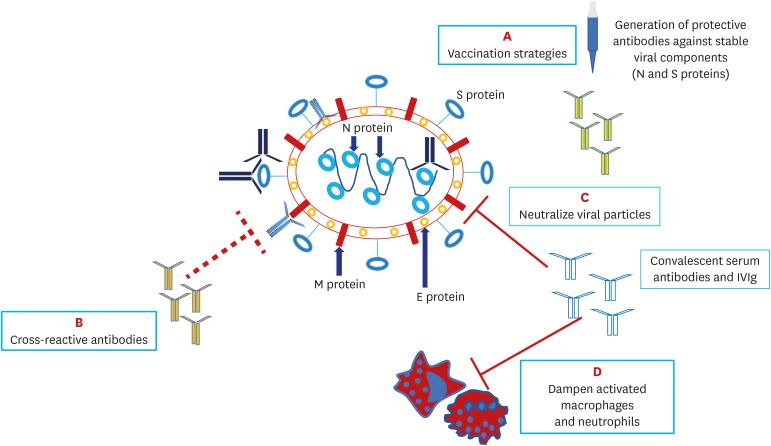
The global fight against coronavirus disease 2019 (COVID-19) is largely based on strategies to boost immune responses to severe acute respiratory syndrome coronavirus 2 (SARS-CoV-2) and prevent its severe course and complications. The human defence may include antibodies which interact with SARS-CoV-2 and neutralize its aggressive actions on multiple organ systems. Protective cross-reactivity of antibodies against measles and other known viral infections has been postulated, primarily as a result of the initial observations of asymptomatic and mild COVID-19 in children. Uncontrolled case series have demonstrated virus-neutralizing effect of convalescent plasma, supporting its efficiency at early stages of contracting SARS-CoV-2. Given the variability of the virus structure, the utility of convalescent plasma is limited to the geographic area of its preparation, and for a short period of time. Intravenous immunoglobulin may also be protective in view of its nonspecific antiviral and immunomodulatory effects. Finally, human monoclonal antibodies may interact with some SARS-CoV-2 proteins, inhibiting the virus-receptor interaction and prevent tissue injury. The improved understanding of the host antiviral responses may help develop safe and effective immunotherapeutic strategies against COVID-19 in the foreseeable future.
全球对抗 2019 年冠状病毒病(COVID-19)的主要策略是增强对严重急性呼吸综合征冠状病毒 2(SARS-CoV-2)的免疫反应,防止其严重病程和并发症。人体防御可能包括与 SARS-CoV-2 相互作用并中和其对多个器官系统的侵袭作用的抗体。麻疹和其他已知病毒感染的保护性交叉反应性已被推测,主要是由于最初观察到儿童无症状和轻症 COVID-19。未经控制的病例系列表明恢复期血浆具有中和病毒的作用,支持其在感染 SARS-CoV-2 的早期阶段的效率。鉴于病毒结构的可变性,恢复期血浆的用途仅限于其制备的地理区域,且时间有限。鉴于其非特异性抗病毒和免疫调节作用,静脉注射免疫球蛋白也可能具有保护作用。最后,人单克隆抗体可能与某些 SARS-CoV-2 蛋白相互作用,抑制病毒-受体相互作用并防止组织损伤。对宿主抗病毒反应的深入了解可能有助于在可预见的未来开发针对 COVID-19 的安全有效的免疫治疗策略。