Department of Neurosurgery, First Affiliated Hospital, Wenzhou Medical University, Wenzhou, China.
Department of Neurosurgery, Xinhua Hospital Affiliated to Shanghai Jiaotong University School of Medicine, Shanghai, China.
Aging (Albany NY). 2020 May 8;12(9):8241-8260. doi: 10.18632/aging.103136.
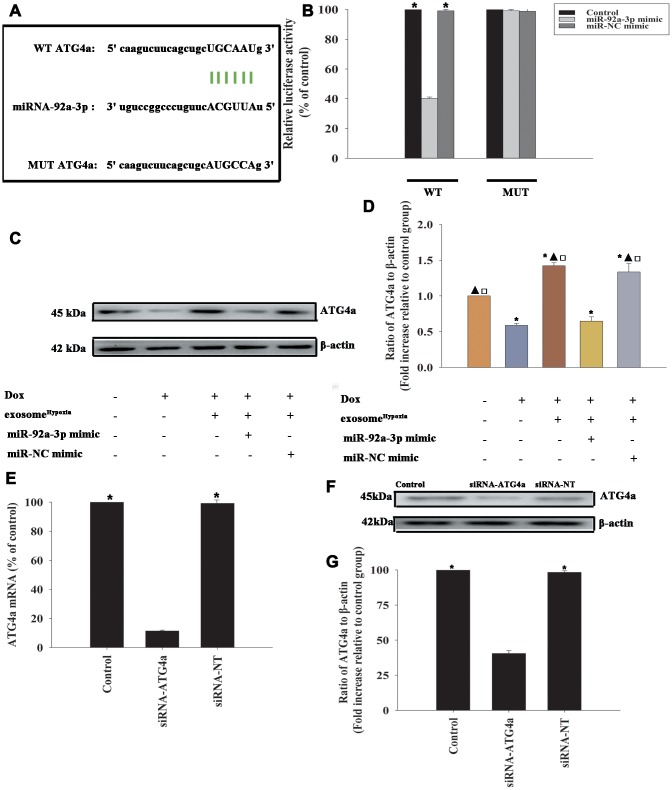
The clinical application of doxorubicin (Dox) is limited due to its undesirable cardiotoxicity side effects. Cellular senescence plays an important role in Dox-induced cardiotoxicity. Exosomes derived from stem cells showed a therapeutic effect in Dox-induced cardiomyopathy (DIC). Hypoxia-preconditioned exosomes (exosome) display pro-metabolism and pro-survival abilities. Several long-noncoding RNAs/microRNAs act as competing endogenous RNAs (ceRNAs) modulating DIC. No study investigated whether exosome could attenuate DIC through modulating ceRNAs.Treatment of the human adipose-derived mesenchymal stem cells with hypoxia induced lncRNA-MALAT1 accumulation in the secreted exosomes. In addition, the lncRNA-MALAT1 was identified as an exosomal transfer RNA to repress miR-92a-3p expression. Silencing the lncRNA-MALAT1 in MSCs or miR-92a-3p overexpression in cardiomyocytes significantly impaired the rejuvenation induced by exosome. TargetScan and luciferase assay showed that miR-92a-3p targeted the ATG4a 3' untranslated region. Silencing ATG4a blocked the anti-senescent effect of exosome.This study identified the lncRNA-MALAT1 that functioned as ceRNA binding to miR-92a-3p, leading to ATG4a activation, thus improving mitochondrial metabolism. LncRNA-MALAT1/miR-92a-3p/ATG4a partially mediates the cardioprotective roles of exosome in Dox-induced cardiac damage. Exosome may serve as a potential therapeutic target against DIC.
阿霉素(Dox)的临床应用受到其不良心脏毒性副作用的限制。细胞衰老在 Dox 诱导的心脏毒性中起重要作用。源自干细胞的外泌体在 Dox 诱导的心肌病(DIC)中显示出治疗效果。缺氧预处理的外泌体(exosome)显示出促进代谢和生存的能力。几种长非编码 RNA/ microRNA 作为竞争性内源性 RNA(ceRNA)调节 DIC。没有研究探讨外泌体是否可以通过调节 ceRNA 来减轻 DIC。用缺氧处理人脂肪间充质干细胞可诱导分泌的外泌体中 lncRNA-MALAT1 积累。此外,lncRNA-MALAT1 被鉴定为一种外泌体转移 RNA,可抑制 miR-92a-3p 的表达。在 MSC 中沉默 lncRNA-MALAT1 或在心肌细胞中过表达 miR-92a-3p 会显著损害外泌体诱导的再生。靶标扫描和荧光素酶测定表明,miR-92a-3p 靶向 ATG4a 的 3'非翻译区。沉默 ATG4a 阻断了外泌体的抗衰老作用。本研究鉴定了 lncRNA-MALAT1,它作为 ceRNA 与 miR-92a-3p 结合,导致 ATG4a 激活,从而改善线粒体代谢。lncRNA-MALAT1/miR-92a-3p/ATG4a 部分介导了外泌体在 Dox 诱导的心脏损伤中的心脏保护作用。外泌体可能成为治疗 DIC 的潜在治疗靶点。