Abushouk Abdelrahman Ibrahim, Salem Amr Muhammad Abdo, Saad Anas, Afifi Ahmed M, Afify Abdelrahman Yousry, Afify Hesham, Salem Hazem S E, Ghanem Esraa, Abdel-Daim Mohamed M
Faculty of Medicine, Ain Shams University, Cairo, Egypt.
School of Medicine, New Giza University, Giza, Egypt.
Front Pharmacol. 2019 Jun 14;10:635. doi: 10.3389/fphar.2019.00635. eCollection 2019.
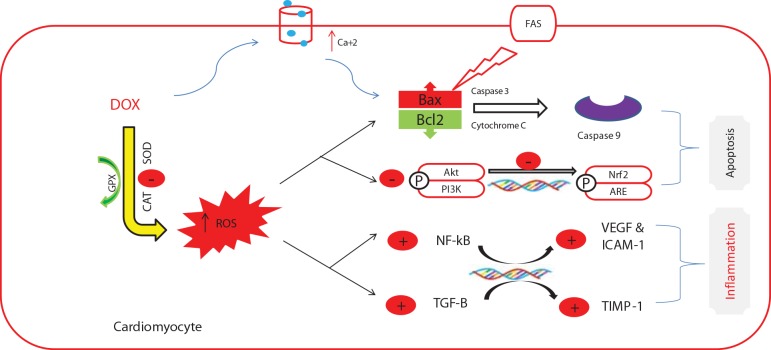
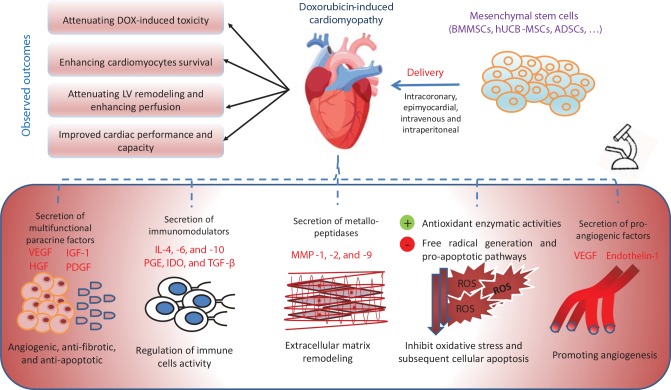
Over the past decades, researchers have reported several mechanisms for doxorubicin (DOX)-induced cardiomyopathy, including oxidative stress, inflammation, and apoptosis. Another mechanism that has been suggested is that DOX interferes with the cell cycle and induces oxidative stress in C-kit+ cells (commonly known as cardiac progenitor cells), reducing their regenerative capacity. Cardiac regeneration through enhancing the regenerative capacity of these cells or administration of other stem cells types has been the axis of several studies over the past 20 years. Several experiments revealed that local or systemic injections with mesenchymal stem cells (MSCs) were associated with significantly improved cardiac function, ameliorated inflammatory response, and reduced myocardial fibrosis. They also showed that several factors can affect the outcome of MSC treatment for DOX cardiomyopathy, including the MSC type, dose, route, and timing of administration. However, there is growing evidence that the C-kit+ cells do not have a cardiac regenerative potential in the adult mammalian heart. Similarly, the protective mechanisms of MSCs against DOX-induced cardiomyopathy are not likely to include direct differentiation into cardiomyocytes and probably occur through paracrine secretion, antioxidant and anti-inflammatory effects. Better understanding of the involved mechanisms and the factors governing the outcomes of MSCs therapy are essential before moving to clinical application in patients with DOX-induced cardiomyopathy.
在过去几十年中,研究人员报告了几种阿霉素(DOX)诱导的心肌病机制,包括氧化应激、炎症和细胞凋亡。另一种被提出的机制是,DOX干扰细胞周期并在C-kit+细胞(通常称为心脏祖细胞)中诱导氧化应激,降低其再生能力。在过去20年中,通过增强这些细胞的再生能力或给予其他类型干细胞来进行心脏再生一直是多项研究的核心。多项实验表明,局部或全身注射间充质干细胞(MSC)与心脏功能显著改善、炎症反应减轻和心肌纤维化减少有关。他们还表明,有几个因素会影响MSC治疗DOX心肌病的效果,包括MSC的类型、剂量、给药途径和时间。然而,越来越多的证据表明,C-kit+细胞在成年哺乳动物心脏中没有心脏再生潜力。同样,MSC对DOX诱导的心肌病的保护机制不太可能包括直接分化为心肌细胞,可能是通过旁分泌、抗氧化和抗炎作用实现的。在将其应用于DOX诱导的心肌病患者的临床治疗之前,更好地了解相关机制以及控制MSC治疗效果的因素至关重要。