• 文献检索
  • 文档翻译
  • 深度研究
  • 学术资讯
  • Suppr Zotero 插件Zotero 插件
  • 邀请有礼
  • 套餐&价格
  • 历史记录
应用&插件
Suppr Zotero 插件Zotero 插件浏览器插件Mac 客户端Windows 客户端微信小程序
定价
高级版会员购买积分包购买API积分包
服务
文献检索文档翻译深度研究API 文档MCP 服务
关于我们
关于 Suppr公司介绍联系我们用户协议隐私条款
关注我们

Suppr 超能文献

核心技术专利:CN118964589B侵权必究
粤ICP备2023148730 号-1Suppr @ 2026

文献检索

告别复杂PubMed语法,用中文像聊天一样搜索,搜遍4000万医学文献。AI智能推荐,让科研检索更轻松。

立即免费搜索

文件翻译

保留排版,准确专业,支持PDF/Word/PPT等文件格式,支持 12+语言互译。

免费翻译文档

深度研究

AI帮你快速写综述,25分钟生成高质量综述,智能提取关键信息,辅助科研写作。

立即免费体验

从注视分配和瞳孔扩张分解损失厌恶。

Decomposing loss aversion from gaze allocation and pupil dilation.

机构信息

Wharton Neuroscience Initiative, The Wharton School, University of Pennsylvania, Philadelphia, PA 19104;

Marketing Department, The Wharton School, University of Pennsylvania, Philadelphia, PA 19104.

出版信息

Proc Natl Acad Sci U S A. 2020 May 26;117(21):11356-11363. doi: 10.1073/pnas.1919670117. Epub 2020 May 8.

DOI:10.1073/pnas.1919670117
PMID:32385152
原文链接:https://pmc.ncbi.nlm.nih.gov/articles/PMC7260957/
Abstract

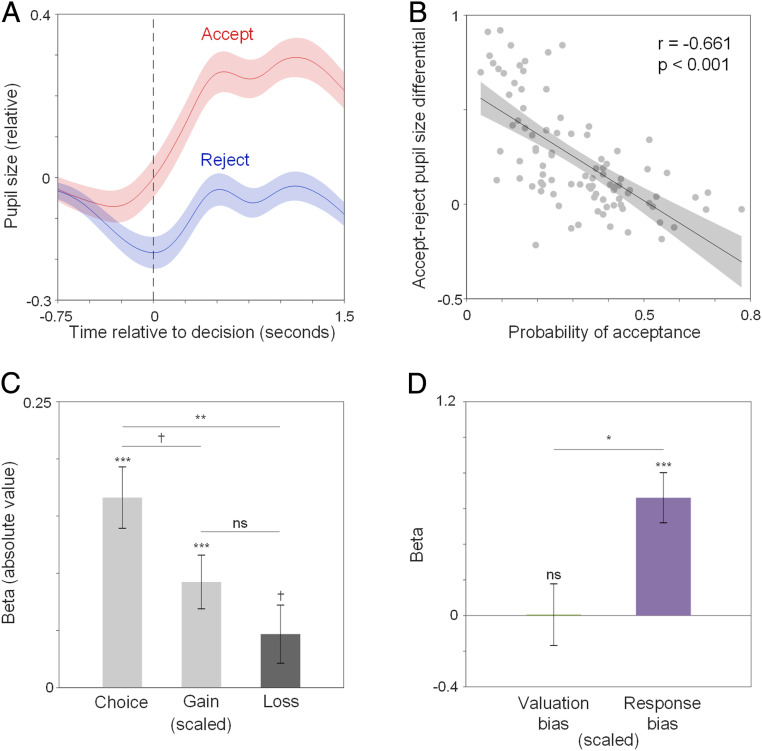
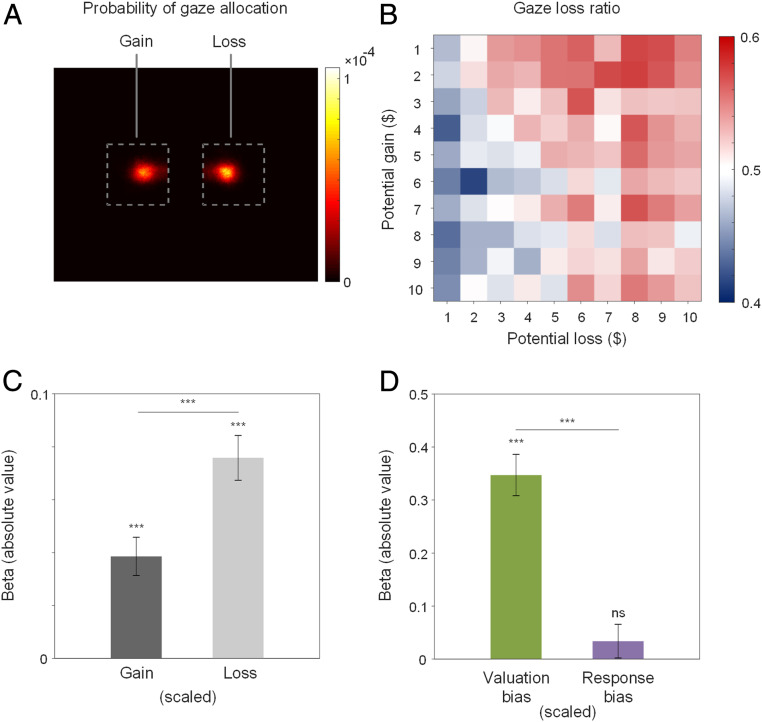
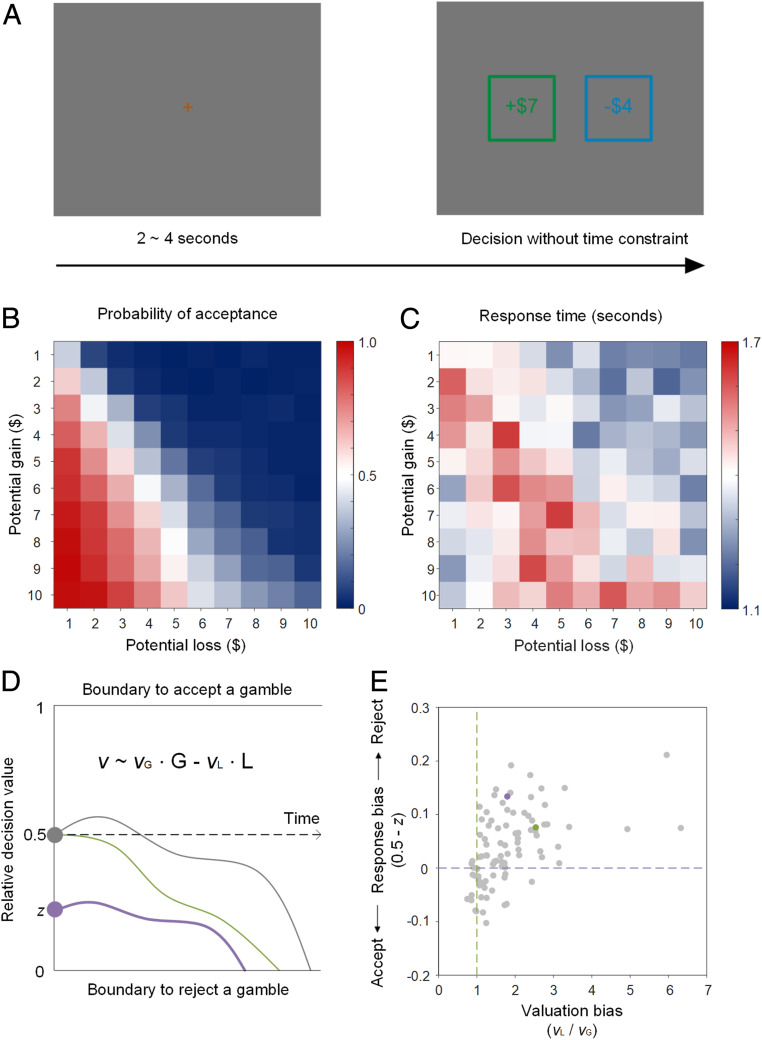
Loss-averse decisions, in which one avoids losses at the expense of gains, are highly prevalent. However, the underlying mechanisms remain controversial. The prevailing account highlights a valuation bias that overweighs losses relative to gains, but an alternative view stresses a response bias to avoid choices involving potential losses. Here we couple a computational process model with eye-tracking and pupillometry to develop a physiologically grounded framework for the decision process leading to accepting or rejecting gambles with equal odds of winning and losing money. Overall, loss-averse decisions were accompanied by preferential gaze toward losses and increased pupil dilation for accepting gambles. Using our model, we found gaze allocation selectively indexed valuation bias, and pupil dilation selectively indexed response bias. Finally, we demonstrate that our computational model and physiological biomarkers can identify distinct types of loss-averse decision makers who would otherwise be indistinguishable using conventional approaches. Our study provides an integrative framework for the cognitive processes that drive loss-averse decisions and highlights the biological heterogeneity of loss aversion across individuals.

摘要

规避损失的决策,即人们不惜以牺牲收益为代价来避免损失,非常普遍。然而,其潜在机制仍存在争议。主流观点强调了一种估值偏差,即相对于收益,损失被高估,但另一种观点则强调了一种避免涉及潜在损失的选择的反应偏差。在这里,我们结合计算过程模型、眼动追踪和瞳孔测量,为导致接受或拒绝具有相同赢钱和输钱概率的赌博的决策过程开发了一个基于生理的框架。总体而言,规避损失的决策伴随着对损失的优先注视,以及对接受赌博的瞳孔扩大。使用我们的模型,我们发现注视分配选择性地反映了估值偏差,而瞳孔扩张则选择性地反映了反应偏差。最后,我们证明我们的计算模型和生理生物标志物可以识别出不同类型的规避损失的决策者,而使用传统方法则无法区分这些决策者。我们的研究为驱动规避损失决策的认知过程提供了一个综合框架,并强调了个体之间规避损失的生物异质性。
https://cdn.ncbi.nlm.nih.gov/pmc/blobs/7af9/7260957/7da486fb37a3/pnas.1919670117fig03.jpg
https://cdn.ncbi.nlm.nih.gov/pmc/blobs/7af9/7260957/d52049de942d/pnas.1919670117fig01.jpg
https://cdn.ncbi.nlm.nih.gov/pmc/blobs/7af9/7260957/f5cf1161365a/pnas.1919670117fig02.jpg
https://cdn.ncbi.nlm.nih.gov/pmc/blobs/7af9/7260957/7da486fb37a3/pnas.1919670117fig03.jpg
https://cdn.ncbi.nlm.nih.gov/pmc/blobs/7af9/7260957/d52049de942d/pnas.1919670117fig01.jpg
https://cdn.ncbi.nlm.nih.gov/pmc/blobs/7af9/7260957/f5cf1161365a/pnas.1919670117fig02.jpg
https://cdn.ncbi.nlm.nih.gov/pmc/blobs/7af9/7260957/7da486fb37a3/pnas.1919670117fig03.jpg

相似文献

1
Decomposing loss aversion from gaze allocation and pupil dilation.从注视分配和瞳孔扩张分解损失厌恶。
Proc Natl Acad Sci U S A. 2020 May 26;117(21):11356-11363. doi: 10.1073/pnas.1919670117. Epub 2020 May 8.
2
Eye tracking and pupillometry are indicators of dissociable latent decision processes.眼动追踪和瞳孔测量是可分离的潜在决策过程的指标。
J Exp Psychol Gen. 2014 Aug;143(4):1476-88. doi: 10.1037/a0035813. Epub 2014 Feb 17.
3
Psychological mechanisms of loss aversion: A drift-diffusion decomposition.损失规避的心理机制:漂移-扩散分解。
Cogn Psychol. 2020 Dec;123:101331. doi: 10.1016/j.cogpsych.2020.101331. Epub 2020 Aug 7.
4
Decomposing loss aversion from a single neural signal.从单个神经信号中分解损失厌恶。
iScience. 2024 Jun 6;27(7):110153. doi: 10.1016/j.isci.2024.110153. eCollection 2024 Jul 19.
5
Win-Concurrent Sensory Cues Can Promote Riskier Choice.正强化的感觉线索能促进风险选择。
J Neurosci. 2018 Nov 28;38(48):10362-10370. doi: 10.1523/JNEUROSCI.1171-18.2018. Epub 2018 Oct 29.
6
No Evidence of Emotional Dysregulation or Aversion to Mutual Gaze in Preschoolers with Autism Spectrum Disorder: An Eye-Tracking Pupillometry Study.自闭症谱系障碍学龄前儿童不存在情绪失调或对视厌恶的证据:一项眼动追踪瞳孔测量研究。
J Autism Dev Disord. 2015 Nov;45(11):3433-45. doi: 10.1007/s10803-015-2479-5.
7
Pupil size dynamics during fixation impact the accuracy and precision of video-based gaze estimation.注视过程中瞳孔大小的动态变化会影响基于视频的注视估计的准确性和精确性。
Vision Res. 2016 Jan;118:48-59. doi: 10.1016/j.visres.2014.12.018. Epub 2015 Jan 9.
8
Asymmetric valuation of gains and losses in effort-based decision making.基于努力的决策中收益和损失的非对称评估。
PLoS One. 2019 Oct 15;14(10):e0223268. doi: 10.1371/journal.pone.0223268. eCollection 2019.
9
Beyond eye gaze: What else can eyetracking reveal about cognition and cognitive development?超越目光注视:眼动追踪还能揭示关于认知和认知发展的哪些方面?
Dev Cogn Neurosci. 2017 Jun;25:69-91. doi: 10.1016/j.dcn.2016.11.001. Epub 2016 Nov 11.
10
A gaze interactive assembly instruction with pupillometric recording.带瞳孔测量记录的注视互动装配说明。
Behav Res Methods. 2018 Aug;50(4):1723-1733. doi: 10.3758/s13428-018-1074-z.

引用本文的文献

1
The neural dynamics of loss aversion.损失厌恶的神经动力学
Imaging Neurosci (Camb). 2023 Dec 18;1. doi: 10.1162/imag_a_00047. eCollection 2023.
2
Deliberation during online bargaining reveals strategic information.在线讨价还价过程中的深思熟虑揭示了战略信息。
Proc Natl Acad Sci U S A. 2025 Feb 18;122(7):e2410956122. doi: 10.1073/pnas.2410956122. Epub 2025 Feb 12.
3
Risk and Loss Aversion and Attitude to COVID and Vaccines in Anxious Individuals.焦虑个体对新冠病毒及疫苗的风险与损失厌恶及态度

本文引用的文献

1
Psychological mechanisms of loss aversion: A drift-diffusion decomposition.损失规避的心理机制:漂移-扩散分解。
Cogn Psychol. 2020 Dec;123:101331. doi: 10.1016/j.cogpsych.2020.101331. Epub 2020 Aug 7.
2
Pupillometry: Psychology, Physiology, and Function.瞳孔测量法:心理学、生理学与功能
J Cogn. 2018 Feb 21;1(1):16. doi: 10.5334/joc.18.
3
Preprocessing pupil size data: Guidelines and code.预处理瞳孔大小数据:指南和代码。
Comput Psychiatr. 2025 Feb 7;9(1):23-38. doi: 10.5334/cpsy.115. eCollection 2025.
4
Identifying the bioimaging features of Alzheimer's disease based on pupillary light response-driven brain-wide fMRI in awake mice.基于清醒小鼠瞳孔光反应驱动的全脑 fMRI 识别阿尔茨海默病的脑影像学特征。
Nat Commun. 2024 Nov 7;15(1):9657. doi: 10.1038/s41467-024-53878-y.
5
Decomposing loss aversion from a single neural signal.从单个神经信号中分解损失厌恶。
iScience. 2024 Jun 6;27(7):110153. doi: 10.1016/j.isci.2024.110153. eCollection 2024 Jul 19.
6
Exploring the Loss Aversion Scale's psychometric properties in Spain.探索西班牙的损失规避量表的心理测量学特性。
Sci Rep. 2024 Jul 8;14(1):15756. doi: 10.1038/s41598-024-66695-6.
7
Multiple timescales of temporal context in risky choice: Behavioral identification and relationships to physiological arousal.风险选择中的多个时间尺度的时间背景:行为识别及其与生理唤醒的关系。
PLoS One. 2024 Jan 19;19(1):e0296681. doi: 10.1371/journal.pone.0296681. eCollection 2024.
8
The art of the deal: Deciphering the endowment effect from traders' eyes.交易的艺术:从交易者的眼光中解读禀赋效应。
Sci Adv. 2023 Aug 25;9(34):eadf2115. doi: 10.1126/sciadv.adf2115. Epub 2023 Aug 23.
9
Measuring utility with diffusion models.使用扩散模型衡量效用。
Sci Adv. 2023 Aug 25;9(34):eadf1665. doi: 10.1126/sciadv.adf1665. Epub 2023 Aug 23.
10
Implicit Negativity Bias Leads to Greater Loss Aversion and Learning during Decision-Making.内隐负性偏见导致决策时更大的损失规避和学习。
Int J Environ Res Public Health. 2022 Dec 19;19(24):17037. doi: 10.3390/ijerph192417037.
Behav Res Methods. 2019 Jun;51(3):1336-1342. doi: 10.3758/s13428-018-1075-y.
4
Acceptable losses: the debatable origins of loss aversion.可接受的损失:损失规避的有争议起源。
Psychol Res. 2019 Oct;83(7):1327-1339. doi: 10.1007/s00426-018-1013-8. Epub 2018 Apr 16.
5
Revealing Neurocomputational Mechanisms of Reinforcement Learning and Decision-Making With the hBayesDM Package.使用hBayesDM软件包揭示强化学习和决策的神经计算机制。
Comput Psychiatr. 2017 Oct 1;1:24-57. doi: 10.1162/CPSY_a_00002. eCollection 2017 Oct.
6
Prospect theory reflects selective allocation of attention.前景理论反映了注意力的选择性分配。
J Exp Psychol Gen. 2018 Feb;147(2):147-169. doi: 10.1037/xge0000406.
7
Loss Aversion Reflects Information Accumulation, Not Bias: A Drift-Diffusion Model Study.损失厌恶反映信息积累,而非偏差:一项漂移扩散模型研究。
Front Psychol. 2017 Oct 10;8:1708. doi: 10.3389/fpsyg.2017.01708. eCollection 2017.
8
Diffusion Decision Model: Current Issues and History.扩散决策模型:当前问题与历史
Trends Cogn Sci. 2016 Apr;20(4):260-281. doi: 10.1016/j.tics.2016.01.007. Epub 2016 Mar 5.
9
Relationships between Pupil Diameter and Neuronal Activity in the Locus Coeruleus, Colliculi, and Cingulate Cortex.瞳孔直径与蓝斑、丘系和扣带回皮质中神经元活动之间的关系。
Neuron. 2016 Jan 6;89(1):221-34. doi: 10.1016/j.neuron.2015.11.028. Epub 2015 Dec 17.
10
Determinants of Propranolol's Selective Effect on Loss Aversion.普萘洛尔对损失厌恶的选择性作用的决定因素。
Psychol Sci. 2015 Jul;26(7):1123-30. doi: 10.1177/0956797615582026. Epub 2015 Jun 10.