• 文献检索
  • 文档翻译
  • 深度研究
  • 学术资讯
  • Suppr Zotero 插件Zotero 插件
  • 邀请有礼
  • 套餐&价格
  • 历史记录
应用&插件
Suppr Zotero 插件Zotero 插件浏览器插件Mac 客户端Windows 客户端微信小程序
定价
高级版会员购买积分包购买API积分包
服务
文献检索文档翻译深度研究API 文档MCP 服务
关于我们
关于 Suppr公司介绍联系我们用户协议隐私条款
关注我们

Suppr 超能文献

核心技术专利:CN118964589B侵权必究
粤ICP备2023148730 号-1Suppr @ 2026

文献检索

告别复杂PubMed语法,用中文像聊天一样搜索,搜遍4000万医学文献。AI智能推荐,让科研检索更轻松。

立即免费搜索

文件翻译

保留排版,准确专业,支持PDF/Word/PPT等文件格式,支持 12+语言互译。

免费翻译文档

深度研究

AI帮你快速写综述,25分钟生成高质量综述,智能提取关键信息,辅助科研写作。

立即免费体验

损失厌恶反映信息积累,而非偏差:一项漂移扩散模型研究。

Loss Aversion Reflects Information Accumulation, Not Bias: A Drift-Diffusion Model Study.

作者信息

Clay Summer N, Clithero John A, Harris Alison M, Reed Catherine L

机构信息

Department of Behavioral and Organizational Sciences, Claremont Graduate University, Claremont, CA, United States.

Department of Economics, Pomona College, Claremont, CA, United States.

出版信息

Front Psychol. 2017 Oct 10;8:1708. doi: 10.3389/fpsyg.2017.01708. eCollection 2017.

DOI:10.3389/fpsyg.2017.01708
PMID:29066987
原文链接:https://pmc.ncbi.nlm.nih.gov/articles/PMC5641396/
Abstract

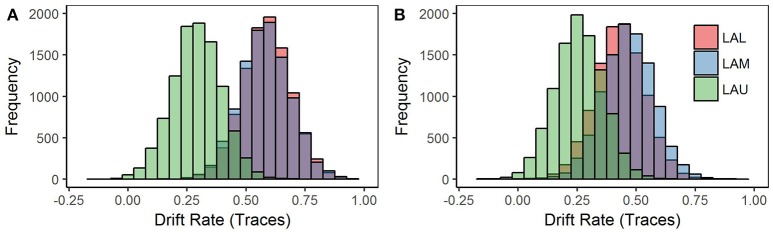
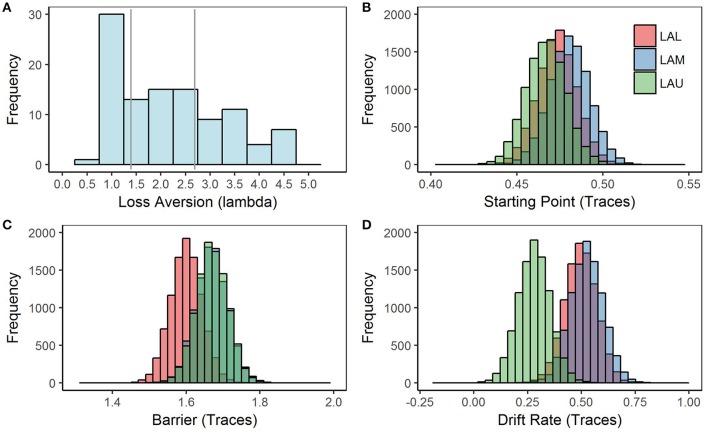
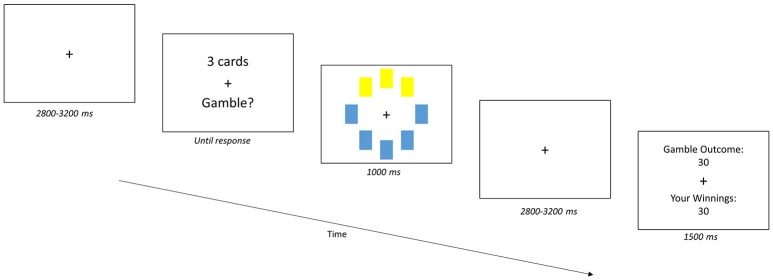
Defined as increased sensitivity to losses, loss aversion is often conceptualized as a cognitive bias. However, findings that loss aversion has an attentional or emotional regulation component suggest that it may instead reflect differences in information processing. To distinguish these alternatives, we applied the drift-diffusion model (DDM) to choice and response time (RT) data in a card gambling task with unknown risk distributions. Loss aversion was measured separately for each participant. Dividing the participants into terciles based on loss aversion estimates, we found that the most loss-averse group showed a significantly lower drift rate than the other two groups, indicating overall slower uptake of information. In contrast, neither the starting bias nor the threshold separation (barrier) varied by group, suggesting that decision thresholds are not affected by loss aversion. These results shed new light on the cognitive mechanisms underlying loss aversion, consistent with an account based on information accumulation.

摘要

损失厌恶被定义为对损失的敏感性增加,它通常被概念化为一种认知偏差。然而,有研究发现损失厌恶具有注意力或情绪调节成分,这表明它可能反而反映了信息处理方面的差异。为了区分这些可能性,我们将漂移扩散模型(DDM)应用于风险分布未知的纸牌赌博任务中的选择和反应时间(RT)数据。对每个参与者分别测量损失厌恶程度。根据损失厌恶估计值将参与者分为三组,我们发现最厌恶损失的组的漂移率明显低于其他两组,这表明总体信息获取速度较慢。相比之下,起始偏差和阈值分离(屏障)在各组之间均无差异,这表明决策阈值不受损失厌恶的影响。这些结果为损失厌恶背后的认知机制提供了新的线索,与基于信息积累的解释一致。
https://cdn.ncbi.nlm.nih.gov/pmc/blobs/f496/5641396/7b55125fdc4a/fpsyg-08-01708-g0003.jpg
https://cdn.ncbi.nlm.nih.gov/pmc/blobs/f496/5641396/9295d0695ac9/fpsyg-08-01708-g0001.jpg
https://cdn.ncbi.nlm.nih.gov/pmc/blobs/f496/5641396/b80fd9972e47/fpsyg-08-01708-g0002.jpg
https://cdn.ncbi.nlm.nih.gov/pmc/blobs/f496/5641396/7b55125fdc4a/fpsyg-08-01708-g0003.jpg
https://cdn.ncbi.nlm.nih.gov/pmc/blobs/f496/5641396/9295d0695ac9/fpsyg-08-01708-g0001.jpg
https://cdn.ncbi.nlm.nih.gov/pmc/blobs/f496/5641396/b80fd9972e47/fpsyg-08-01708-g0002.jpg
https://cdn.ncbi.nlm.nih.gov/pmc/blobs/f496/5641396/7b55125fdc4a/fpsyg-08-01708-g0003.jpg

相似文献

1
Loss Aversion Reflects Information Accumulation, Not Bias: A Drift-Diffusion Model Study.损失厌恶反映信息积累,而非偏差:一项漂移扩散模型研究。
Front Psychol. 2017 Oct 10;8:1708. doi: 10.3389/fpsyg.2017.01708. eCollection 2017.
2
Psychological mechanisms of loss aversion: A drift-diffusion decomposition.损失规避的心理机制:漂移-扩散分解。
Cogn Psychol. 2020 Dec;123:101331. doi: 10.1016/j.cogpsych.2020.101331. Epub 2020 Aug 7.
3
Emotion-induced loss aversion and striatal-amygdala coupling in low-anxious individuals.低焦虑个体中情绪诱发的损失厌恶与纹状体-杏仁核耦合
Soc Cogn Affect Neurosci. 2016 Apr;11(4):569-79. doi: 10.1093/scan/nsv139. Epub 2015 Nov 19.
4
Decomposing loss aversion from gaze allocation and pupil dilation.从注视分配和瞳孔扩张分解损失厌恶。
Proc Natl Acad Sci U S A. 2020 May 26;117(21):11356-11363. doi: 10.1073/pnas.1919670117. Epub 2020 May 8.
5
The drift diffusion model as the choice rule in inter-temporal and risky choice: A case study in medial orbitofrontal cortex lesion patients and controls.时际与风险选择中的漂移扩散模型作为选择规则:内侧眶额皮层损伤患者与对照的病例研究。
PLoS Comput Biol. 2020 Apr 20;16(4):e1007615. doi: 10.1371/journal.pcbi.1007615. eCollection 2020 Apr.
6
Understanding perceptual judgment in autism spectrum disorder using the drift diffusion model.使用漂移扩散模型理解自闭症谱系障碍中的知觉判断。
Neuropsychology. 2017 Feb;31(2):173-180. doi: 10.1037/neu0000320. Epub 2016 Oct 10.
7
Loss aversion is associated with bilateral insula volume. A voxel based morphometry study.损失厌恶与双侧脑岛体积相关。一项基于体素的形态测量学研究。
Neurosci Lett. 2016 Apr 21;619:172-6. doi: 10.1016/j.neulet.2016.03.029. Epub 2016 Mar 21.
8
Losing my loss aversion: The effects of current and past environment on the relative sensitivity to losses and gains.失去损失厌恶:当前和过去环境对损失和收益相对敏感性的影响。
Psychon Bull Rev. 2020 Dec;27(6):1333-1340. doi: 10.3758/s13423-020-01775-y.
9
Effects of loss aversion on neural responses to loss outcomes: An event-related potential study.损失厌恶对损失结果神经反应的影响:一项事件相关电位研究。
Biol Psychol. 2017 May;126:30-40. doi: 10.1016/j.biopsycho.2017.04.005. Epub 2017 Apr 8.
10
Logical decisions after a psychosocial stressor: The late phase of acute stress reduces loss aversion.心理应激源后的逻辑决策:急性应激的晚期阶段降低了损失规避。
Physiol Behav. 2023 Sep 1;268:114232. doi: 10.1016/j.physbeh.2023.114232. Epub 2023 May 11.

引用本文的文献

1
The neural dynamics of loss aversion.损失厌恶的神经动力学
Imaging Neurosci (Camb). 2023 Dec 18;1. doi: 10.1162/imag_a_00047. eCollection 2023.
2
Attention biases the process of risky decision-making: Evidence from eye-tracking.注意偏向风险决策过程:来自眼动追踪的证据。
Psych J. 2024 Apr;13(2):157-165. doi: 10.1002/pchj.724. Epub 2023 Dec 28.
3
The art of the deal: Deciphering the endowment effect from traders' eyes.交易的艺术:从交易者的眼光中解读禀赋效应。

本文引用的文献

1
How the threat of losses makes people explore more than the promise of gains.损失的威胁如何使人们探索得更多,而非收益的承诺。
Psychon Bull Rev. 2017 Jun;24(3):708-720. doi: 10.3758/s13423-016-1158-7.
2
Appetitive and aversive outcome associations modulate exogenous cueing.正向和负向结果关联调节外源性线索提示。
Atten Percept Psychophys. 2016 Oct;78(7):2253-65. doi: 10.3758/s13414-016-1107-6.
3
Diffusion Decision Model: Current Issues and History.扩散决策模型:当前问题与历史
Sci Adv. 2023 Aug 25;9(34):eadf2115. doi: 10.1126/sciadv.adf2115. Epub 2023 Aug 23.
4
Decision neuroscience and neuroeconomics: Recent progress and ongoing challenges.决策神经科学与神经经济学:近期进展与现存挑战。
Wiley Interdiscip Rev Cogn Sci. 2022 May;13(3):e1589. doi: 10.1002/wcs.1589. Epub 2022 Feb 8.
5
Neural Substrates of the Drift-Diffusion Model in Brain Disorders.脑部疾病中漂移扩散模型的神经基质
Front Comput Neurosci. 2022 Jan 7;15:678232. doi: 10.3389/fncom.2021.678232. eCollection 2021.
6
Commentary: Dopamine-Dependent Loss Aversion during Effort-Based Decision-Making.评论:基于努力的决策过程中多巴胺依赖的损失厌恶
Front Neurosci. 2020 May 13;14:468. doi: 10.3389/fnins.2020.00468. eCollection 2020.
7
Decomposing loss aversion from gaze allocation and pupil dilation.从注视分配和瞳孔扩张分解损失厌恶。
Proc Natl Acad Sci U S A. 2020 May 26;117(21):11356-11363. doi: 10.1073/pnas.1919670117. Epub 2020 May 8.
8
Revise the Belief in Loss Aversion.修正对损失厌恶的信念。
Front Psychol. 2019 Dec 3;10:2723. doi: 10.3389/fpsyg.2019.02723. eCollection 2019.
9
Affect and Decision Making: Insights and Predictions from Computational Models.情感与决策:计算模型的洞察与预测。
Trends Cogn Sci. 2019 Jul;23(7):602-614. doi: 10.1016/j.tics.2019.04.005. Epub 2019 May 16.
10
Differential modulation of cognitive control networks by monetary reward and punishment.金钱奖励和惩罚对认知控制网络的差异调节。
Soc Cogn Affect Neurosci. 2019 Mar 5;14(3):305-317. doi: 10.1093/scan/nsz006.
Trends Cogn Sci. 2016 Apr;20(4):260-281. doi: 10.1016/j.tics.2016.01.007. Epub 2016 Mar 5.
4
Relevance drives attention: Attentional bias for gain- and loss-related stimuli is driven by delayed disengagement.关联性驱动注意力:对收益和损失相关刺激的注意力偏差由延迟脱离所驱动。
Q J Exp Psychol (Hove). 2016;69(4):752-63. doi: 10.1080/17470218.2015.1049624. Epub 2015 Jul 3.
5
Interoceptive ability predicts aversion to losses.内感受能力预示着对损失的厌恶。
Cogn Emot. 2015;29(4):695-701. doi: 10.1080/02699931.2014.925426. Epub 2014 Jun 11.
6
Attentional capture by signals of threat.受威胁信号的注意力捕获
Cogn Emot. 2015;29(4):687-94. doi: 10.1080/02699931.2014.924484. Epub 2014 Jun 5.
7
Eye tracking and pupillometry are indicators of dissociable latent decision processes.眼动追踪和瞳孔测量是可分离的潜在决策过程的指标。
J Exp Psychol Gen. 2014 Aug;143(4):1476-88. doi: 10.1037/a0035813. Epub 2014 Feb 17.
8
Loss attention in a dual-task setting.在双重任务设置中注意力丧失。
Psychol Sci. 2014 Feb;25(2):494-502. doi: 10.1177/0956797613510725. Epub 2013 Dec 19.
9
HDDM: Hierarchical Bayesian estimation of the Drift-Diffusion Model in Python.HDDM:在 Python 中对 Drift-Diffusion 模型进行层次贝叶斯估计。
Front Neuroinform. 2013 Aug 2;7:14. doi: 10.3389/fninf.2013.00014. eCollection 2013.
10
Influence of branding on preference-based decision making.品牌对基于偏好的决策的影响。
Psychol Sci. 2013 Jul 1;24(7):1208-15. doi: 10.1177/0956797612470701. Epub 2013 May 21.