Cavanagh James F, Wiecki Thomas V, Kochar Angad, Frank Michael J
Department of Cognitive, Linguistic, and Psychological Sciences, Brown University.
J Exp Psychol Gen. 2014 Aug;143(4):1476-88. doi: 10.1037/a0035813. Epub 2014 Feb 17.
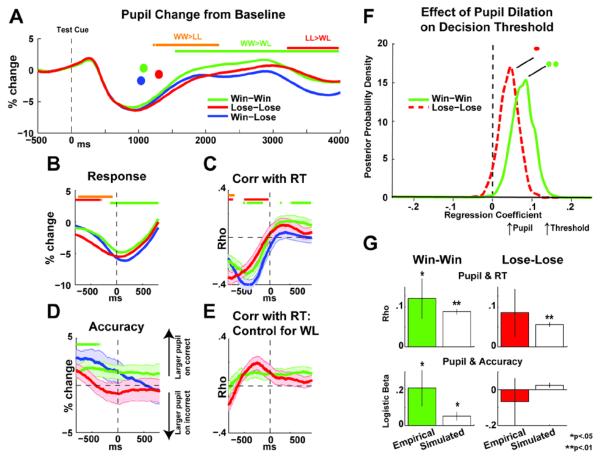
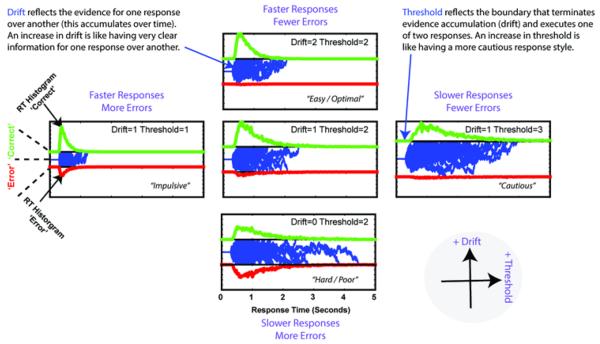
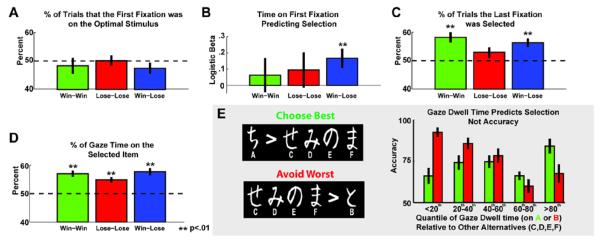
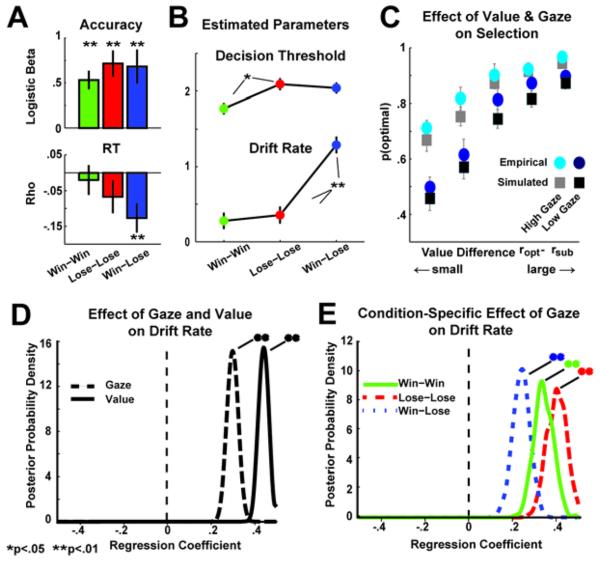
Can you predict what people are going to do just by watching them? This is certainly difficult: it would require a clear mapping between observable indicators and unobservable cognitive states. In this report, we demonstrate how this is possible by monitoring eye gaze and pupil dilation, which predict dissociable biases during decision making. We quantified decision making using the drift diffusion model (DDM), which provides an algorithmic account of how evidence accumulation and response caution contribute to decisions through separate latent parameters of drift rate and decision threshold, respectively. We used a hierarchical Bayesian estimation approach to assess the single trial influence of observable physiological signals on these latent DDM parameters. Increased eye gaze dwell time specifically predicted an increased drift rate toward the fixated option, irrespective of the value of the option. In contrast, greater pupil dilation specifically predicted an increase in decision threshold during difficult decisions. These findings suggest that eye tracking and pupillometry reflect the operations of dissociated latent decision processes.
仅仅通过观察人们就能预测他们接下来会做什么吗?这无疑颇具难度:这需要在可观察指标与不可观察的认知状态之间建立清晰的映射关系。在本报告中,我们展示了通过监测注视和瞳孔扩张来实现这一点的可能性,这两者能够预测决策过程中不同的偏差。我们使用漂移扩散模型(DDM)对决策进行量化,该模型通过漂移率和决策阈值这两个独立的潜在参数,分别对证据积累和反应谨慎如何促成决策提供了一种算法解释。我们采用分层贝叶斯估计方法来评估可观察生理信号对这些潜在DDM参数的单次试验影响。眼注视停留时间的增加具体预测了朝向注视选项的漂移率增加,而与该选项的值无关。相比之下,瞳孔扩张幅度越大则具体预测了在困难决策过程中决策阈值的增加。这些发现表明,眼动追踪和瞳孔测量反映了不同潜在决策过程的运作。