Department of Diagnostic Radiology, Chang Gung Memorial Hospital, Chiayi County, Taiwan.
Health Information and Epidemiology Laboratory, Chang Gung Memorial Hospital, Chiayi County, Taiwan.
Sci Rep. 2020 May 8;10(1):7759. doi: 10.1038/s41598-020-64805-8.
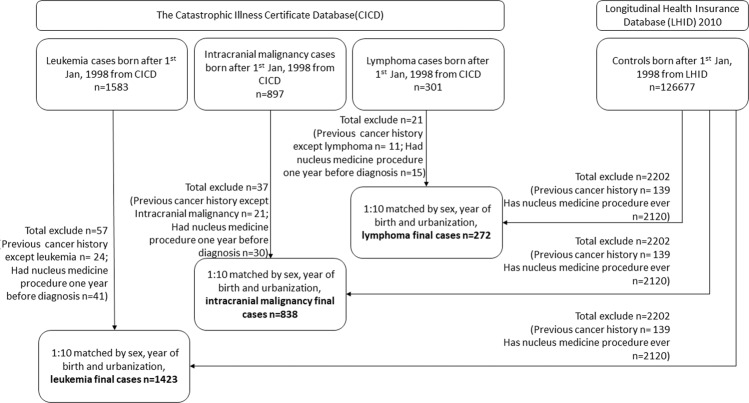
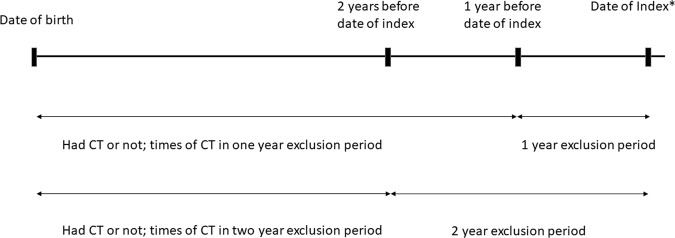
Red bone marrow and brain tissue are highly radiosensitive in children. We investigate the relationship between childhood computed tomography (CT) exposure and leukaemia, intracranial malignancy and lymphoma. All participants in the study were aged less than 16 years. A total of 1,479 patients in the leukaemia group, 976 patients in the intracranial malignancy group and 301 patients in the lymphoma group were extracted from the Catastrophic Illness Certificate Database in Taiwan as the disease group. In total, 126,677 subjects were extracted from the Longitudinal Health Insurance Database 2010 of the Taiwan National Health Insurance Research Database as the non-disease group. The odds ratios (ORs) and 95% confidence intervals (CIs) for childhood CT exposure and times of childhood CT were estimated. Childhood CT exposure was correlated to the intracranial malignancy group in both one-year (OR = 1.95, 95% CI 1.40-2.71, p < 0.001) and two-year (OR = 1.56, 95% CI 1.04-2.33, p = 0.031) exclusion periods. The time of childhood CT was also correlated to intracranial malignancy in both one-year (OR = 1.69, 95% CI 1.34-2.13, p < 0.001) and two-year (OR = 1.55, 95% CI 1.17-2.04, p = 0.002) exclusion periods. The results indicated that childhood CT exposure was correlated with an increased risk of future intracranial malignancy.
红骨髓和脑组织在儿童中对辐射高度敏感。我们研究了儿童期计算机断层扫描(CT)暴露与白血病、颅内恶性肿瘤和淋巴瘤之间的关系。研究中的所有参与者年龄均小于 16 岁。从台湾灾难性疾病证书数据库中提取了白血病组的 1479 例患者、颅内恶性肿瘤组的 976 例患者和淋巴瘤组的 301 例患者作为疾病组。从台湾全民健康保险研究数据库的 2010 年纵向健康保险数据库中提取了 126677 名受试者作为非疾病组。估计了儿童 CT 暴露和儿童 CT 次数与儿童 CT 暴露的比值比(OR)和 95%置信区间(CI)。儿童 CT 暴露与颅内恶性肿瘤组在一年(OR=1.95,95%CI 1.40-2.71,p<0.001)和两年(OR=1.56,95%CI 1.04-2.33,p=0.031)排除期均相关。儿童 CT 时间也与颅内恶性肿瘤在一年(OR=1.69,95%CI 1.34-2.13,p<0.001)和两年(OR=1.55,95%CI 1.17-2.04,p=0.002)排除期均相关。结果表明,儿童 CT 暴露与未来颅内恶性肿瘤的风险增加相关。