Murabayashi Toji, Ogawa Takahisa, Koshita Shinsuke, Kanno Yoshihide, Kusunose Hiroaki, Sakai Toshitaka, Masu Kaori, Yonamine Keisuke, Miyamoto Kazuaki, Kozakai Fumisato, Endo Kazuki, Noda Yutaka, Ito Kei
Department of Gastroenterology, Sendai City Medical Center, Japan.
Intern Med. 2020 Aug 15;59(16):1925-1930. doi: 10.2169/internalmedicine.4463-20. Epub 2020 May 8.
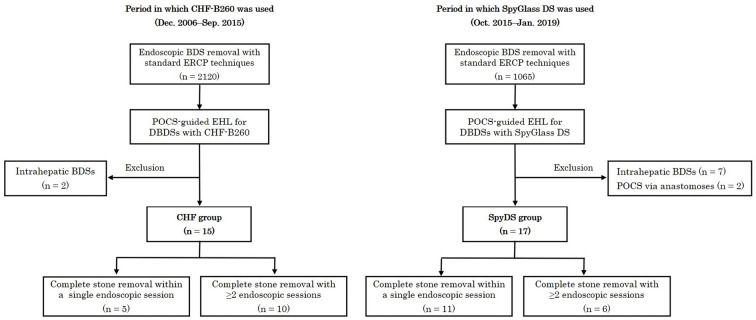
Objective Recently, a new digital peroral cholangioscopy (POCS) system, the SpyGlass DS (SpyDS), has been used for POCS-guided lithotripsy for difficult bile duct stones (DBDSs). The aim of this retrospective study was to compare the efficacy of SpyDS-guided electrohydraulic lithotripsy (EHL) for DBDS with that of a conventional digital cholangioscope. Methods Seventeen consecutive patients who had undergone POCS-guided EHL for DBDS with the SpyDS between October 2015 and January 2019 were enrolled in this study group (SpyDS group) using a prospectively maintained database. Fifteen other consecutive patients who had undergone POCS-guided EHL with a conventional digital cholangioscope (CHF-B260) just prior to the introduction of the SpyDS between December 2006 and September 2015 were analyzed as a control group (CHF group). The main outcome measurement was the total procedure time to complete stone removal. Results The rate of complete stone removal was 100% for both groups. The mean total procedure time for the SpyDS group was significantly shorter than that for the CHF group (67±30 minutes vs. 107±64 minutes, p=0.038). The mean number of endoscopic sessions for the SpyDS group was significantly lower than that for the CHF group (1.35±0.49 vs. 2.00±0.85, p=0.037). There were no significant differences in the rate of adverse events between the two groups. Conclusion The SpyDS appears useful for decreasing the procedure time and number of endoscopic sessions for complete stone removal in POCS-guided EHL for DBDS compared with a conventional digital cholangioscope.
目的 最近,一种新型数字式经口胆管镜检查(POCS)系统,即SpyGlass DS(SpyDS),已被用于在POCS引导下对困难胆管结石(DBDS)进行碎石术。这项回顾性研究的目的是比较SpyDS引导下的DBDS电液压碎石术(EHL)与传统数字式胆管镜的疗效。方法 利用一个前瞻性维护的数据库,将2015年10月至2019年1月期间连续17例使用SpyDS在POCS引导下接受DBDS的EHL治疗的患者纳入本研究组(SpyDS组)。将2006年12月至2015年9月在SpyDS引入之前,连续15例使用传统数字式胆管镜(CHF-B260)在POCS引导下接受EHL治疗的患者作为对照组(CHF组)进行分析。主要结局指标是完成结石清除的总手术时间。结果 两组的结石完全清除率均为100%。SpyDS组的平均总手术时间明显短于CHF组(67±30分钟对107±64分钟,p=0.038)。SpyDS组的平均内镜检查次数明显低于CHF组(1.35±0.49对2.00±0.85,p=0.037)。两组之间的不良事件发生率无显著差异。结论 与传统数字式胆管镜相比,SpyDS似乎有助于减少POCS引导下DBDS的EHL中完成结石完全清除的手术时间和内镜检查次数。