Jiang Yifeng, Li Guoxin, Yu Lingxue, Li Liwei, Zhang Yujiao, Zhou Yanjun, Tong Wu, Liu Changlong, Gao Fei, Tong Guangzhi
Research Team on Porcine Viral Reproductive Disorder Syndrome, Shanghai Veterinary Research Institute, Chinese Academy of Agricultural Sciences, Shanghai, China.
Jiangsu Co-innovation Center for the Prevention and Control of Important Animal Infectious Disease and Zoonosis, Yangzhou University, Yangzhou, China.
Front Microbiol. 2020 Apr 24;11:618. doi: 10.3389/fmicb.2020.00618. eCollection 2020.
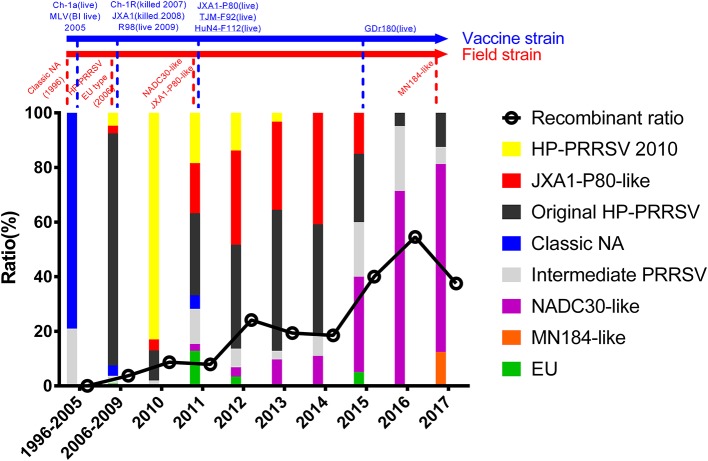
Porcine reproductive and respiratory syndrome (PRRS) is one of the most devastating diseases of the global swine industry. The causative agent (PRRSV) was first isolated in China in 1996 and has evolved quickly during the last two decades. To fully understand virus diversity, epidemic situation in the field, and make future predictions, a total of 365 PRRSV strains were used for evolution and genome analysis in which 353 strains were isolated from mainland China. The results showed that high diversity was found among PRRSV isolates. Total PRRSV isolates could be divided into eight subgroups. Among these subgroups strains, Original HP-PRRSV, NADC30-like, and Intermediate PRRSV were the major epidemic PRRSV strains circling in the field and would play a major role in PRRS epidemic in the future. Deletions, insertions, and recombinations have occurred frequently in the PRRSV genome. Deletions were the main driving force of viral evolution before 2006 and may also contribute further to the virus' evolution in a relatively closed or low strain diversity circumstance. The recombinant strains could be divided into three groups: the Inner group, Extensional group, and Propagating group. The evolutionary directions of the isolates in the Extensional and Propagating groups have changed, and the routes of recombination in the Propagating group were analyzed and sorted into three types. The increases in recombinant strains and high rates of recombination in recent years indicate that recombination has played a very important role in the virus' evolution. Isolates, which incorporate the advantages of their parental strains, will influence PRRSV evolution and make adverse effects on PRRS control in the future.
猪繁殖与呼吸综合征(PRRS)是全球养猪业中最具毁灭性的疾病之一。致病因子(PRRSV)于1996年首次在中国分离出来,并在过去二十年中迅速演变。为了全面了解病毒多样性、田间流行情况并做出未来预测,共使用了365株PRRSV毒株进行进化和基因组分析,其中353株从中国大陆分离得到。结果表明,PRRSV分离株具有高度多样性。PRRSV分离株总共可分为八个亚组。在这些亚组毒株中,经典高致病性PRRSV、NADC30样毒株和中间型PRRSV是在田间传播的主要流行PRRSV毒株,未来将在PRRS流行中发挥主要作用。PRRSV基因组中频繁发生缺失、插入和重组。缺失是2006年之前病毒进化的主要驱动力,在相对封闭或毒株多样性较低的情况下,可能也会进一步推动病毒进化。重组毒株可分为三组:内部组、扩展组和传播组。扩展组和传播组中分离株的进化方向发生了变化,并对传播组中的重组途径进行了分析,分为三种类型。近年来重组毒株的增加和高重组率表明重组在病毒进化中发挥了非常重要的作用。整合了亲本毒株优势的分离株将影响PRRSV的进化,并对未来PRRS的防控产生不利影响。