Meng Fanbo, Pan Yuxin, Wang Jinpeng, Yu Jigao, Liu Chao, Zhang Zhikang, Wei Chendan, Guo He, Wang Xiyin
School of Life Sciences, North China University of Science and Technology, Tangshan, China.
Institute for Genomics and Bio-Big-Data, Chengdu University of Traditional Chinese Medicine, Chengdu, China.
Front Genet. 2020 Apr 23;11:239. doi: 10.3389/fgene.2020.00239. eCollection 2020.
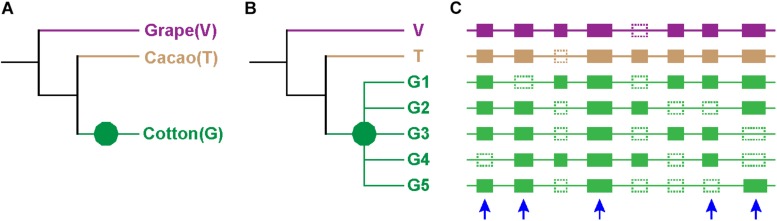
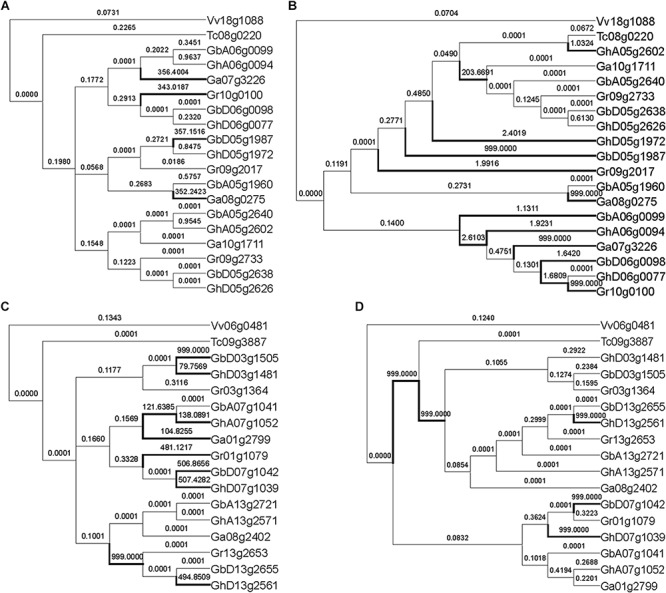
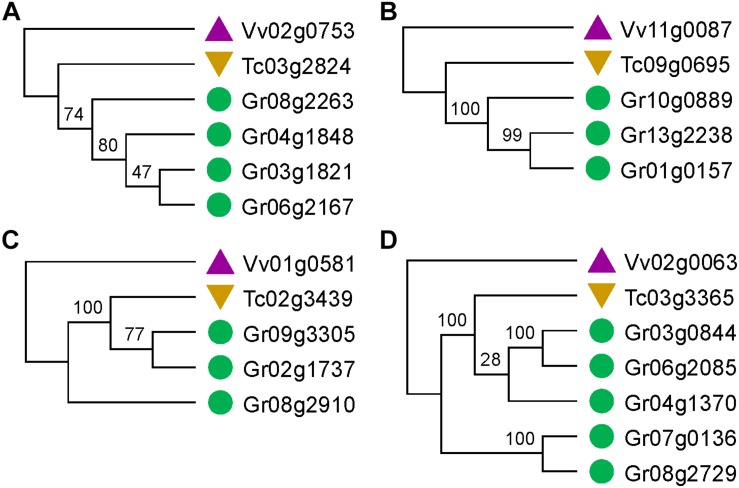
A phylogenetic tree can be used to illustrate the evolutionary relationship between a group of genes, especially duplicated genes, which are sources of genetic innovation and are often a hotspot of research. However, duplicated genes may have complex phylogenetic topologies due to changes in their evolutionary rates. Here, by constructing phylogenetic trees using different methods, we evaluated the phylogenetic relationships of duplicated genes produced by polyploidization in cotton. We found that at least 83.2% of phylogenetic trees did not conform the expected topology. Moreover, cotton homologous gene copy number has little effect on the topology of duplicated genes. Compared with their cacao orthologs, elevated evolutionary rates of cotton genes are responsible for distorted tree topology. Furthermore, as to both branch and site models, we inferred that positive natural selection during the divergence of fiber-development-related MYB genes was likely, and found that the reconstructed tree topology may often overestimate natural selection, as compared to the inference with the expected trees. Therefore, we emphasize the importance of borrowing precious information from gene collinearity in tree construction and evaluation, and have evidence to alert the citation of thousands of previous reports of adaptivity and functional innovation of duplicated genes.
系统发育树可用于阐明一组基因之间的进化关系,尤其是重复基因,它们是遗传创新的来源,且常常是研究热点。然而,由于进化速率的变化,重复基因可能具有复杂的系统发育拓扑结构。在此,我们通过使用不同方法构建系统发育树,评估了棉花中多倍体化产生的重复基因的系统发育关系。我们发现,至少83.2%的系统发育树不符合预期拓扑结构。此外,棉花同源基因拷贝数对重复基因的拓扑结构影响不大。与可可的直系同源基因相比,棉花基因进化速率的提高导致了树形拓扑结构的扭曲。此外,对于分支模型和位点模型,我们推断在纤维发育相关MYB基因分化过程中可能存在正自然选择,并且发现与预期树的推断相比,重建的树形拓扑结构可能经常高估自然选择。因此,我们强调在树构建和评估中借鉴基因共线性宝贵信息的重要性,并有证据警示人们谨慎引用此前关于重复基因适应性和功能创新的数千篇报道。