Li Chunxiao, Chen Qian, Zhang Xi, Li Huaguo, Liu Quanhua, Fei Ping, Huang Lisu, Yao Zhirong
Department of Dermatology, Xinhua Hospital, Shanghai Jiaotong University School of Medicine, Shanghai, China.
Institute of Dermatology, Shanghai Jiao Tong University School of Medicine, Shanghai, China.
Front Pediatr. 2020 Apr 24;8:192. doi: 10.3389/fped.2020.00192. eCollection 2020.
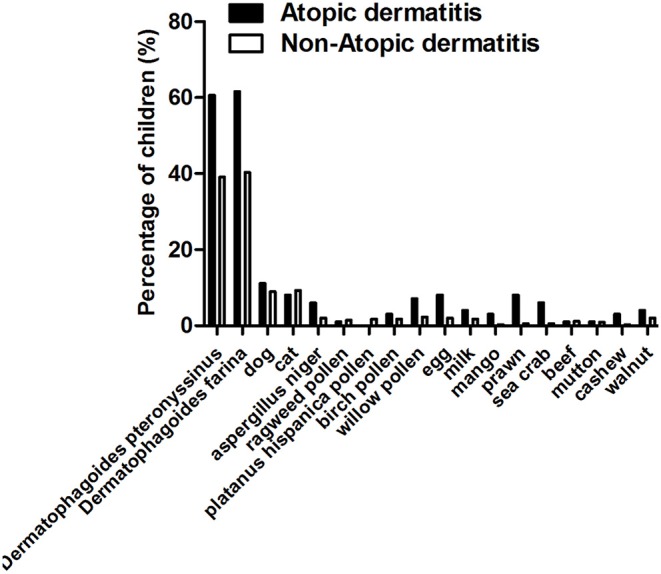
Although domestic pet ownership is on the rise, the impact of early life pet ownership on children's pet sensitization and atopic dermatitis (AD) remains controversial. Shanghai Allergy Cohort is an ongoing prospective study followed up to the age of 5 years. Pregnant mothers were recruited and their offspring were followed up every year by a group of pediatricians. Information on furred pet ownership was collected by the questionnaire. AD was diagnosed by dermatologists according to disease history and Williams criteria at 5 years ± 1 months. Skin prick test (SPT) was performed to determine sensitization to specific allergens. Multiple logistic regression models were used to evaluate the associations between pet ownership and AD, dog/cat sensitization. In the 538 children at preschool age, 112 (20.82%) were diagnosed with AD. Dermatophagoides pteronyssinus and Dermatophagoides farina were the most common allergens, and almost 10% of children were positive to dog and cat. The percentage of positive SPT reactors at 5-year old was 65.28% in the group of children with AD, higher than that in non-AD group (44.57%). Domestic pet ownership at both infant and preschool period was positively associated with an increased risk of sensitization to dog (OR = 2.85 [95% CI: 1.08-7.50 for infant exposure], OR = 2.73 [95% CI: 1.33-5.61] for preschool exposure), and interestingly, pet ownership at infant period negatively associated with higher risk of AD at 5-year old (OR adjusted = 0.33 [95% CI: 0.12-0.88]). This is the first prospective birth cohort study in Shanghai that found half of preschool children had positive allergen sensitization even in the non-AD children. Although early life exposure to dog may increase the risk of dog sensitization, it significantly decreased the risk of AD. The underlying mechanisms warrant further investigations.
尽管家庭宠物饲养量在上升,但儿童早期饲养宠物对其宠物致敏和特应性皮炎(AD)的影响仍存在争议。上海过敏队列研究是一项正在进行的前瞻性研究,随访至5岁。招募了怀孕的母亲,一组儿科医生每年对她们的后代进行随访。通过问卷收集有关饲养有毛宠物的信息。皮肤科医生根据病史和威廉姆斯标准在5岁±1个月时诊断AD。进行皮肤点刺试验(SPT)以确定对特定过敏原的致敏情况。使用多重逻辑回归模型评估宠物饲养与AD、狗/猫致敏之间的关联。在538名学龄前儿童中,112名(20.82%)被诊断为AD。屋尘螨和粉尘螨是最常见的过敏原,近10%的儿童对狗和猫呈阳性反应。AD组5岁儿童SPT阳性反应者的百分比为65.28%,高于非AD组(44.57%)。婴儿期和学龄前期饲养宠物均与狗致敏风险增加呈正相关(婴儿期接触的OR = 2.85 [95% CI:1.08 - 7.50],学龄前期接触的OR = 2.73 [95% CI:1.33 - 5.61]),有趣的是,婴儿期饲养宠物与5岁时患AD的较高风险呈负相关(调整后的OR = 0.33 [95% CI:0.12 - 0.88])。这是上海第一项前瞻性出生队列研究,发现即使在非AD儿童中,也有一半的学龄前儿童过敏原致敏呈阳性。虽然儿童早期接触狗可能会增加狗致敏的风险,但它显著降低了患AD的风险。其潜在机制值得进一步研究。