Rastaldo Raffaella, Vitale Emanuela, Giachino Claudia
Department of Clinical and Biological Sciences, University of Turin, Turin, Italy.
Front Cell Dev Biol. 2020 Apr 24;8:276. doi: 10.3389/fcell.2020.00276. eCollection 2020.
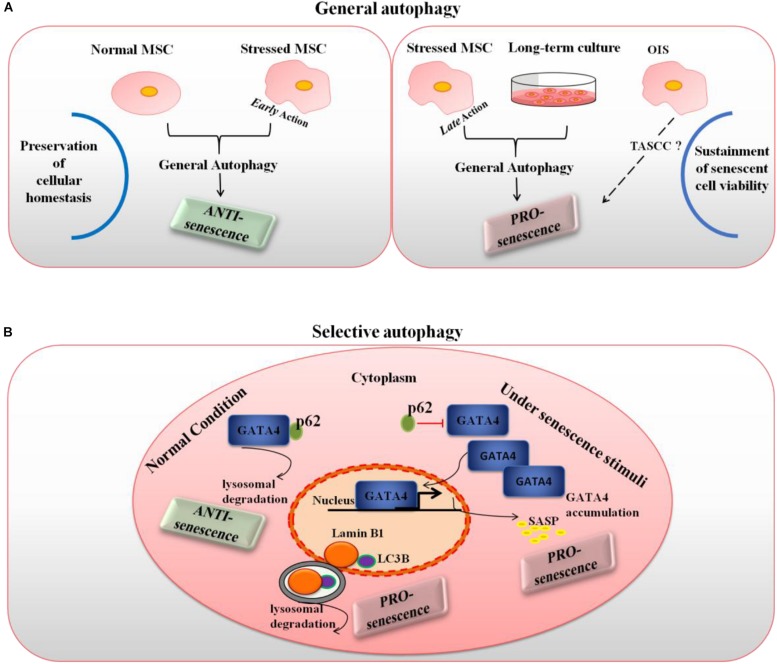
During their development and overall life, mesenchymal stem cells (MSCs) encounter a plethora of internal and external stress signals and therefore, they need to put in action homeostatic changes in order to face these stresses. To this aim, similar to other mammalian cells, MSCs are endowed with two crucial biological responses, autophagy and senescence. Sharing of a number of stimuli like shrinkage of telomeres, oncogenic and oxidative stress, and DNA damage, suggest an intriguingly close relationship between autophagy and senescence. Autophagy is at first reported to suppress MSC senescence by clearing injured cytoplasmic organelles and impaired macromolecules, yet recent investigations also showed that autophagy can promote MSC senescence by inducing the production of senescence-associated secretory proteins (SASP). These apparently contrary contributions of autophagy may mirror an intricate image of autophagic regulation on MSC senescence. We here tackle the pro-senescence and anti-senescence roles of autophagy in MSCs while concentrating on some possible mechanistic explanations of such an intricate liaison. Clarifying the autophagy/senescence relationship in MSCs will help the development of more effective and safer therapeutic strategies.
在其发育和整个生命过程中,间充质干细胞(MSC)会遇到大量内部和外部应激信号,因此,它们需要进行稳态变化以应对这些应激。为此,与其他哺乳动物细胞类似,MSC具有两种关键的生物学反应,即自噬和衰老。端粒缩短、致癌和氧化应激以及DNA损伤等多种刺激因素表明,自噬与衰老之间存在着惊人的密切关系。自噬最初被报道通过清除受损的细胞质细胞器和受损的大分子来抑制MSC衰老,但最近的研究也表明,自噬可通过诱导衰老相关分泌蛋白(SASP)的产生来促进MSC衰老。自噬这些明显相反的作用可能反映了自噬对MSC衰老调控的复杂情况。我们在此探讨自噬在MSC中的促衰老和抗衰老作用,同时关注这种复杂联系的一些可能的机理解释。阐明MSC中的自噬/衰老关系将有助于开发更有效、更安全的治疗策略。