School of Biological Sciences, Seoul National University, Seoul 08826, Korea.
Mol Cells. 2017 Sep 30;40(9):607-612. doi: 10.14348/molcells.2017.0151. Epub 2017 Sep 20.
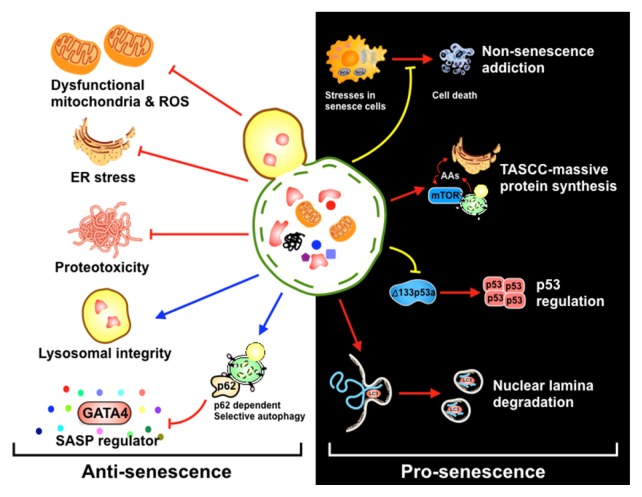
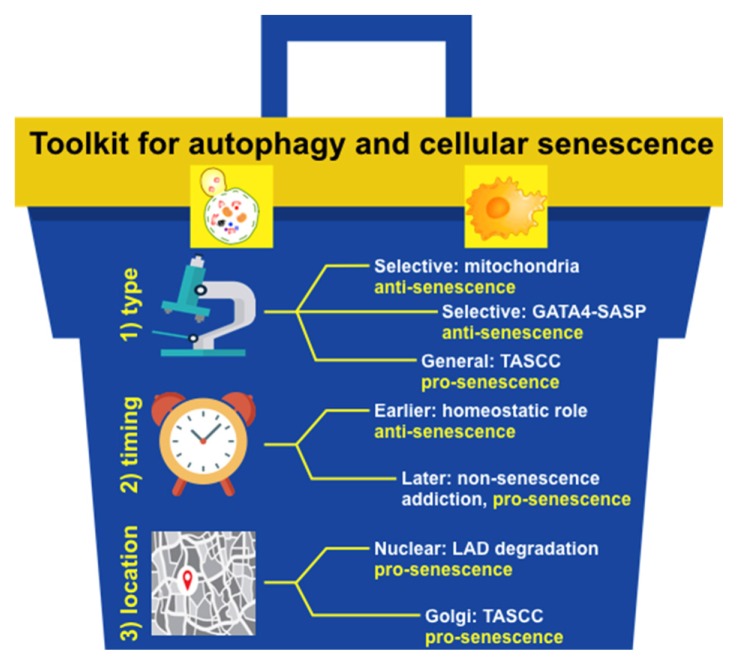
When mammalian cells and animals face a variety of internal or external stresses, they need to make homeostatic changes so as to cope with various stresses. To this end, mammalian cells are equipped with two critical stress responses, autophagy and cellular senescence. Autophagy and cellular senescence share a number of stimuli including telomere shortening, DNA damage, oncogenic stress and oxidative stress, suggesting their intimate relationship. Autophagy is originally thought to suppress cellular senescence by removing damaged macromolecules or organelles, yet recent studies also indicated that autophagy promotes cellular senescence by facilitating the synthesis of senescence-associated secretory proteins. These seemingly opposite roles of autophagy may reflect a complex picture of autophagic regulation on cellular senescence, including different types of autophagy or a unique spatiotemporal activation of autophagy. Thus, a better understanding of autophagy process will lead us to not only elucidate the conundrum how autophagy plays dual roles in the regulation of cellular senescence but also helps the development of new therapeutic strategies for many human diseases associated with cellular senescence. We address the pro-senescence and anti-senescence roles of autophagy while focusing on the potential mechanistic aspects of this complex relationship between autophagy and cellular senescence.
当哺乳动物细胞和动物面临各种内部或外部压力时,它们需要做出稳态变化,以应对各种压力。为此,哺乳动物细胞配备了两种关键的应激反应,自噬和细胞衰老。自噬和细胞衰老具有许多共同的刺激因素,包括端粒缩短、DNA 损伤、致癌应激和氧化应激,这表明它们之间存在密切的关系。自噬最初被认为通过清除受损的大分子或细胞器来抑制细胞衰老,但最近的研究也表明,自噬通过促进衰老相关分泌蛋白的合成来促进细胞衰老。自噬的这些看似相反的作用可能反映了自噬对细胞衰老的调控的复杂情况,包括不同类型的自噬或自噬的独特时空激活。因此,更好地了解自噬过程不仅将使我们不仅阐明自噬在细胞衰老调控中发挥双重作用的难题,还有助于开发与细胞衰老相关的许多人类疾病的新治疗策略。我们讨论了自噬在促进衰老和抑制衰老方面的作用,同时重点关注自噬和细胞衰老之间这种复杂关系的潜在机制方面。