Stanley Institute for Cognitive Genomics, Cold Spring Harbor Laboratory, 500 Sunnyside Blvd., Woodbury, NY 11797, USA.
Nucleic Acids Res. 2020 Jul 2;48(W1):W566-W571. doi: 10.1093/nar/gkaa348.
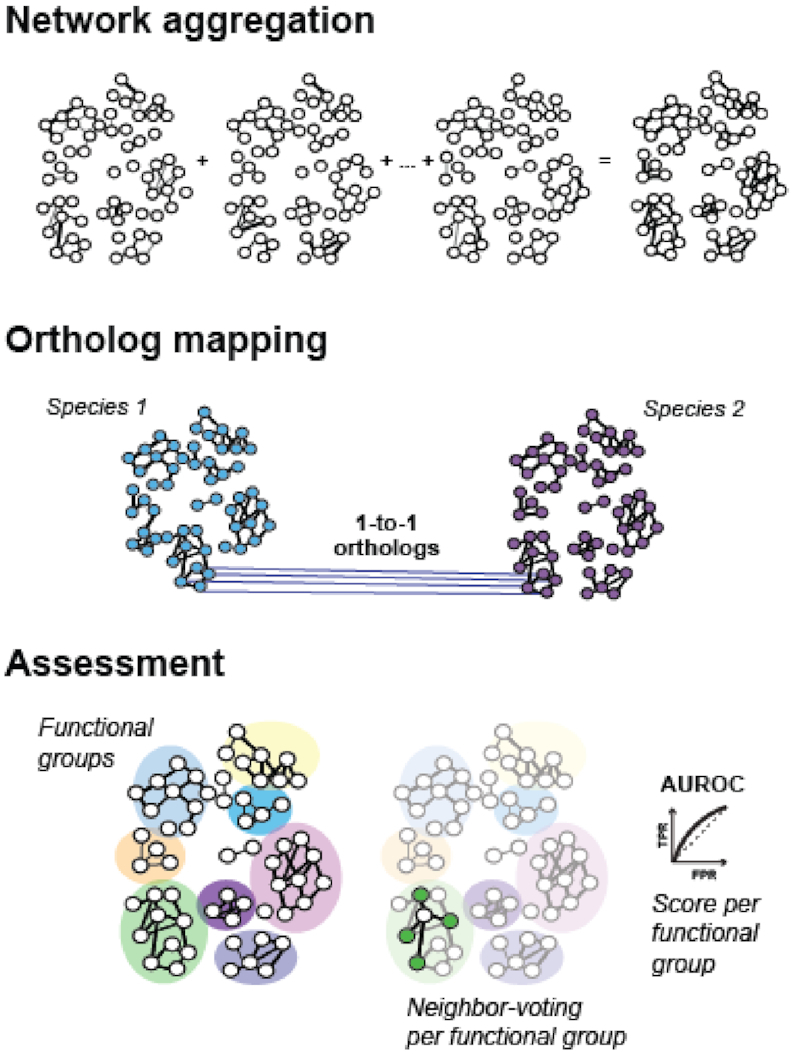
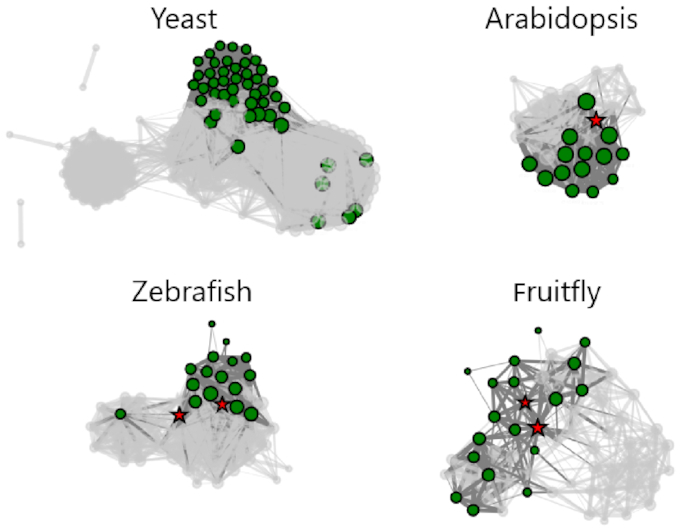
Co-expression analysis has provided insight into gene function in organisms from Arabidopsis to zebrafish. Comparison across species has the potential to enrich these results, for example by prioritizing among candidate human disease genes based on their network properties or by finding alternative model systems where their co-expression is conserved. Here, we present CoCoCoNet as a tool for identifying conserved gene modules and comparing co-expression networks. CoCoCoNet is a resource for both data and methods, providing gold standard networks and sophisticated tools for on-the-fly comparative analyses across 14 species. We show how CoCoCoNet can be used in two use cases. In the first, we demonstrate deep conservation of a nucleolus gene module across very divergent organisms, and in the second, we show how the heterogeneity of autism mechanisms in humans can be broken down by functional groups and translated to model organisms. CoCoCoNet is free to use and available to all at https://milton.cshl.edu/CoCoCoNet, with data and R scripts available at ftp://milton.cshl.edu/data.
共表达分析为从拟南芥到斑马鱼等生物的基因功能提供了深入的了解。跨物种的比较有可能丰富这些结果,例如,根据其网络特性对候选人类疾病基因进行优先级排序,或者找到其共表达保守的替代模型系统。在这里,我们提出了 CoCoCoNet 作为一种识别保守基因模块和比较共表达网络的工具。CoCoCoNet 是一个数据和方法的资源,提供了黄金标准网络和复杂的工具,可在 14 个物种之间进行即时比较分析。我们展示了如何在两个用例中使用 CoCoCoNet。在第一个用例中,我们证明了核仁基因模块在非常不同的生物体中深度保守,在第二个用例中,我们展示了如何通过功能组将人类自闭症机制的异质性分解,并转化为模型生物。CoCoCoNet 可免费使用,并在 https://milton.cshl.edu/CoCoCoNet 上向所有人开放,数据和 R 脚本可在 ftp://milton.cshl.edu/data 上获取。