Department of Stomatology, Beijing Friendship Hospital, Capital Medical University, Beijing, China.
Center for Chronic and Non-communicable Disease Control and Prevention, Chinese Center for Disease Control and Prevention, Beijing, China.
BMC Oral Health. 2020 May 11;20(1):137. doi: 10.1186/s12903-020-01128-0.
The financial burden of oral diseases is a growing concern as the medical expenses rise worldwide. The aim of this study was to investigate the dental expenditure, analyze its progressivity and horizontal inequality under the general health finance and insurance system, and identify the key social determinants of the inequality for Chinese adults.
A secondary analysis used the data of 13,464 adults from the 4th National Oral Health Epidemiological Survey (NOHES) in China was undertaken. The dental expenditure was collected and divided into out-of-pocket and health insurance payments. Horizontal inequality index and Kakwani index were used to analyze the horizontal inequality and progressivity, respectively. The decomposition model of the concentration index was set up to explore the associated socioeconomic determinants.
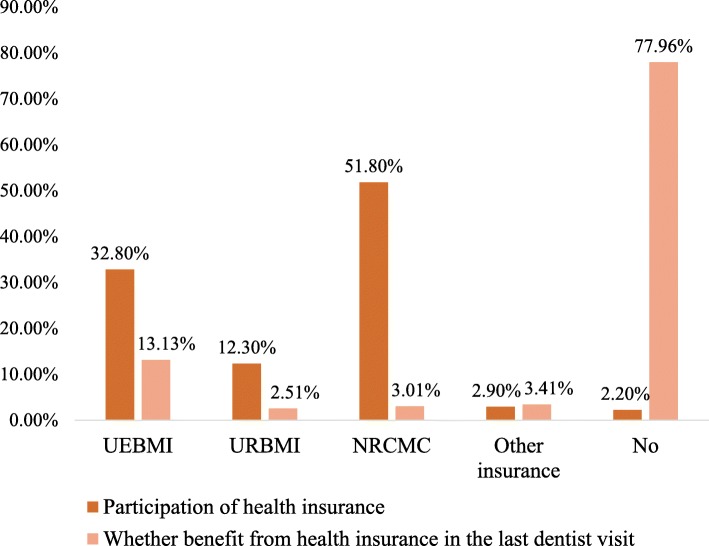
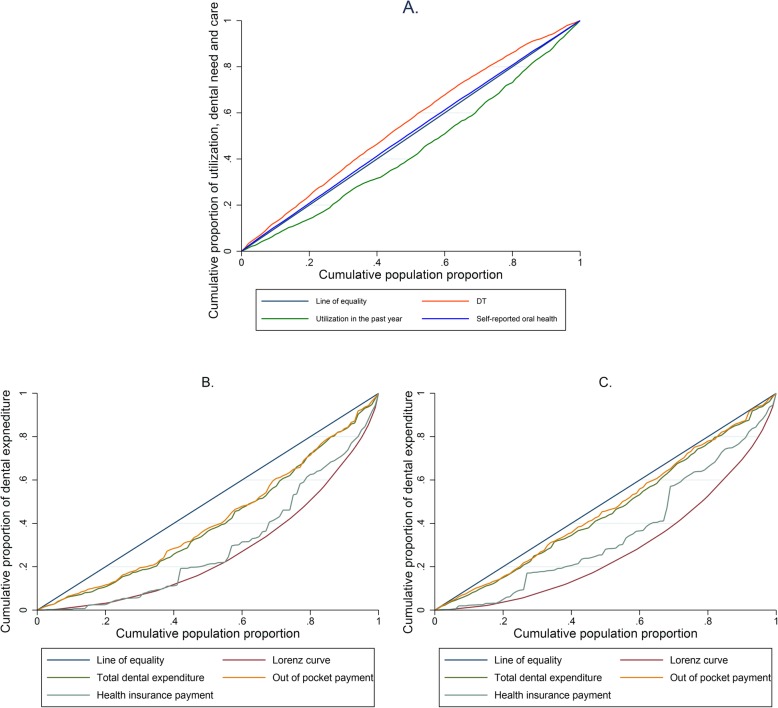
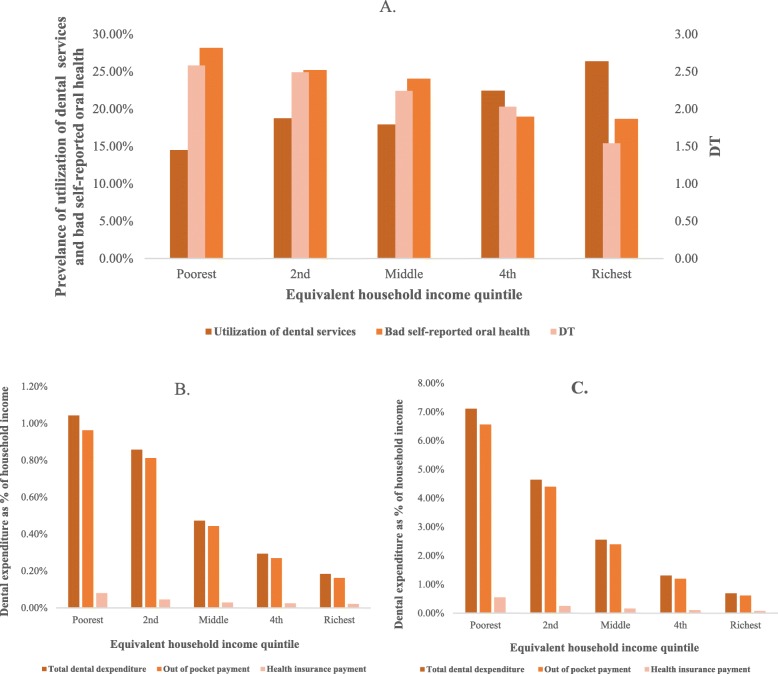
The results showed that a mean dental expenditure per capita of Chinese adults was $20.55 (95% Confidence Interval-CI: 18.83,22.26). Among those who actually used dental service, the cost was $100.95 (95%CI: 93.22,108.68). Over 90% of dental spending was due to out-of-pocket expenses. For self-reported oral health, the horizontal inequality index was - 0.1391 and for the decayed tooth (DT), it was - 0.2252. For out-of-pocket payment, the Kakwani index was - 0.3154 and for health insurance payment it was - 0.1598. Income, residential location, educational attainment, oral hygiene practice, self-reported oral health, age difference were the main contributors to the inequality of dental expenditure.
Dental expenditure for Chinese adults was at a lower level due to underutilization. The ratio of payments of dental expenditure and utilization was disproportional, whether it was out-of-pocket or insurance payment. Individuals who were more in need of oral care showed less demand for service or not required service in time. For future policy making on oral health, it is worth the effort to further promote the awareness of the importance of oral health and utilization of dental service.
随着全球医疗费用的上涨,口腔疾病的经济负担日益加重。本研究旨在调查中国成年人在一般卫生金融和保险体系下的牙科支出、分析其累进性和水平不平等,并确定导致不平等的关键社会决定因素。
利用中国第四次全国口腔健康流行病学调查(NOHES)的 13464 名成年人的数据进行二次分析。收集了牙科支出数据,并分为自付和医疗保险支付。使用水平不平等指数和 Kakwani 指数分别分析水平不平等和累进性。建立集中指数分解模型,探讨相关社会经济决定因素。
结果显示,中国成年人的人均牙科支出平均值为 20.55 美元(95%置信区间-CI:18.83,22.26)。在实际使用牙科服务的人群中,费用为 100.95 美元(95%CI:93.22,108.68)。超过 90%的牙科支出是自付费用。对于自我报告的口腔健康,水平不平等指数为-0.1391,对于龋齿(DT),水平不平等指数为-0.2252。对于自付支付,Kakwani 指数为-0.3154,对于医疗保险支付,Kakwani 指数为-0.1598。收入、居住地点、教育程度、口腔卫生习惯、自我报告的口腔健康、年龄差异是牙科支出不平等的主要原因。
由于利用不足,中国成年人的牙科支出水平较低。无论是自付还是保险支付,牙科支出和利用的支付比例都不成比例。那些更需要口腔护理的人对服务的需求较低或没有及时得到服务。对于未来的口腔健康政策制定,值得努力进一步提高对口腔健康重要性和牙科服务利用的认识。