Serviço de Cardiologia e Cirurgia Cardiovascular e Centro de Telessaúde, Hospital das Clínicas da Universidade Federal de Minas Gerais, Belo Horizonte, MG, Brazil.
Serviço de Cardiologia e Cirurgia Cardiovascular e Centro de Telessaúde, Hospital das Clínicas da Universidade Federal de Minas Gerais, Belo Horizonte, MG, Brazil
BMJ Open. 2020 May 10;10(5):e036827. doi: 10.1136/bmjopen-2020-036827.
Echocardiographic (echo) screening is an important tool to estimate rheumatic heart disease (RHD) prevalence, but the natural history of screen-detected RHD remains unclear. The PROVAR+ () study, which uses non-experts, telemedicine and portable echo, pioneered RHD screening in Brazil. We aimed to assess the mid-term evolution of Brazilian schoolchildren (5-18 years) with echocardiography-detected subclinical RHD and to assess the performance of a simplified score consisting of five components of the World Heart Federation criteria, as a predictor of unfavourable echo outcomes.
Public schools of underserved areas and private schools in Minas Gerais, southeast Brazil.
A total of 197 patients (170 borderline and 27 definite RHD) with follow-up of 29±9 months were included. Median age was 14 (12-16) years, and 130 (66%) were woman. Only four patients in the definite group were regularly receiving penicillin.
Unfavourable outcome was based on the 2-year follow-up echo, defined as worsening diagnostic category, remaining with mild definite RHD or development/worsening of valve regurgitation/stenosis.
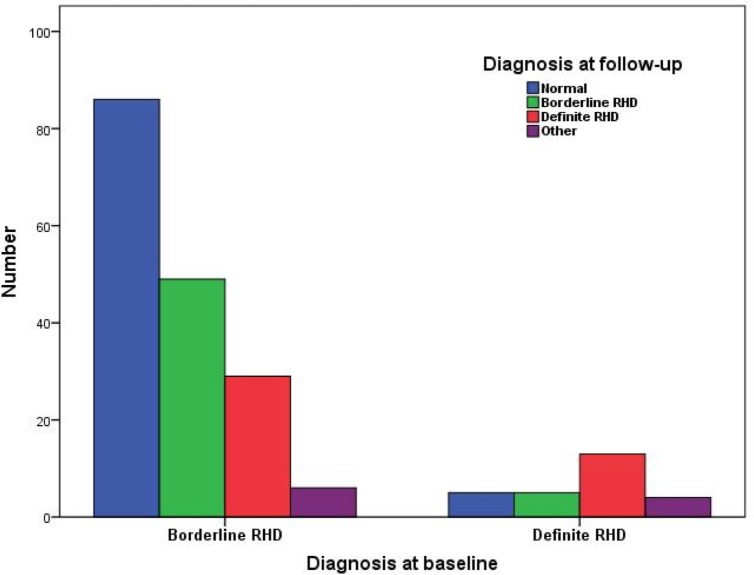
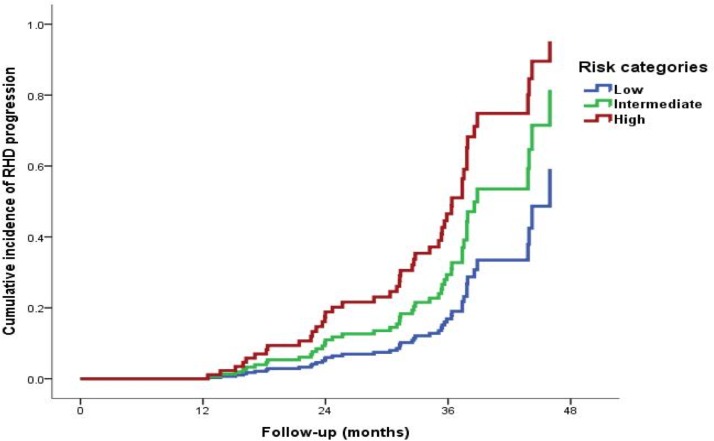
Among patients with borderline RHD, 29 (17.1%) progressed to definite, 49 (28.8%) remained stable, 86 (50.6%) regressed to normal and 6 (3.5%) were reclassified as other heart diseases. Among those with definite RHD, 13 (48.1%) remained in the category, while 5 (18.5%) regressed to borderline, 5 (18.5%) regressed to normal and 4 (14.8%) were reclassified as other heart diseases. The simplified echo score was a significant predictor of RHD unfavourable outcome (HR 1.197, 95% CI 1.098 to 1.305, p<0.001).
The simple risk score provided an accurate prediction of RHD status at 2-year follow-up, showing a good performance in Brazilian schoolchildren, with a potential value for risk stratification and monitoring of echocardiography-detected RHD.
超声心动图(echo)筛查是评估风湿性心脏病(RHD)患病率的重要工具,但 screen-detected RHD 的自然史仍不清楚。PROVAR+()研究使用非专家、远程医疗和便携式超声心动图在巴西首创了 RHD 筛查。我们旨在评估巴西学龄儿童(5-18 岁)超声心动图检出的亚临床 RHD 的中期演变,并评估由世界心脏联合会(WHF)五项标准组成的简化评分作为预测不利超声心动图结果的预测因子的性能。
巴西东南部米纳斯吉拉斯州的贫困地区公立学校和私立学校。
共纳入 197 名患者(170 名边缘和 27 名确诊 RHD),随访 29±9 个月。中位年龄为 14 岁(12-16 岁),130 名(66%)为女性。只有 4 名确诊组患者定期接受青霉素治疗。
不良结局是基于 2 年的超声心动图随访结果,定义为诊断类别恶化、轻度确诊 RHD 持续存在或瓣膜反流/狭窄的发展/恶化。
在边缘性 RHD 患者中,29 例(17.1%)进展为确诊,49 例(28.8%)病情稳定,86 例(50.6%)恢复正常,6 例(3.5%)重新分类为其他心脏病。在确诊 RHD 患者中,13 例(48.1%)仍处于该类别,5 例(18.5%)恢复为边缘性,5 例(18.5%)恢复正常,4 例(14.8%)重新分类为其他心脏病。简化的超声心动图评分是 RHD 不良结局的显著预测因子(HR 1.197,95%CI 1.098 至 1.305,p<0.001)。
简单的风险评分可准确预测 2 年随访时的 RHD 状况,在巴西学龄儿童中表现出良好的性能,对超声心动图检出的 RHD 具有潜在的风险分层和监测价值。