Henning Kayley A, Ravindran Mithunan, Qiu Feng, Fam Neil P, Seth Tej N, Austin Peter C, Wijeysundera Harindra C
Institute for Clinical Evaluative Sciences, Toronto, Ontario, Canada.
Department of Cardiology, Schulich Heart Centre, University of Toronto, Toronto, Ontario, Canada.
Open Heart. 2020 May;7(1). doi: 10.1136/openhrt-2020-001241.
There has been rapid growth in the demand for transcatheter aortic valve replacement (TAVR), which has the potential to overwhelm current capacity. This imbalance between demand and capacity may lead to prolonged wait times, and subsequent adverse outcomes while patients are on the waitlist. We sought to understand the relationship between regional differences in capacity, TAVR wait times and morbidity/mortality on the waitlist.
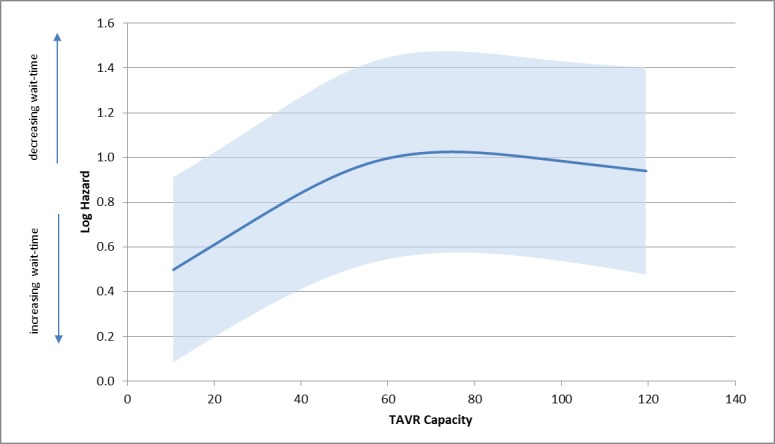
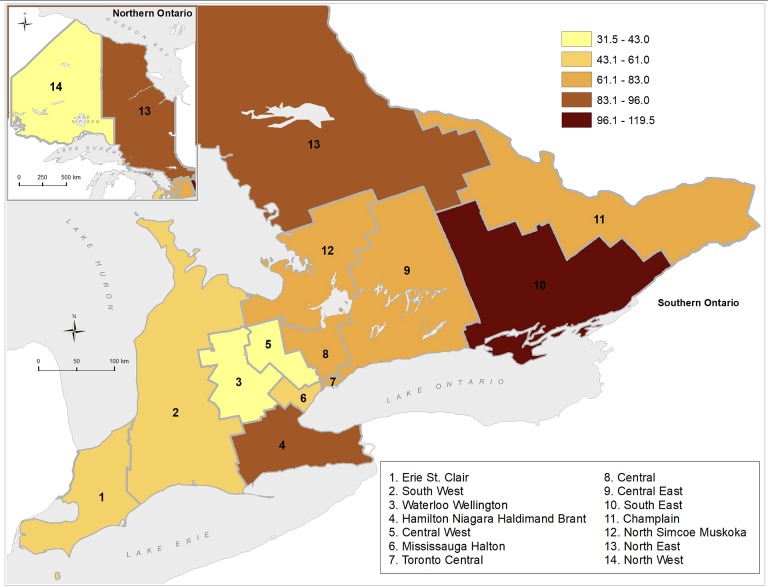
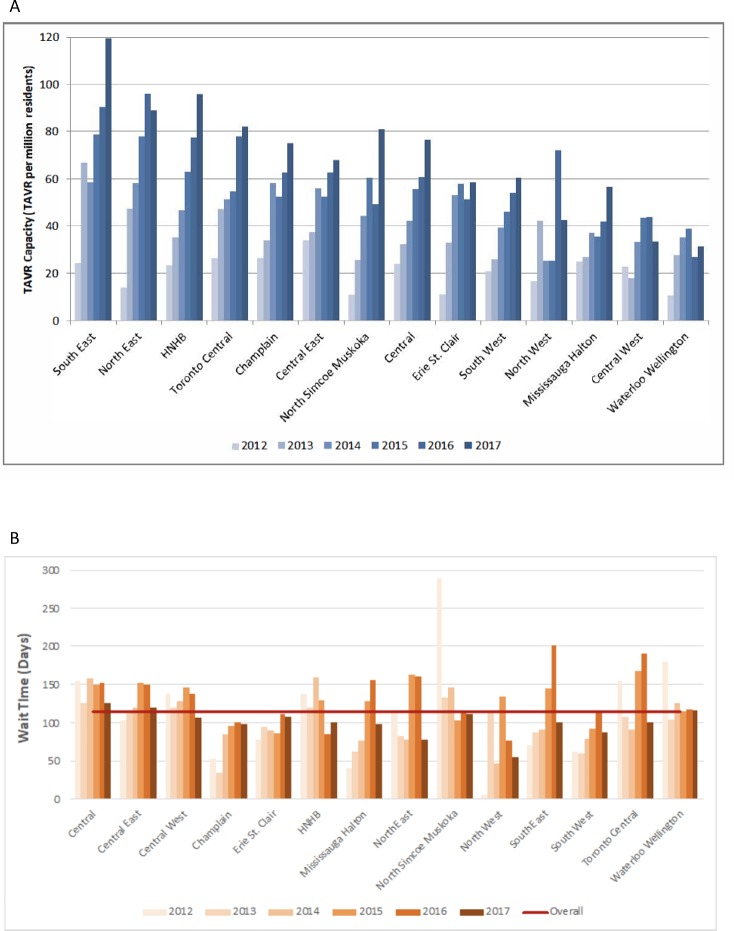
We modelled the effect of TAVR capacity, defined as the number of TAVR procedures per million residents/region, on the hazard of having a TAVR in Ontario from April 2012 to March 2017. Our primary outcome was the time from referral to a TAVR procedure or other off-list reasons on the waitlist/end of the observation period as measured in days. Clinical outcomes of interest were all-cause mortality, all-cause hospitalisations or heart failure-related hospitalisations while on the waitlist for TAVR. There was an almost fourfold difference in TAVR capacity across the 14 regions in Ontario, ranging from 31.5 to 119.5 TAVR procedures per million residents. The relationship between TAVR capacity and wait times was complex and non-linear. In general, increased capacity was associated with shorter wait times (p<0.001), reduced mortality (HR 0.94; p=0.08) and all-cause hospitalisations (p=0.009).
The results of the present study have important policy implications, suggesting that there is a need to improve TAVR capacity, as well as develop wait-time strategies to triage patients, in order to decrease wait times and mitigate the hazard of adverse patient outcomes while on the waitlist.
经导管主动脉瓣置换术(TAVR)的需求迅速增长,这有可能超出当前的服务能力。需求与能力之间的这种不平衡可能导致等待时间延长,并在患者等待名单期间引发后续不良后果。我们试图了解能力的区域差异、TAVR等待时间与等待名单上的发病率/死亡率之间的关系。
我们对2012年4月至2017年3月安大略省TAVR能力(定义为每百万居民/地区的TAVR手术数量)对接受TAVR的风险的影响进行了建模。我们的主要结局是从转诊到TAVR手术或等待名单上的其他非名单原因/观察期结束的时间,以天为单位进行测量。感兴趣的临床结局是在等待TAVR期间的全因死亡率、全因住院或心力衰竭相关住院。安大略省14个地区的TAVR能力存在近四倍的差异,范围为每百万居民31.5至119.5例TAVR手术。TAVR能力与等待时间之间的关系复杂且呈非线性。一般来说,能力增加与等待时间缩短(p<0.001)、死亡率降低(HR 0.94;p=0.08)和全因住院率降低(p=0.009)相关。
本研究结果具有重要的政策意义,表明有必要提高TAVR能力,并制定等待时间策略对患者进行分类,以减少等待时间,并降低患者在等待名单期间出现不良结局的风险。