Wang Wenlong, Liu Zheng, Wu Sijun
Department of Orthopedics, Peking University Shougang Hospital, Shijingshang District, Beijing 100144, China.
Case Rep Orthop. 2020 Jan 20;2020:2163909. doi: 10.1155/2020/2163909. eCollection 2020.
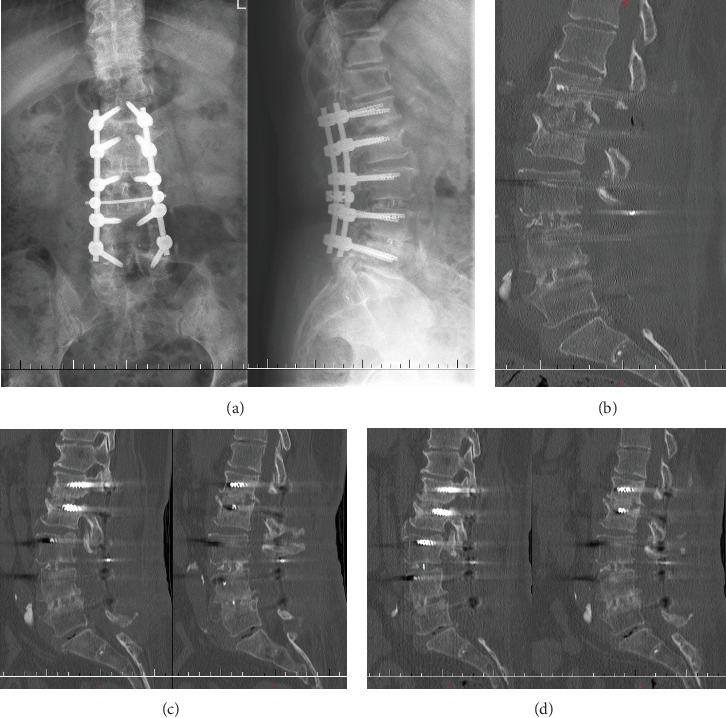
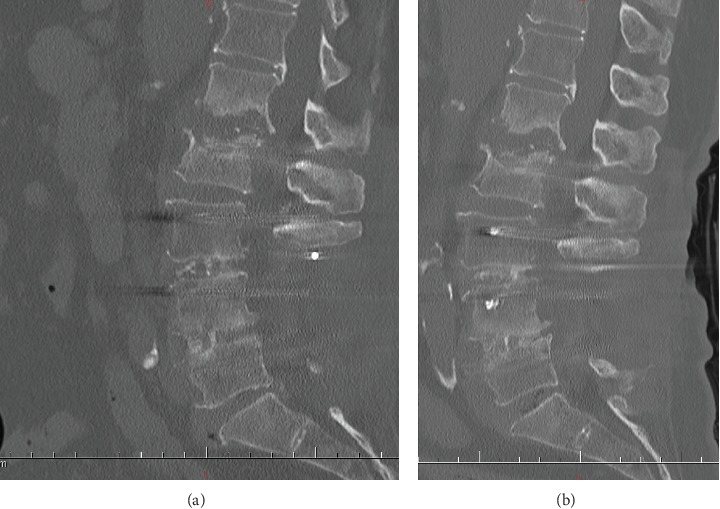
Adjacent segment infective spondylodiscitis is a rare type of surgical spinal infection after lumbar fusion with few reports. We report a further case of adjacent segment infection after three-level lumbar fusion managed successfully with anti-infective therapy and revision surgery. . A clinical case of a 69-year-old female with multilevel lumbar degenerative disease received three-level fusion. The leading preoperative symptoms were relieved after decompression surgery. However, severe back pain recurred and prompted her to be rehospitalized 2 months later. The signal of spondylitis and discitis at the adjacent segment was detected by magnetic resonance imaging (MRI). No bacteria were identified despite blood cultures being taken before antibiotic treatment. After a long-term anti-infective therapy with vancomycin, the patient gained symptom relief and was discharged home. However, the patient complained of severe back pain again after long-term oral antibiotic treatment and was rehospitalized 6 months after surgery. The computed tomography (CT) scan showed obvious bony endplate destruction at the adjacent segment space. The patient received a debridement operation and autologous iliac bone graft. The infective inflammatory markers were controlled, and the infective space achieved fusion finally.
Adjacent segment space infection is a rare reported complication that occurs after spinal fusion surgery. Conservative antibiotic therapy may not control the infection completely, and disc space debridement and autologous iliac bone graft can achieve ultimate fusion and a satisfactory outcome.
相邻节段感染性脊椎椎间盘炎是腰椎融合术后一种罕见的手术部位脊柱感染类型,相关报道较少。我们报告了一例三级腰椎融合术后相邻节段感染的病例,通过抗感染治疗和翻修手术成功治愈。一名69岁患有多节段腰椎退行性疾病的女性患者接受了三级融合手术。减压手术后,术前的主要症状得到缓解。然而,2个月后严重背痛复发,促使她再次住院。通过磁共振成像(MRI)检测到相邻节段存在脊柱炎和椎间盘炎信号。尽管在使用抗生素治疗前进行了血培养,但未发现细菌。经过长期使用万古霉素抗感染治疗,患者症状缓解并出院。然而,长期口服抗生素治疗后患者再次出现严重背痛,术后6个月再次住院。计算机断层扫描(CT)显示相邻节段间隙有明显的骨质终板破坏。患者接受了清创手术和自体髂骨移植。感染性炎症标志物得到控制,感染间隙最终实现融合。
相邻节段间隙感染是脊柱融合术后一种罕见的并发症。保守的抗生素治疗可能无法完全控制感染,椎间盘间隙清创和自体髂骨移植可实现最终融合并取得满意疗效。