Zhong Junlong, Wang Bin, Chen Yufeng, Li Huizi, Lin Nan, Xu Xianghe, Lu Huading
Department of Orthopaedics, The Fifth Affiliated Hospital of Sun Yat-sen University, Zhuhai 519000, China.
Ann Transl Med. 2020 Apr;8(7):464. doi: 10.21037/atm.2020.03.112.
Periprosthetic joint infection (PJI) is a disastrous complication after total hip arthroplasty (THA) and total knee arthroplasty (TKA). The relationship between body mass index (BMI) and the incidence of PJI remains controversial. To better understand the impact of increasing BMI on PJI, we conducted this study to investigate the dose-response relationship between BMI and the risk of PJI after primary THA or TKA.
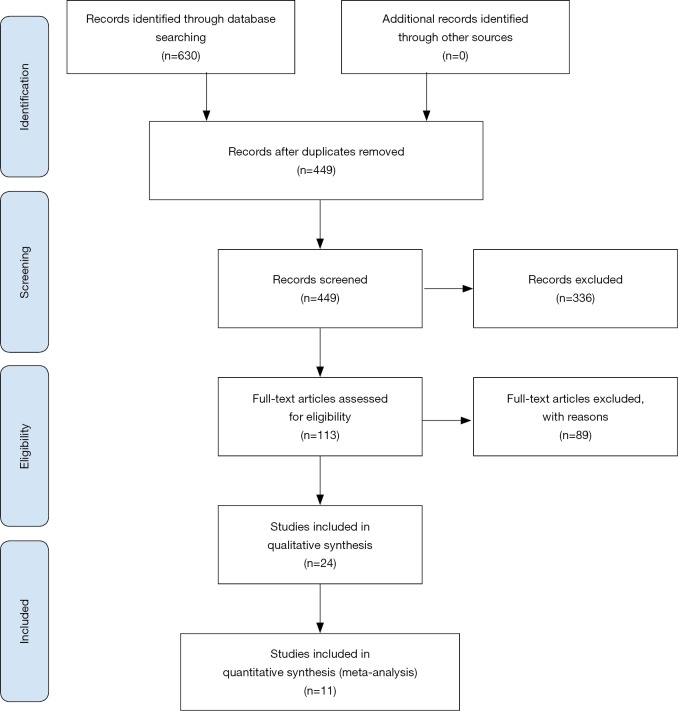
A systematic search was conducted in PubMed, Embase, and Cochrane Library databases from inception to August 17, 2019. After study selection and data extraction, a dose-response meta-analysis was performed to investigate the relationship between BMI and PJI. Adjusted relative risks (RRs) with 95% confidence intervals (CIs) were pooled using fixed-effects or random-effects models.
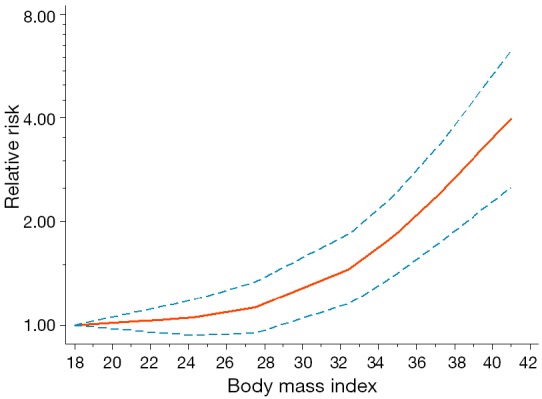
Eleven studies comprising 505,303 arthroplasties were included. The dose-response analysis showed a significant non-linear relationship between BMI and the risk of PJI (P <0.001). Patients following THA (RR, 1.489; 95% CI, 1.343-1.651; P<0.001) were more likely to suffer from PJI than patients following TKA. Furthermore, American Society of Anesthesiologists (ASA) score ≥3 (RR, 2.287; 95% CI, 1.650-3.170; P<0.001), lung disease (RR, 1.484; 95% CI, 1.208-1.823; P<0.001) and diabetes (RR, 1.695; 95% CI, 1.071-2.685; P=0.024) were identified as risk factors for PJI, but male (RR, 1.649; 95% CI, 0.987-2.755; P=0.056) and hypertension (RR, 0.980; 95% CI, 0.502-1.916; P=0.954) were not recognized as risk factors for PJI.
The J-shaped non-linear relationship demonstrated that increased BMI was associated with an increased risk for PJI after primary THA or TKA. Patients following THA were more likely to suffer from PJI than patients following TKA. Also, patients with ASA score ≥3, lung disease and diabetes have a higher risk of PJI. Gender and hypertension did not influence the incidence of PJI.
人工关节周围感染(PJI)是全髋关节置换术(THA)和全膝关节置换术(TKA)后一种灾难性的并发症。体重指数(BMI)与PJI发生率之间的关系仍存在争议。为了更好地理解BMI升高对PJI的影响,我们开展了这项研究,以调查BMI与初次THA或TKA后PJI风险之间的剂量反应关系。
从数据库建立至2019年8月17日,在PubMed、Embase和Cochrane图书馆数据库中进行了系统检索。经过研究筛选和数据提取后,进行了剂量反应荟萃分析,以研究BMI与PJI之间的关系。采用固定效应或随机效应模型汇总95%置信区间(CI)的调整相对风险(RR)。
纳入了11项研究,共505303例关节置换术。剂量反应分析显示BMI与PJI风险之间存在显著的非线性关系(P<0.001)。THA患者(RR,1.489;95%CI,1.343 - 1.651;P<0.001)比TKA患者更易发生PJI。此外,美国麻醉医师协会(ASA)评分≥3(RR,2.287;95%CI,1.650 - 3.170;P<0.001)、肺部疾病(RR,1.484;95%CI,1.208 - 1.823;P<0.001)和糖尿病(RR,1.695;95%CI,1.071 - 2.685;P = 0.024)被确定为PJI的危险因素,但男性(RR,1.649;95%CI,0.987 - 2.755;P = 0.056)和高血压(RR,0.980;95%CI,0.502 - 1.916;P = 0.954)未被视为PJI的危险因素。
J形非线性关系表明,BMI升高与初次THA或TKA后PJI风险增加相关。THA患者比TKA患者更易发生PJI。此外,ASA评分≥3、肺部疾病和糖尿病患者发生PJI的风险更高。性别和高血压不影响PJI的发生率。