Mendoza Mayra N, Raudsepp Terje, More Manuel J, Gutiérrez Gustavo A, Ponce de León F Abel
Instituto de Investigación en Bioquímica y Biología Molecular, Universidad Nacional Agraria La Molina, Lima, Peru.
Molecular Cytogenetics and Genomics Laboratory, Texas A&M University, College Station, TX 77845-4458, USA.
Genes (Basel). 2020 May 8;11(5):522. doi: 10.3390/genes11050522.
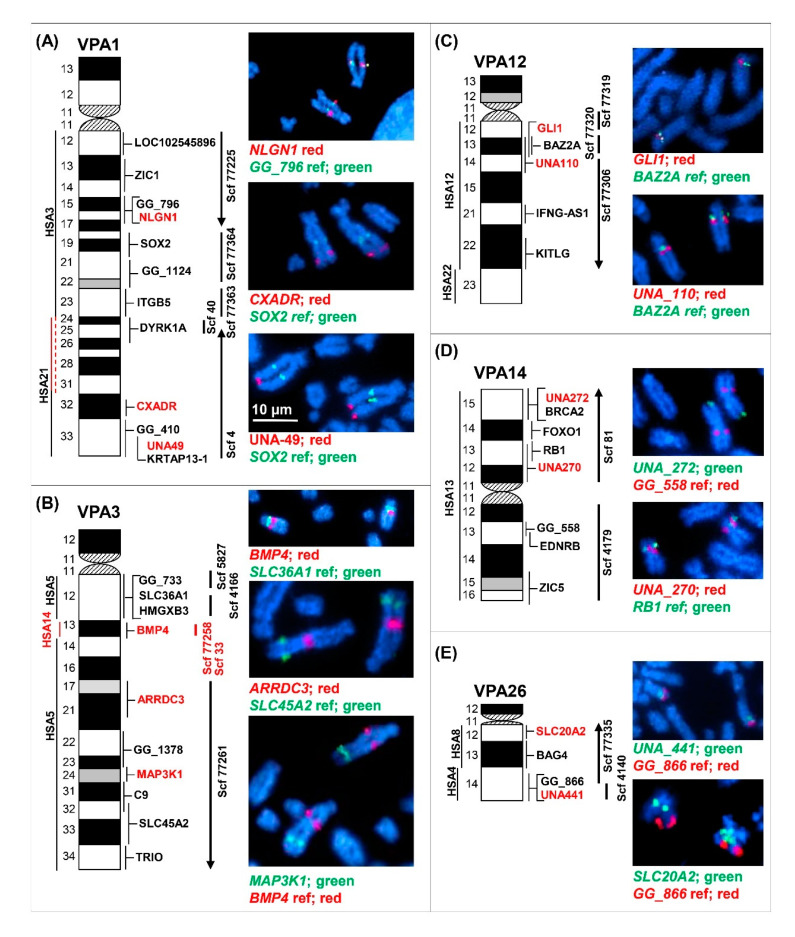
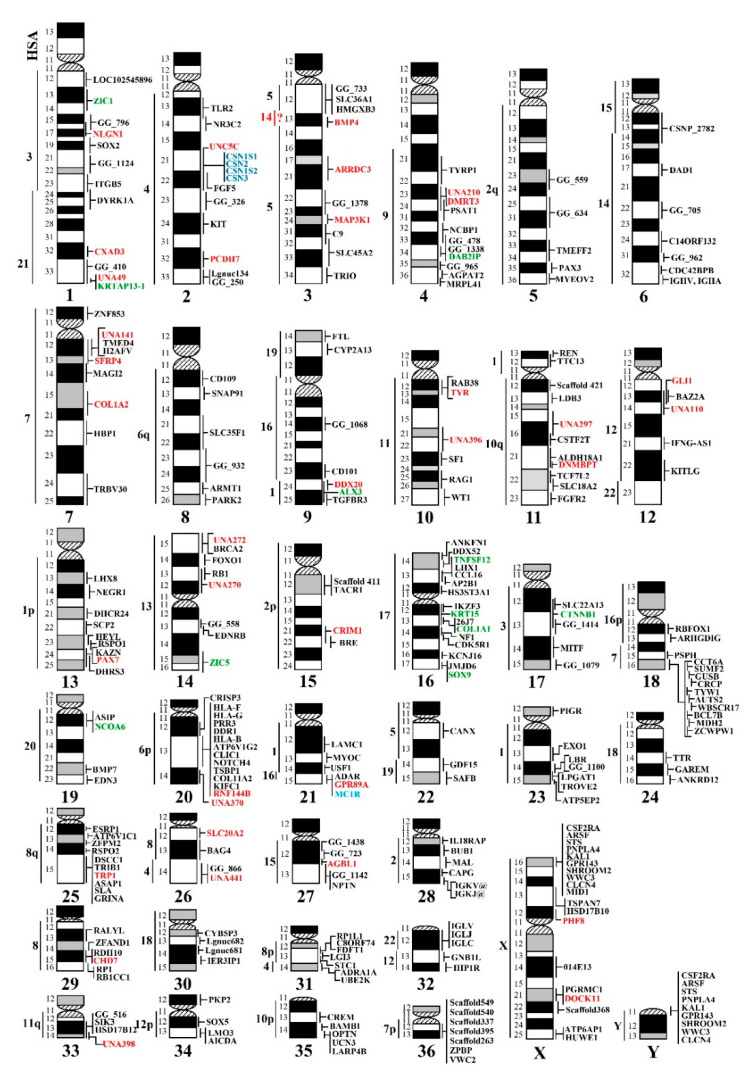
Alpaca is a camelid species of broad economic, biological and biomedical interest, and an essential part of the cultural and historical heritage of Peru. Recently, efforts have been made to improve knowledge of the alpaca genome, and its genetics and cytogenetics, to develop molecular tools for selection and breeding. Here, we report cytogenetic mapping of 35 new markers to 19 alpaca autosomes and the X chromosome. Twenty-eight markers represent alpaca SNPs, of which 17 are located inside or near protein-coding genes, two are in ncRNA genes and nine are intergenic. The remaining seven markers correspond to candidate genes for fiber characteristics (, coat color () and development (). The results take the tally of cytogenetically mapped markers in alpaca to 281, covering all 36 autosomes and the sex chromosomes. The new map assignments overall agree with human-camelid conserved synteny data, except for mapping to VPA3, suggesting a hitherto unknown homology with HSA14. The findings validate, refine and correct the current alpaca assembly by anchoring unassigned sequence scaffolds, and ordering and orienting assigned scaffolds. The study contributes to the improvement in the alpaca reference genome and advances camelid molecular cytogenetics.
羊驼是一种具有广泛经济、生物学和生物医学价值的骆驼科动物,也是秘鲁文化和历史遗产的重要组成部分。最近,人们致力于增进对羊驼基因组及其遗传学和细胞遗传学的了解,以开发用于选择和育种的分子工具。在此,我们报告了35个新标记在19条羊驼常染色体和X染色体上的细胞遗传学定位。28个标记代表羊驼单核苷酸多态性(SNP),其中17个位于蛋白质编码基因内部或附近,2个位于非编码RNA基因中,9个为基因间区域。其余7个标记对应于与纤维特性、毛色和发育相关的候选基因。这些结果使羊驼细胞遗传学定位标记的总数达到281个,覆盖了所有36条常染色体和性染色体。除了标记 定位到VPA3外,新的图谱分配总体上与人类-骆驼科保守同线性数据一致,这表明与人类14号染色体(HSA14)存在迄今未知的同源性。这些发现通过锚定未分配的序列支架以及对已分配支架进行排序和定向,验证、完善并校正了当前的羊驼基因组组装。该研究有助于改进羊驼参考基因组,并推动骆驼科分子细胞遗传学的发展。