Research Unit for Exercise Epidemiology, Centre of Research in Childhood Health, Department of Sports Science and Clinical Biomechanics, University of Southern Denmark, 5230, Odense M, Denmark.
Research Center for Applied Health Science, University College Lillebælt, 5230, Odense M, Denmark.
BMC Public Health. 2020 May 12;20(1):664. doi: 10.1186/s12889-020-08810-6.
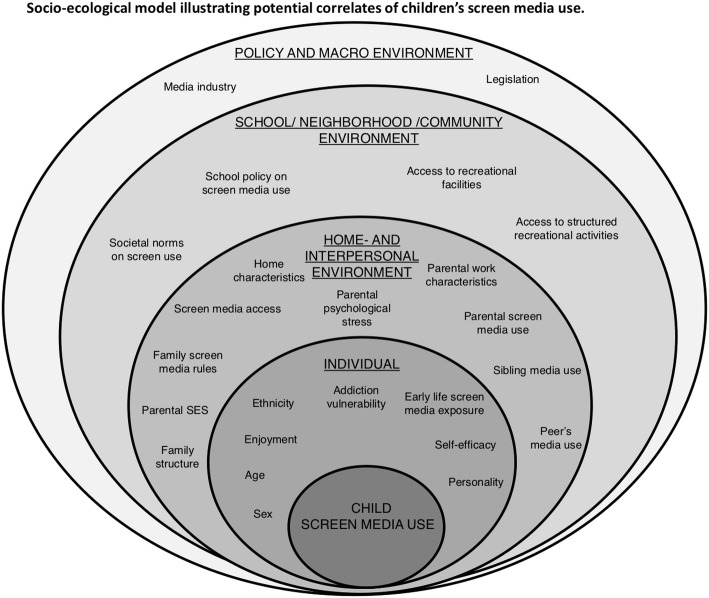
The screen-media landscape has changed drastically during the last decade with wide-scale ownership and use of new portable touchscreen-based devices plausibly causing changes in the volume of screen media use and the way children and young people entertain themselves and communicate with friends and family members. This rapid development is not sufficiently mirrored in available tools for measuring children's screen media use. The aim of this study was to develop and evaluate a parent-reported standardized questionnaire to assess 6-10-year old children's multiple screen media use and habits, their screen media environment, and its plausible proximal correlates based on a suggested socio-ecological model.
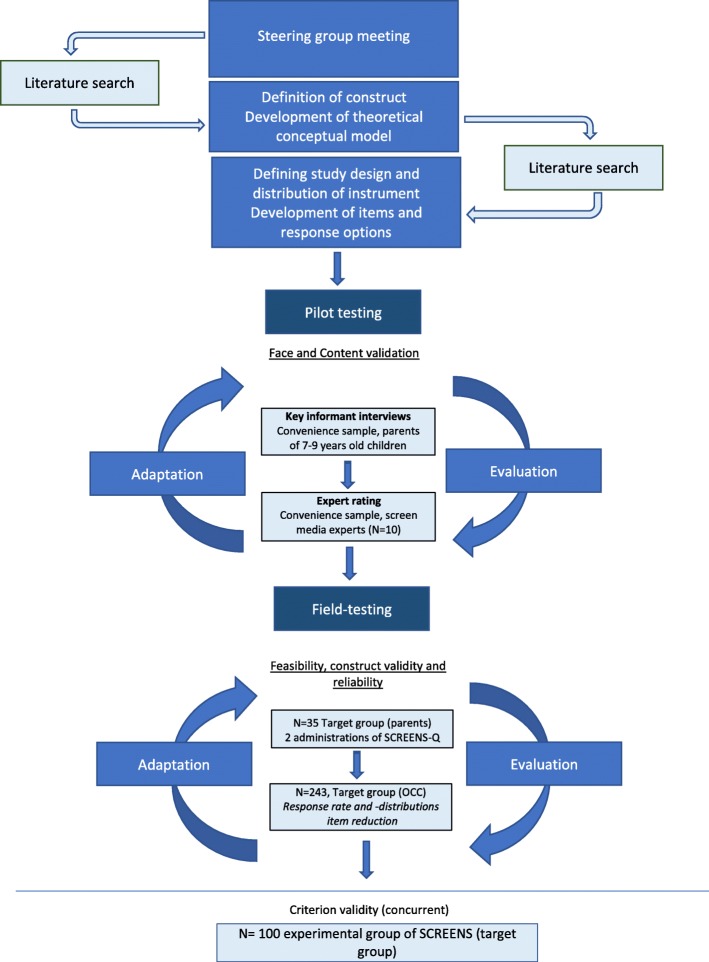
An iterative process was conducted developing the SCREENS questionnaire. Informed by the literature, media experts and end-users, a conceptual framework was made to guide the development of the questionnaire. Parents and media experts evaluated face and content validity. Pilot and field testing in the target group was conducted to assess test-retest reliability using Kappa statistics and intraclass correlation coefficients (ICC). Construct validity of relevant items was assessed using pairwise non-parametric correlations (Spearman's). The SCREENS questionnaire is based on a multidimensional and formative model.
The SCREENS questionnaire covers six domains validated to be important factors of screen media use in children and comprises 19 questions and 92 items. Test-retest reliability (n = 37 parents) for continuous variables was moderate to substantial with ICC's ranging from 0.67 to 0.90. For relevant nominal and ordinal data, kappa values were all above 0.50 with more than 80% of the values above 0.61 indicating good test-retest reliability. Internal consistency between two different time use variables (from n = 243) showed good correlations with rho ranging from 0.59 to 0.66. Response-time was within 15 min for all participants.
SCREENS-Q is a comprehensive tool to assess children's screen media habits, the screen media environment and possible related correlates. It is a feasible questionnaire with multiple validated constructs and moderate to substantial test-retest reliability of all evaluated items. The SCREENS-Q is a promising tool to investigate children screen media use.
在过去的十年中,屏幕媒体景观发生了巨大变化,新的便携式触摸屏设备得到了广泛的拥有和使用,这可能导致儿童和年轻人使用屏幕媒体的数量和方式发生变化,以及他们与朋友和家人交流的方式发生变化。这种快速发展在现有的儿童屏幕媒体使用测量工具中并没有得到充分体现。本研究旨在开发和评估一种基于建议的社会生态模型,通过父母报告的标准化问卷来评估 6-10 岁儿童的多种屏幕媒体使用和习惯、他们的屏幕媒体环境及其可能的近端相关因素。
通过迭代过程开发了 SCREENS 问卷。根据文献、媒体专家和最终用户的意见,制定了一个概念框架来指导问卷的制定。家长和媒体专家评估了表面效度和内容效度。在目标人群中进行了试点和现场测试,使用 Kappa 统计和组内相关系数(ICC)评估测试-重测信度。使用非参数相关(Spearman's)评估相关项目的结构效度。SCREENS 问卷基于一个多维和形成性模型。
SCREENS 问卷涵盖了六个经过验证的对儿童屏幕媒体使用重要的领域,包含 19 个问题和 92 个项目。对连续变量的重测信度(n=37 位家长)为中等至较高,ICC 值范围为 0.67 至 0.90。对于相关的名义和有序数据,kappa 值均高于 0.50,其中超过 80%的值高于 0.61,表明重测信度良好。来自不同时间使用变量(n=243)的两个内部一致性显示出良好的相关性,rho 值范围为 0.59 至 0.66。所有参与者的响应时间均在 15 分钟内。
SCREENS-Q 是一种全面的工具,用于评估儿童的屏幕媒体习惯、屏幕媒体环境和可能相关的因素。它是一种可行的问卷,具有多个经过验证的结构,所有评估项目的重测信度为中等至较高。SCREENS-Q 是一种很有前途的研究儿童屏幕媒体使用的工具。