Department of Dermatology, People's Hospital of Xinjiang Uygur Autonomous Region, 91 Tianchi Road, Tianshan District, Urumqi, 830001, Xinjiang, China.
Department of Spine Surgery, The First Affiliated Hospital of Xinjiang Medical University, Urumqi, 830054, Xinjiang, China.
BMC Med Genet. 2020 May 12;21(1):103. doi: 10.1186/s12881-020-01041-x.
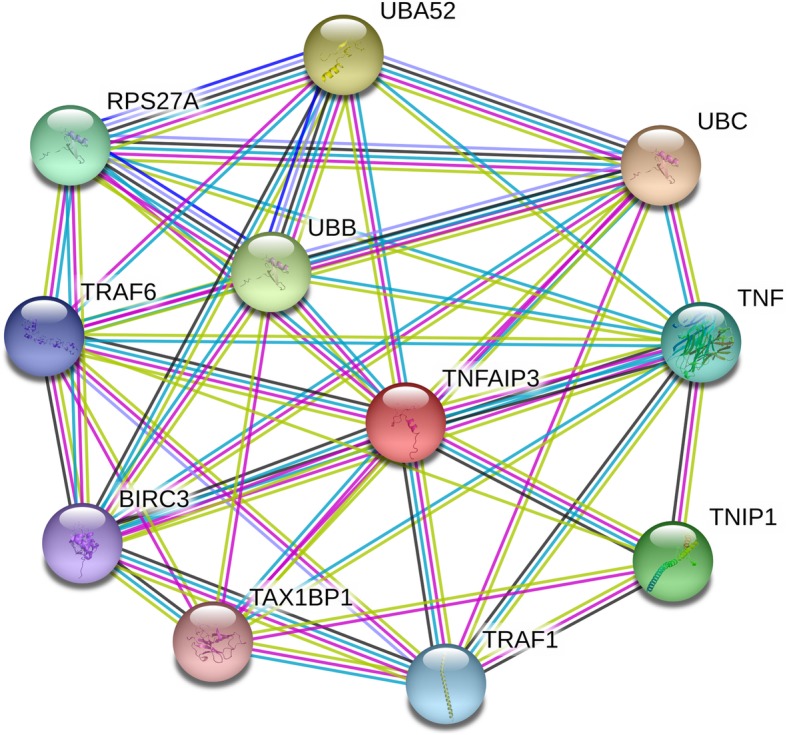
To date, the fundamental pathophysiology underlying the occurrence and progression of psoriasis are still unanswered questions. Genome-wide association surveys have revealed that TNFAIP3 and TNIP1 were key biomarkers for psoriasis. Here, we intended to conduct a survey on the association between TNFAIP3 and TNIP1 gene polymorphisms and psoriasis risk.
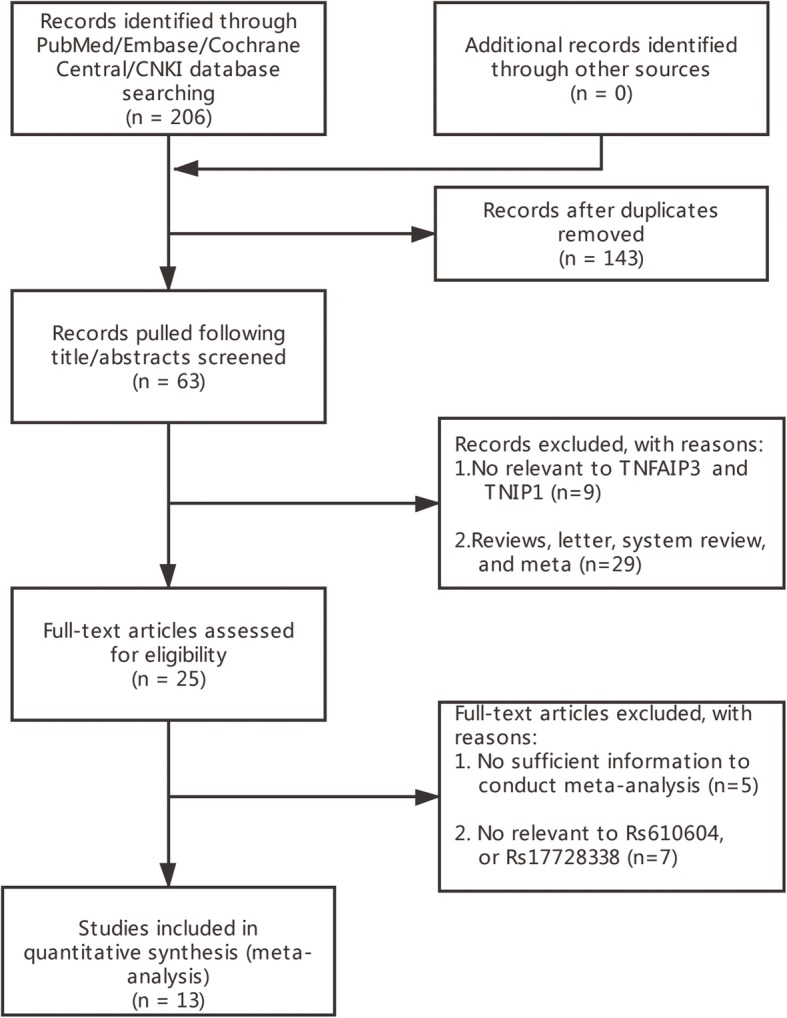
A comprehensive search of four online databases-China National Knowledge Infrastructure (CNKI), PubMed, Embase, and Cochrane Library was undertaken up to August 25, 2019. We chose allele genetic model to deal with the original data. Newcastle-Ottawa scale (NOS) was used to evaluate the risk bias of each study. The RevMan 5.3 software was used to calculate the combined odds ratio and 95% confidence interval.
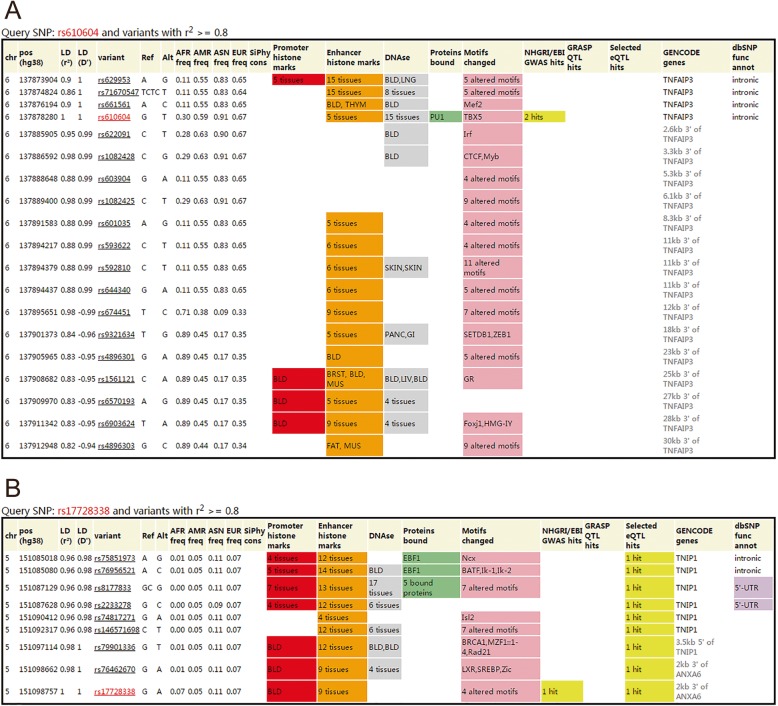
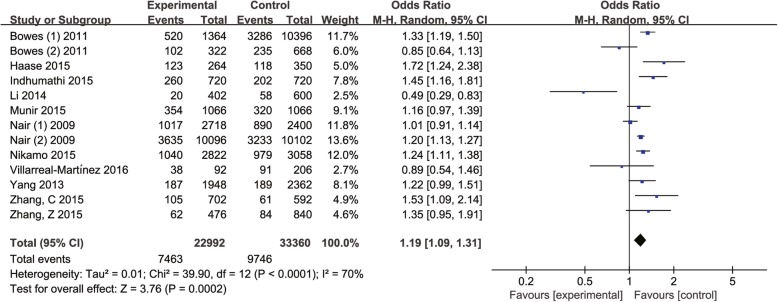
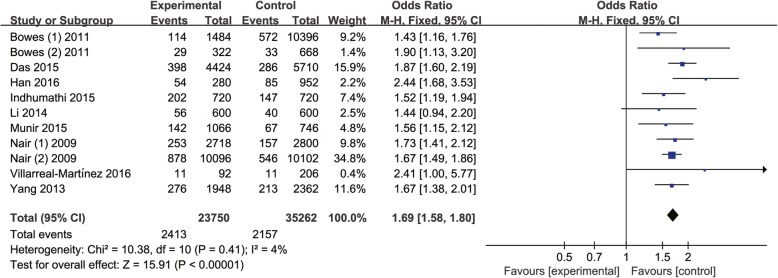
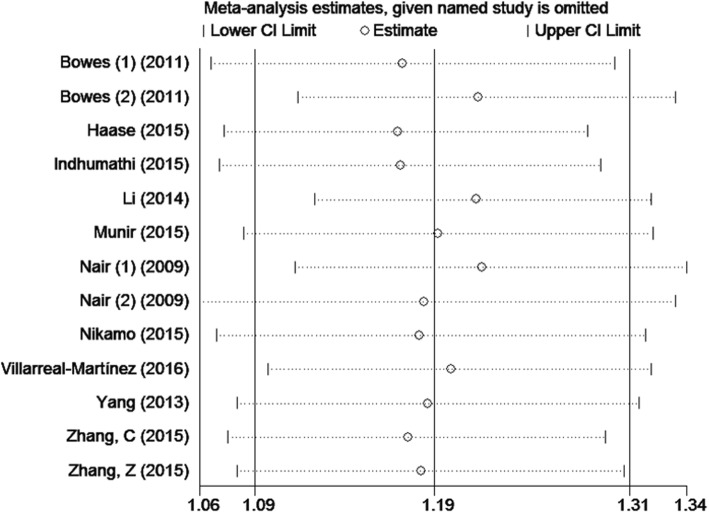
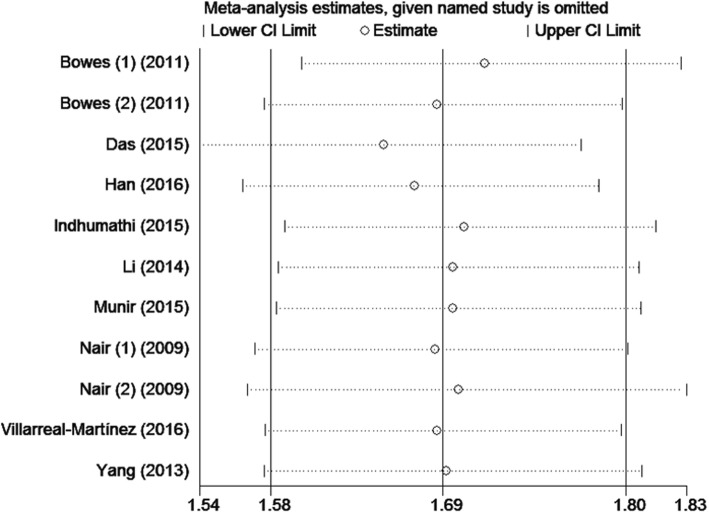
In total, we included 13 case-control studies consist of 13,908 psoriasis patients and 20,051 controls in this work. Our results demonstrated that rs610604 in TNFAIP3 polymorphism was significantly associated with psoriasis risk using random-effect model (G vs. T, OR = 1.19, 95% CI: 1.09-1.31, P = 0.0002), and a significant association between rs17728338 in TNIP1 polymorphism and psoriasis vulnerability using fixed-effect model (A vs. G, OR = 1.69, 95% CI:1.58-1.80, P < 0.00001).
Our findings indicated that rs610604 in TNFAIP3 and rs17728338 in TNIP1 gene polymorphisms were associated with psoriasis susceptibility.
迄今为止,银屑病发生和发展的基本病理生理学仍然是悬而未决的问题。全基因组关联调查显示,TNFAIP3 和 TNIP1 是银屑病的关键生物标志物。在这里,我们旨在调查 TNFAIP3 和 TNIP1 基因多态性与银屑病风险之间的关联。
我们对四个在线数据库-中国知网(CNKI)、PubMed、Embase 和 Cochrane Library 进行了全面搜索,截至 2019 年 8 月 25 日。我们选择等位基因遗传模型来处理原始数据。使用纽卡斯尔-渥太华量表(NOS)评估每个研究的风险偏倚。使用 RevMan 5.3 软件计算合并的优势比和 95%置信区间。
在这项工作中,我们共纳入了 13 项病例对照研究,包括 13908 例银屑病患者和 20051 例对照。我们的结果表明,TNFAIP3 多态性中的 rs610604 与银屑病风险显著相关,使用随机效应模型(G 与 T,OR=1.19,95%CI:1.09-1.31,P=0.0002),并且 TNIP1 多态性中的 rs17728338 与银屑病易感性之间存在显著关联,使用固定效应模型(A 与 G,OR=1.69,95%CI:1.58-1.80,P<0.00001)。
我们的研究结果表明,TNFAIP3 中的 rs610604 和 TNIP1 基因多态性中的 rs17728338 与银屑病易感性有关。