Department of Psychiatry and Biobehavioral Science, Geffen School of Medicine, University of California Los Angeles, Los Angeles, California, United States of America.
VA Greater Los Angeles Healthcare System, Los Angeles, California, United States of America.
PLoS One. 2020 May 13;15(5):e0232855. doi: 10.1371/journal.pone.0232855. eCollection 2020.
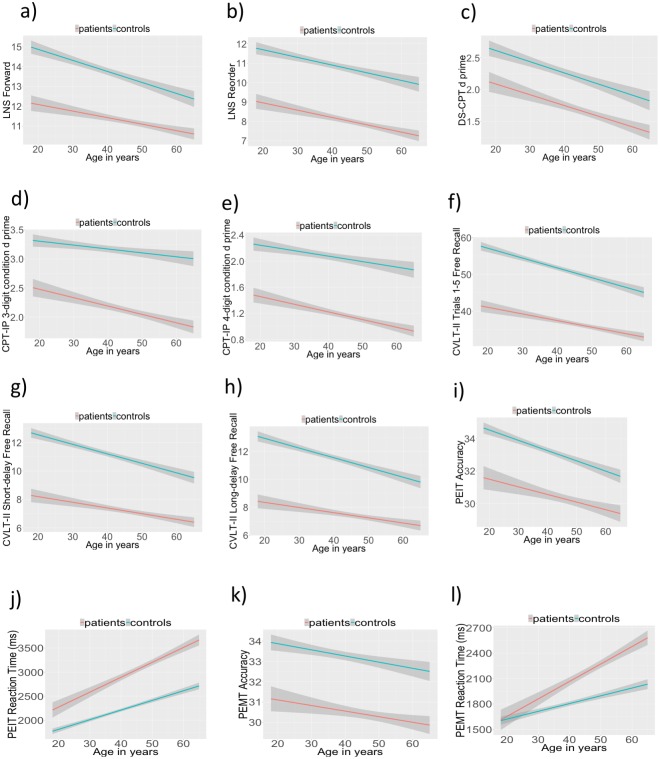
Recently emerging evidence indicates accelerated age-related changes in the structure and function of the brain in schizophrenia, raising a question about its potential consequences on cognitive function. Using a large sample of schizophrenia patients and controls and a battery of tasks across multiple cognitive domains, we examined whether patients show accelerated age-related decline in cognition and whether an age-related effect differ between females and males. We utilized data of 1,415 schizophrenia patients and 1,062 healthy community collected by the second phase of the Consortium on the Genetics of Schizophrenia (COGS-2). A battery of cognitive tasks included the Letter-Number Span Task, two forms of the Continuous Performance Test, the California Verbal Learning Test, Second Edition, the Penn Emotion Identification Test and the Penn Facial Memory Test. The effect of age and gender on cognitive performance was examined with a general linear model. We observed age-related changes on most cognitive measures, which was similar between males and females. Compared to controls, patients showed greater deterioration in performance on attention/vigilance and greater slowness of processing social information with increasing age. However, controls showed greater age-related changes in working memory and verbal memory compared to patients. Age-related changes (η2p of 0.001 to .008) were much smaller than between-group differences (η2p of 0.005 to .037). This study found that patients showed continued decline of cognition on some domains but stable impairment or even less decline on other domains with increasing age. These findings indicate that age-related changes in cognition in schizophrenia are subtle and not uniform across multiple cognitive domains.
最近出现的证据表明,精神分裂症患者大脑结构和功能的衰老速度加快,这引发了一个问题,即这是否会对认知功能产生潜在影响。本研究使用大量精神分裂症患者和对照者样本以及一系列跨认知领域的任务,考察了患者是否表现出认知功能随年龄增长的加速衰退,以及这种年龄相关效应是否在女性和男性中存在差异。我们利用精神分裂症遗传学联合会(COGS-2)第二阶段收集的 1415 名精神分裂症患者和 1062 名健康对照者的数据。认知任务包括字母数字跨度任务、两种连续性能测试形式、加利福尼亚语言学习测试修订版、宾夕法尼亚情绪识别测试和宾夕法尼亚面孔记忆测试。采用一般线性模型考察年龄和性别对认知表现的影响。我们观察到大多数认知测量指标都随年龄变化,且男性和女性之间的变化相似。与对照组相比,患者随着年龄的增长,在注意力/警觉性方面的表现恶化更明显,处理社会信息的速度更慢。然而,与患者相比,对照组的工作记忆和言语记忆随年龄的变化更大。年龄相关的变化(η2p 为 0.001 至 0.008)远小于组间差异(η2p 为 0.005 至 0.037)。本研究发现,患者在某些领域的认知功能持续下降,但在其他领域的认知功能稳定受损甚至下降幅度较小。这些发现表明,精神分裂症患者的认知衰老变化是微妙的,并且在多个认知领域并不均匀。