Department of Hygiene and Public Health, Nippon Medical School, 1-1-5 Sendagi, Bunkyo-ku, Tokyo, 113-8602, Japan.
Public Health, Department of Social Medicine, Osaka University Graduate School of Medicine, 2-2 Yamadaoka, Suita, Osaka, 565-0871, Japan.
BMC Public Health. 2020 May 13;20(1):677. doi: 10.1186/s12889-020-08764-9.
While the prevalence of post-disaster musculoskeletal pain has been documented, its associated disaster-related factors have not been investigated. This study was to investigate the association of lifestyle factors associated with musculoskeletal pain after the Great East Japan Earthquake.
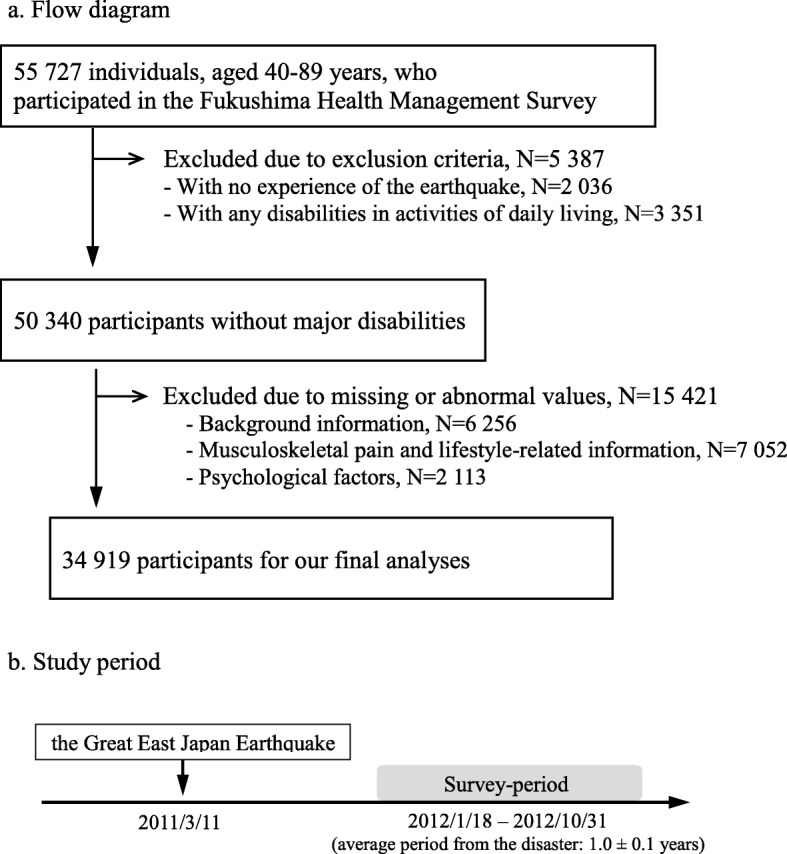
We conducted a cross-sectional study of 34,919 participants, aged 40-89 years, without any major disabilities at about 1 year after the disaster. The participants were asked about their musculoskeletal pain (low back and limb pain) and lifestyle factors: use of evacuation shelters or temporary housing at any point of time, job loss after the disaster, decreased income after the disaster, current smoking status, current drinking status, lack of sleep, regular exercise, and participation in recreational or community activities. Furthermore, psychological factors, such as traumatic reactions, psychological distress, and uncomfortable symptoms, affecting musculoskeletal pain were assessed. We used multinomial logistic regression analysis to calculate odds ratios of each lifestyle factor for prevalent and prevalent plus exacerbated musculoskeletal pain.
Musculoskeletal pain prevalence was 32.8%: 27.6% for prevalent and 5.2% for prevalent plus exacerbated musculoskeletal pain. Multivariable adjusted odds ratios and 95% confidence intervals of lifestyle factors associated with prevalent and prevalent plus exacerbated musculoskeletal pain were as follows: shelter use (prevalent: 1.02, 0.96-1.08; exacerbated: 1.44, 1.29-1.60), job loss (prevalent: 1.03, 0.96-1.10; exacerbated: 1.30, 1.16-1.47), decreased income (prevalent: 1.13, 1.05-1.21; exacerbated: 1.29, 1.14-1.45), current heavy drinking (prevalent: 1.33, 1.21-1.47; exacerbated: 1.38, 1.14-1.68), insomnia (prevalent: 1.22, 1.15-1.29; exacerbated: 1.50, 1.36-1.65), exercising almost daily (prevalent: 0.83, 0.77-0.91; exacerbated: 0.80, 0.68-0.95), and participating in community activities often (prevalent: 0.83, 0.75-0.92; exacerbated: 0.76, 0.61-0.95).
Prevalent and exacerbated musculoskeletal pain were inversely associated with exercising almost daily and participating in recreational or community activities sometimes or often, and positively associated with decreased income, current heavy drinking, and insomnia. Besides, the use of evacuation shelters or temporary housing/job loss was positively associated only with exacerbated musculoskeletal pain. These results suggest that post-disaster lifestyle factors are potentially associated with musculoskeletal pain. To achieve better post-disaster pain management, further studies are needed to confirm the consistency of these results in other disasters and to highlight the underlying causative mechanisms.
尽管已经记录了灾后肌肉骨骼疼痛的流行情况,但与之相关的灾害相关因素尚未得到调查。本研究旨在调查与东日本大地震后肌肉骨骼疼痛相关的生活方式因素。
我们对 34919 名年龄在 40-89 岁、无任何重大残疾的参与者进行了横断面研究,这些参与者在灾难发生约 1 年后接受了调查。参与者被问及他们的肌肉骨骼疼痛(下背部和四肢疼痛)和生活方式因素:是否在任何时候使用过疏散避难所或临时住所、灾难后失业、灾难后收入减少、当前吸烟状况、当前饮酒状况、睡眠不足、定期锻炼以及参与娱乐或社区活动。此外,还评估了影响肌肉骨骼疼痛的心理因素,如创伤反应、心理困扰和不适症状。我们使用多变量逻辑回归分析计算了每个生活方式因素与普遍存在和加重的肌肉骨骼疼痛的优势比。
肌肉骨骼疼痛的患病率为 32.8%:27.6%为普遍存在,5.2%为加重。多变量调整后的生活方式因素与普遍存在和加重的肌肉骨骼疼痛相关的优势比和 95%置信区间如下:避难所使用(普遍存在:1.02,0.96-1.08;加重:1.44,1.29-1.60)、失业(普遍存在:1.03,0.96-1.10;加重:1.30,1.16-1.47)、收入减少(普遍存在:1.13,1.05-1.21;加重:1.29,1.14-1.45)、当前重度饮酒(普遍存在:1.33,1.21-1.47;加重:1.38,1.14-1.68)、失眠(普遍存在:1.22,1.15-1.29;加重:1.50,1.36-1.65)、几乎每天锻炼(普遍存在:0.83,0.77-0.91;加重:0.80,0.68-0.95)和经常参加社区活动(普遍存在:0.83,0.75-0.92;加重:0.76,0.61-0.95)。
普遍存在和加重的肌肉骨骼疼痛与几乎每天锻炼和偶尔或经常参加娱乐或社区活动呈负相关,与收入减少、当前重度饮酒和失眠呈正相关。此外,使用疏散避难所或临时住所/失业仅与加重的肌肉骨骼疼痛呈正相关。这些结果表明,灾后生活方式因素可能与肌肉骨骼疼痛有关。为了实现更好的灾后疼痛管理,需要进一步的研究来确认这些结果在其他灾害中的一致性,并强调潜在的因果机制。