Endocrinology, Diabetology & Nutrition, CHRU of Nancy, Brabois Hospital, Lorraine University, 54500, Vandoeuvre-lès-Nancy, France.
Endocrinology, Metabolic Diseases and Nutrition Department, Assistance Publique Hôpitaux de Marseille, Marseille, France.
Cardiovasc Diabetol. 2020 May 13;19(1):65. doi: 10.1186/s12933-020-01034-3.
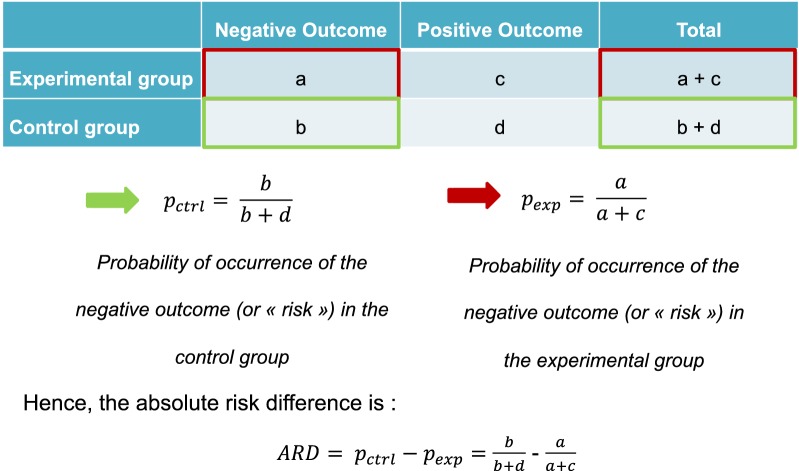
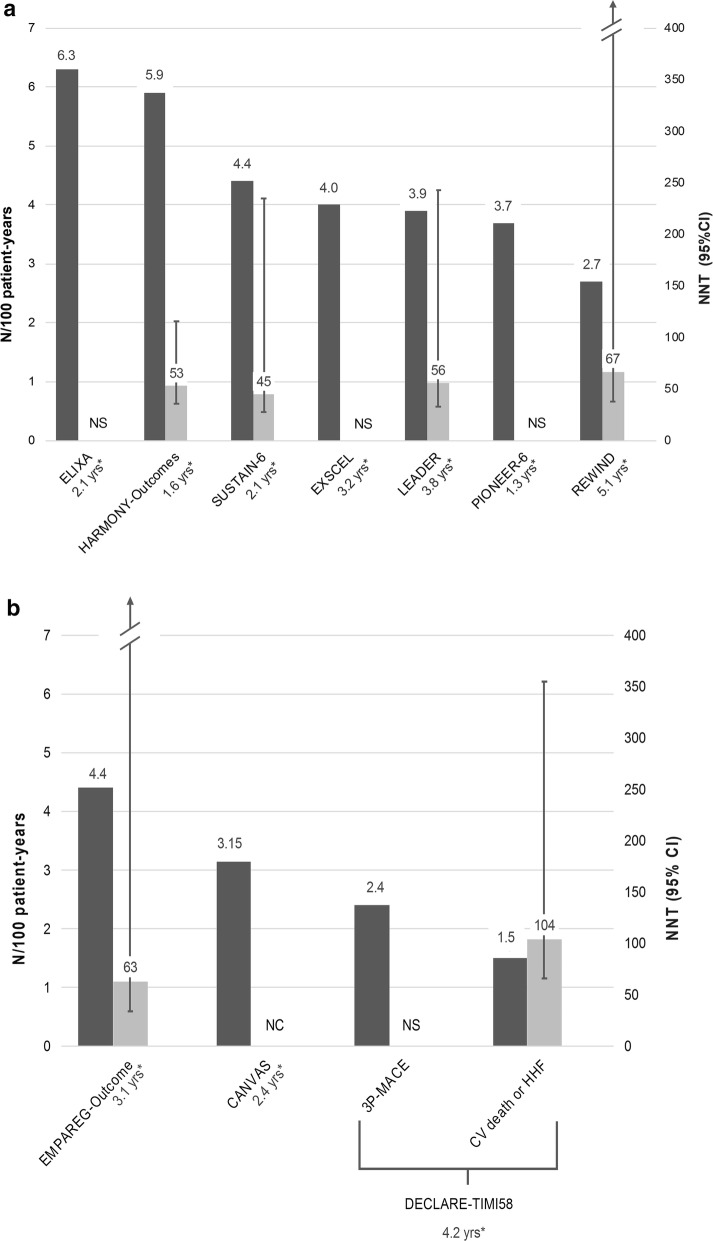
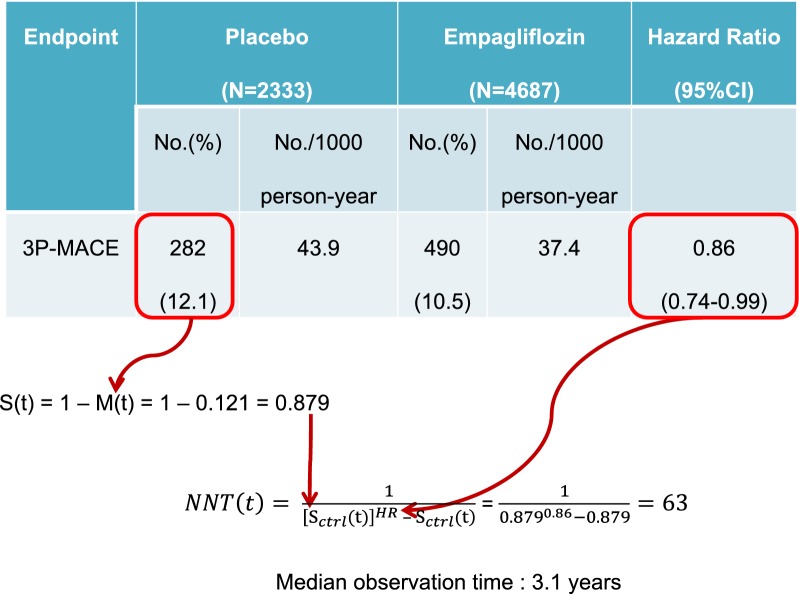
The recent results of Cardiovascular Outcomes Trials (CVOTs) in type 2 diabetes have clearly established the cardiovascular (CV) safety or even the benefit of two therapeutic classes, Glucagon-Like Peptide-1 receptor agonists (GLP-1 RA) and Sodium-Glucose Co-Transporter-2 inhibitors (SGLT-2i). Publication of the latest CVOTs for these therapeutic classes also led to an update of ESC guidelines and ADA/EASD consensus report in 2019, which considers using GLP-1 RA or SGLT-2i with proven cardiovascular benefit early in the management of type 2 diabetic patient with established cardiovascular disease (CVD) or at high risk of atherosclerotic CVD. The main beneficial results of these time-to event studies are supported by conventional statistical measures attesting the effectiveness of GLP-1 RA or SGLT2i on cardiovascular events (absolute risk, absolute risk difference, relative risk, relative risk reduction, odds ratio, hazard ratio). In addition, another measure whose clinical meaning appears to be easier, the Number Needed to Treat (NNT), is often mentioned while discussing the results of CVOTs, in order to estimating the clinical utility of each drug or sometimes trying to establish a power ranking. While the value of the measure is admittedly of interest, the subtleties of its computation in time-to-event studies are little known. We provide in this article a clear and practical explanation on NNT computation methods that should be used in order to estimate its value, according to the type of study design and variables available to describe the event of interest, in any randomized controlled trial. More specifically, a focus is made on time-to-event studies of which CVOTs are part, first to describe in detail an appropriate and adjusted method of NNT computation and second to help properly interpreting NNTs with the example of CVOTs conducted with GLP-1 RA and SGLT-2i. We particularly discuss the risk of misunderstanding of NNT values in CVOTs when some specific parameters inherent in each study are not taken into account, and the following risk of erroneous comparison between NNTs across studies. The present paper highlights the importance of understanding rightfully NNTs from CVOTs and their clinical impact to get the full picture of a drug's effectiveness.
最近 2 型糖尿病心血管结局试验(CVOT)的结果明确确立了两类治疗药物的心血管(CV)安全性,甚至获益,即胰高血糖素样肽-1 受体激动剂(GLP-1RA)和钠-葡萄糖共转运蛋白 2 抑制剂(SGLT-2i)。这些治疗类别的最新 CVOT 结果的公布也导致了 2019 年 ESC 指南和 ADA/EASD 共识报告的更新,该报告考虑在患有已确诊心血管疾病(CVD)或存在动脉粥样硬化性 CVD 高风险的 2 型糖尿病患者的早期管理中使用具有心血管获益证据的 GLP-1RA 或 SGLT-2i。这些时间事件研究的主要有益结果得到了常规统计措施的支持,这些措施证明了 GLP-1RA 或 SGLT2i 对心血管事件的有效性(绝对风险、绝对风险差异、相对风险、相对风险降低、优势比、风险比)。此外,另一种衡量标准,即需要治疗的人数(NNT),在讨论 CVOT 结果时经常被提及,以便估计每种药物的临床实用性,或者有时试图建立一种效力排名。虽然该衡量标准的价值确实很重要,但很少有人了解其在时间事件研究中的计算细节。我们在本文中提供了一个清晰而实用的解释,说明如何根据研究设计类型和可用于描述感兴趣事件的变量,在任何随机对照试验中使用 NNT 计算方法来估计其值。更具体地说,我们将重点放在 CVOT 所属的时间事件研究上,首先详细描述一种适当的调整后的 NNT 计算方法,其次通过 GLP-1RA 和 SGLT-2i 进行的 CVOT 示例来帮助正确解释 NNTs。我们特别讨论了当未考虑到每个研究中固有的一些特定参数时,CVOT 中 NNT 值可能会产生误解的风险,以及在不同研究之间错误比较 NNTs 的风险。本文强调了正确理解来自 CVOT 的 NNTs 及其对药物有效性的临床影响的重要性,以便全面了解药物的疗效。