Department of Medicine, University of Alabama at Birmingham School of Medicine, Birmingham.
Department of Medicine, Louisiana State University Health Sciences Center, New Orleans.
JAMA Netw Open. 2020 May 1;3(5):e204819. doi: 10.1001/jamanetworkopen.2020.4819.
Rates of chlamydial and gonococcal infection continue to increase in the United States, as do the associated costs of untreated infections. Improved diagnostic technologies that support testing and treating in 1 clinical visit are critical to advancing efforts to control the rates of chlamydial and gonococcal infection.
To evaluate the clinical performance of a point-of-care (POC) molecular diagnostic assay for the detection of chlamydia and gonorrhea.
DESIGN, SETTING, AND PARTICIPANTS: A noninterventional, cross-sectional clinical study was conducted from September 18, 2018, through March 13, 2019, at sexually transmitted infection (STI), HIV, family planning, and obstetrics and gynecology clinics where STI screening is routine, using a convenience sample and comparing commercially available assays with a new 30-minute POC assay. Patients included were those eligible for STI screening or diagnostic testing who had not taken antibiotics effective against chlamydia or gonorrhea within the previous 28 days. Four vaginal swab samples were collected from women and a first-catch urine sample was obtained from men.
A composite infection status was used to classify participants as infected if 2 or more comparator results were positive, as not infected if 2 or more comparator samples were negative, and as unevaluable if 1 result was invalid and the other 2 results did not agree with each other.
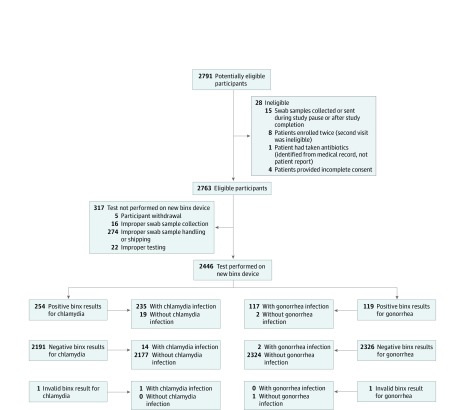
Swab samples from 1523 women (median age, 27 years [interquartile range, 17-37 years]), 817 (53.6%) of whom presented with symptoms, and 922 men (median age, 29 years [interquartile range, 17-41 years]), 308 (33.4%) of whom were symptomatic, were tested. For chlamydia, sensitivity of the new POC assay was 96.1% (95% CI, 91.2%-98.3%) for women and 92.5% (95% CI, 86.4%-96.0%) for men. For gonorrhea, sensitivity estimates were 100.0% (95% CI, 92.1%-100.0%) for women and 97.3% (95% CI, 90.7%-99.3%) for men. For chlamydia, specificity of the new POC assay was 99.1% (95% CI, 98.4%-99.5%) for women and 99.3% (95% CI, 98.4%-99.7%) for men. For gonorrhea, specificity estimates were 99.9% (95% CI, 99.5%-100%) for women and 100% (95% CI, 95.5%-100%) for men. Non-laboratory-trained personnel performed 94.8% of all tests (2318 of 2445) during the study.
This study suggests that self-obtained vaginal swab samples were associated with performance equivalent to laboratory-based molecular diagnostics, which can support use of this POC assay in many settings. The availability of an easy-to-use, rapid (30-minute) molecular test for accurate detection of chlamydia and gonorrhea has the power to facilitate testing and treatment in a single patient visit for these STIs.
在美国,衣原体和淋病的感染率继续上升,未治疗感染的相关费用也在增加。支持在一次就诊中进行检测和治疗的改进诊断技术对于控制衣原体和淋病的感染率至关重要。
评估一种即时检测(POC)分子诊断检测方法用于检测沙眼衣原体和淋病的临床性能。
设计、地点和参与者:这是一项非干预性、横断面临床研究,于 2018 年 9 月 18 日至 2019 年 3 月 13 日期间在美国性传播感染(STI)、艾滋病毒、计划生育和妇产科诊所进行,使用便利样本,通过比较商业上可用的检测方法与新的 30 分钟 POC 检测方法,评估该方法的临床性能。纳入的患者是那些符合 STI 筛查或诊断检测标准的患者,并且在过去 28 天内没有服用过针对衣原体或淋病的有效抗生素。从女性采集 4 个阴道拭子样本,从男性采集首次尿液样本。
使用复合感染状态将参与者分类为如果 2 个或更多比较器结果为阳性则为感染,如果 2 个或更多比较器样本为阴性则为未感染,如果 1 个结果无效且其他 2 个结果不一致,则为无法评估。
对 1523 名女性(中位年龄 27 岁[四分位距 17-37 岁])和 922 名男性(中位年龄 29 岁[四分位距 17-41 岁])的阴道拭子样本进行了检测,其中 817 名女性(53.6%)有症状,308 名男性(33.4%)有症状。对于沙眼衣原体,新的 POC 检测方法的敏感性为女性 96.1%(95%CI,91.2%-98.3%),男性 92.5%(95%CI,86.4%-96.0%)。对于淋病,女性敏感性估计值为 100.0%(95%CI,92.1%-100.0%),男性为 97.3%(95%CI,90.7%-99.3%)。对于沙眼衣原体,新的 POC 检测方法的特异性为女性 99.1%(95%CI,98.4%-99.5%),男性 99.3%(95%CI,98.4%-99.7%)。对于淋病,特异性估计值为女性 99.9%(95%CI,99.5%-100%),男性 100%(95%CI,95.5%-100%)。在研究期间,非实验室培训人员进行了 94.8%(2445 次中的 2318 次)的所有检测。
本研究表明,自我采集的阴道拭子样本与基于实验室的分子诊断相当,这可以支持在许多环境中使用这种 POC 检测方法。一种易于使用、快速(30 分钟)的分子检测方法,可准确检测沙眼衣原体和淋病,这为这些 STI 的单次就诊中进行检测和治疗提供了便利。
