
衣原体和淋病筛查中自我采集与临床医生采集样本的比较:一项系统评价与荟萃分析
Self-Collected versus Clinician-Collected Sampling for Chlamydia and Gonorrhea Screening: A Systemic Review and Meta-Analysis.
作者信息
Lunny Carole, Taylor Darlene, Hoang Linda, Wong Tom, Gilbert Mark, Lester Richard, Krajden Mel, Ogilvie Gina
机构信息
Division of STI/HIV Prevention and Control, BC Centre for Disease Control, Vancouver, British Columbia, Canada; University of British Columbia, Vancouver, British Columbia, Canada; Australasian Cochrane Centre, Monash University, Melbourne, Australia.
Division of STI/HIV Prevention and Control, BC Centre for Disease Control, Vancouver, British Columbia, Canada; University of British Columbia, Vancouver, British Columbia, Canada.
出版信息
PLoS One. 2015 Jul 13;10(7):e0132776. doi: 10.1371/journal.pone.0132776. eCollection 2015.
BACKGROUND
The increases in STI rates since the late 1990s in Canada have occurred despite widespread primary care and targeted public health programs and in the setting of universal health care. More innovative interventions are required that would eliminate barriers to STI testing such as internet-based or mail-in home and community service testing for patients that are hard to reach, who refuse to go for clinician-based testing, or who decline an examination. Jurisdictions such as New Zealand and some American states currently use self-collected sampling, but without the required evidence to determine whether self-collected specimens are as accurate as clinician-collected specimens in terms of chlamydia and gonorrhea diagnostic accuracy. The objective of the review is to compare self-collected vaginal, urine, pharyngeal and rectal samples to our reference standard - clinician-collected cervical, urethral, pharyngeal and rectal sampling techniques to identify a positive specimen using nucleic acid amplification test assays.
METHODS
The hierarchical summary receiver operating characteristic and the fixed effect models were used to assess the accuracy of comparable specimens that were collected by patients compared to clinicians. Sensitivity and specificity estimates with 95% confidence intervals (CI) were reported as our main outcome measures.
FINDINGS
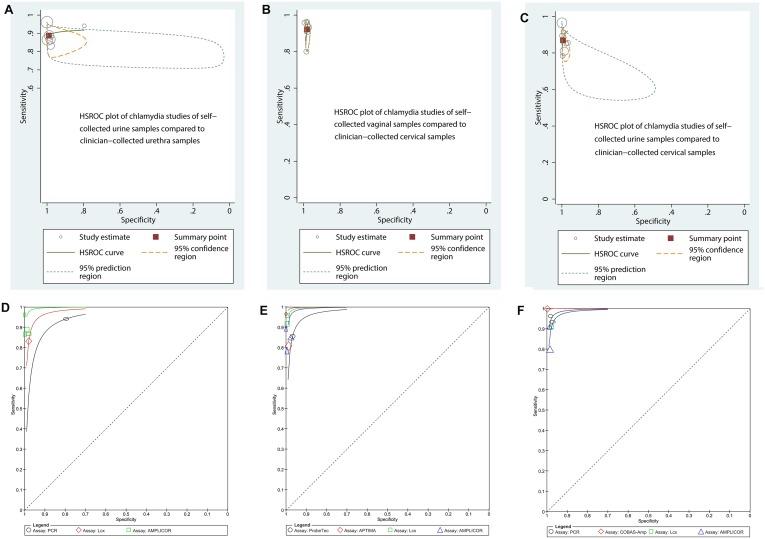
We included 21 studies based on over 6100 paired samples. Fourteen included studies examined chlamydia only, 6 compared both gonorrhea and chlamydia separately in the same study, and one examined gonorrhea. The six chlamydia studies comparing self-collection by vaginal swab to a clinician-collected cervical swab had the highest sensitivity (92%, 95% CI 87-95) and specificity (98%, 95% CI 97-99), compared to other specimen-types (urine/urethra or urine/cervix). Six studies compared urine self-samples to urethra clinician-collected samples in males and produced a sensitivity of 88% (95% CI 83-93) and a specificity of 99% (95% CI 0.94-0.99). Taking into account that urine samples may be less sensitive than cervical samples, eight chlamydia studies that compared urine self-collected verses clinician-collected cervical samples had a sensitivity of 87% (95% CI 81-91) and high specificity of 99% (95% CI 0.98-1.00). For gonorrhea testing, self-collected urine samples compared to clinician-collected urethra samples in males produced a sensitivity of 92% (95% CI 83-97) and specificity of 99% (95% CI 0.98-1.00).
CONCLUSION
The sensitivity and specificity of vaginal self-collected swabs compared to swabs collected by clinicians supports the use of vaginal swab as the recommended specimen of choice in home-based screening for chlamydia and gonorrhea. Urine samples for gonorrhea collected by men had comparably high sensitivity and specificity, so could be recommended as they can be left at room temperature for several days, allowing for the possibility of mail-in home-based testing. In populations that may not go for testing at all, do not have the option of clinical testing, or who refuse a clinical examination, self-collected screening would be a good alternative. We recommend that guidelines on how to self-collect gonorrhea and chlamydia urine, vaginal, rectal and pharyngeal specimens be published.
背景
自20世纪90年代末以来,尽管加拿大开展了广泛的初级保健和针对性的公共卫生项目,且处于全民医疗保健的环境中,但性传播感染(STI)发病率仍在上升。需要更具创新性的干预措施,以消除STI检测的障碍,例如为难以接触到的患者、拒绝接受基于临床医生的检测或拒绝检查的患者提供基于互联网或邮寄到家及社区服务的检测。新西兰和美国的一些州等司法管辖区目前使用自我采集样本,但缺乏确定自我采集的样本在衣原体和淋病诊断准确性方面是否与临床医生采集的样本一样准确所需的证据。本综述的目的是将自我采集的阴道、尿液、咽部和直肠样本与我们的参考标准——临床医生采集的宫颈、尿道、咽部和直肠采样技术进行比较,以使用核酸扩增检测法识别阳性样本。
方法
采用分层汇总接受者操作特征和固定效应模型来评估患者采集的可比样本与临床医生采集的样本的准确性。报告敏感性和特异性估计值及95%置信区间(CI)作为我们的主要结局指标。
结果
我们纳入了基于6100多对样本的21项研究。14项纳入研究仅检测衣原体,6项在同一研究中分别比较了淋病和衣原体,1项检测了淋病。与其他样本类型(尿液/尿道或尿液/宫颈)相比,6项将阴道拭子自我采集与临床医生采集的宫颈拭子进行比较的衣原体研究具有最高的敏感性(92%,95%CI 87 - 95)和特异性(98%,95%CI 97 - 99)。6项研究比较了男性尿液自我样本与临床医生采集的尿道样本,敏感性为88%(95%CI 83 - 93),特异性为99%(95%CI 0.94 - 0.99)。考虑到尿液样本可能比宫颈样本敏感性低,8项比较尿液自我采集与临床医生采集的宫颈样本的衣原体研究,敏感性为87%(95%CI 81 - 91),特异性高达99%(95%CI 0.98 - 1.00)。对于淋病检测,男性自我采集的尿液样本与临床医生采集的尿道样本相比,敏感性为92%(95%CI 83 - 97),特异性为99%(95%CI 0.98 - 1.00)。
结论
与临床医生采集的拭子相比,阴道自我采集拭子的敏感性和特异性支持将阴道拭子作为家庭衣原体和淋病筛查的推荐首选样本。男性采集的淋病尿液样本具有相当高的敏感性和特异性,由于其可在室温下放置数天,可考虑邮寄到家进行检测,因此可推荐使用。对于那些根本不会去检测、没有临床检测选择或拒绝临床检查的人群,自我采集筛查将是一个很好的选择。我们建议发布关于如何自我采集淋病和衣原体尿液、阴道、直肠和咽部样本的指南。




 Zotero 插件