Department of Geriatric Medicine, Marien Hospital Herne, Ruhr-Universität Bochum, 44625 Bochum, Germany.
Department of Radiology, Marien Hospital Herne, Ruhr-Universität Bochum, 44625 Bochum, Germany.
Nutrients. 2020 May 12;12(5):1387. doi: 10.3390/nu12051387.
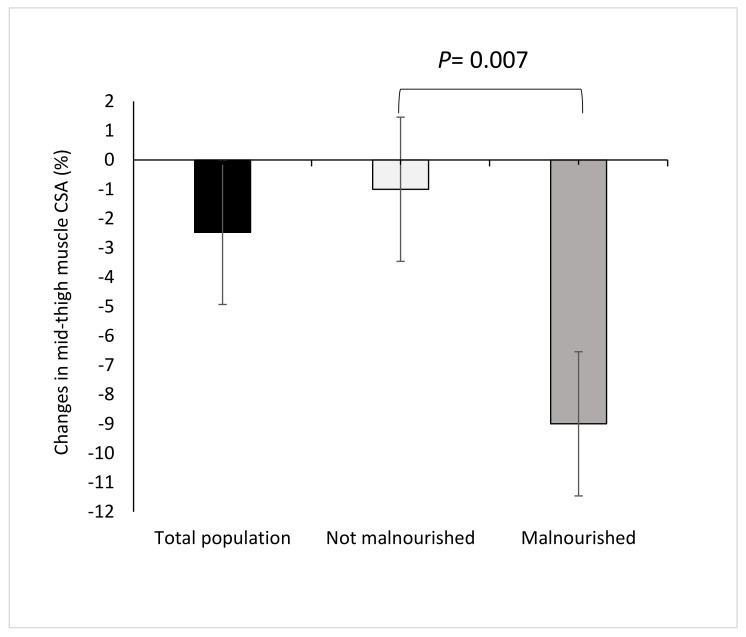
Very little is known about the effect of malnutrition on short-term changes of body composition, particularly muscle, among older hospitalized patients. We sought to investigate the association of malnutrition as assessed by the Global Leadership Initiative on Malnutrition (GLIM) criteria with changes of thigh muscle mass and muscle strength among older patients during hospitalization. Forty-one patients (age range 66-97 years, 73% female) participated in this prospective longitudinal observational study. Nutritional status was evaluated using the GLIM criteria on admission and at discharge. Functional status and mid-thigh magnetic resonance imaging (MRI) measurements of cross-sectional area (CSA) were conducted on admission and before discharge. In all, 17% were malnourished and 83% had no malnutrition. Mean mid-thigh muscle CSA declined by 7.0 cm (-9%) in malnourished patients during hospitalization ( = 0.008) and remained unchanged among non-malnourished patients (-1%, = 0.390). Mean mid-thigh CSA of subcutaneous and intermuscular fat did not change significantly during hospitalization in both groups. Malnourished subjects lost 10% of handgrip strength (-1.8 kg) and 12% of knee extension strength (-1.5 kg) during hospitalization. However, the magnitude of both changes did not differ between groups. In a stepwise multiple regression analysis, malnutrition and changes in body weight during hospitalization were the major independent risk factors for the reduction of muscle CSA. Malnutrition according to the GLIM criteria was significantly and independently associated with acute muscle wasting in frail older patients during 2-week hospitalization.
关于营养不良对住院老年患者身体成分(尤其是肌肉)短期变化的影响,人们知之甚少。我们旨在研究全球营养不良领导倡议(GLIM)标准评估的营养不良与住院期间老年患者大腿肌肉质量和肌肉力量变化之间的相关性。41 名患者(年龄 66-97 岁,73%为女性)参与了这项前瞻性纵向观察研究。入院时和出院时使用 GLIM 标准评估营养状况。入院时和出院前进行功能状态和大腿中段磁共振成像(MRI)横截面积(CSA)测量。总共有 17%的患者存在营养不良,83%的患者没有营养不良。在住院期间,营养不良患者的大腿中段肌肉 CSA 平均减少 7.0cm(-9%)( = 0.008),而非营养不良患者的 CSA 没有变化(-1%, = 0.390)。两组患者的大腿中段皮下和肌间脂肪 CSA 在住院期间均无明显变化。营养不良患者在住院期间手掌握力下降 10%(-1.8kg),膝关节伸展力量下降 12%(-1.5kg)。然而,两组之间这些变化的幅度没有差异。在逐步多元回归分析中,营养不良和住院期间体重变化是 CSA 减少的主要独立危险因素。根据 GLIM 标准评估的营养不良与虚弱老年患者在 2 周住院期间的急性肌肉消耗显著且独立相关。