Department of Obstetrics and Gynecology, University of Helsinki, Helsinki University Hospital, Haartmaninkatu 2, 00029 HUS, Helsinki, Finland.
National Institute for Health and Welfare (THL), Helsinki, Finland.
Arch Gynecol Obstet. 2020 Jul;302(1):85-91. doi: 10.1007/s00404-020-05575-6. Epub 2020 May 14.
To determine whether there is an association between term cesarean breech delivery in the first pregnancy and maternal and neonatal morbidities in the subsequent pregnancy and delivery.
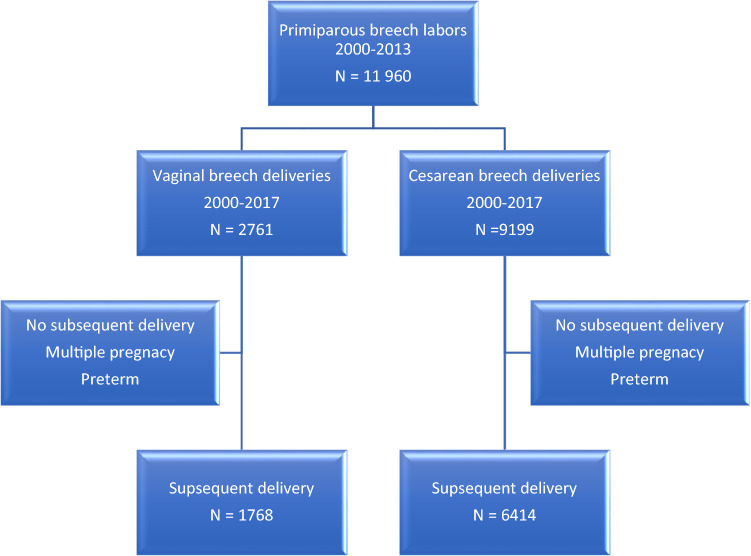
We conducted a retrospective, nationwide Finnish population-based cohort study, including all deliveries from January 2000 to December 2017. We included all women with the first two consecutive singleton deliveries of which the first one was a breech delivery regardless of mode of delivery (n = 11,953), and constructed a data set in which the first two deliveries for these women were connected. The outcomes of the second delivery of the women with a first pregnancy that resulted in cesarean breech delivery at term were compared with women whose first pregnancy resulted in a vaginal breech delivery at term. P-value, odds ratio, and adjusted odds ratio were calculated.
Neonates of a subsequent delivery after cesarean breech delivery had an increased risk for arterial umbilical cord pH below seven, a higher rate of a 5 min APGAR score < 7 and a higher rate of neonatal intensive care unit admission. The women with a history of cesarean section with the fetus in breech presentation were more often in need of a blood transfusion and suffered more often a uterus rupture. In this group, the second delivery was more often a planned cesarean section, an emergency cesarean section, or an instrumental vaginal delivery.
Primary cesarean breech section in the first pregnancy is associated with adverse neonatal and maternal outcomes in the subsequent delivery.
确定首次妊娠足月剖宫产分娩与后续妊娠和分娩时母婴发病率之间是否存在关联。
我们进行了一项回顾性、全国性的芬兰人群队列研究,纳入了 2000 年 1 月至 2017 年 12 月期间所有的分娩病例。我们纳入了所有首次分娩为臀位且无论分娩方式如何(n=11953)的连续两次单胎妊娠的女性,并构建了一个数据集,其中这些女性的前两次分娩被连接起来。将首次妊娠足月剖宫产分娩的女性的第二次分娩结局与首次妊娠足月阴道分娩的女性进行比较。计算 P 值、比值比和调整后的比值比。
与首次足月阴道分娩的女性相比,首次妊娠足月剖宫产分娩的女性其随后分娩的新生儿脐动脉血 pH 值低于 7 的风险增加,5 分钟 APGAR 评分<7 的发生率更高,需要入住新生儿重症监护病房的比例更高。有剖宫产史且胎儿为臀位的女性更常需要输血,且更常发生子宫破裂。在这组女性中,第二次分娩更常为计划性剖宫产、紧急剖宫产或器械性阴道分娩。
首次妊娠足月剖宫产分娩与后续妊娠时母婴不良结局相关。