Department of Molecular Microbiology, National Medicines Institute, Chełmska 30/34, 00-725, Warsaw, Poland.
Department of Epidemiology and Clinical Microbiology, National Medicines Institute, Chełmska 30/34, 00-725, Warsaw, Poland.
Eur J Clin Microbiol Infect Dis. 2020 Oct;39(10):1865-1878. doi: 10.1007/s10096-020-03916-6. Epub 2020 May 14.
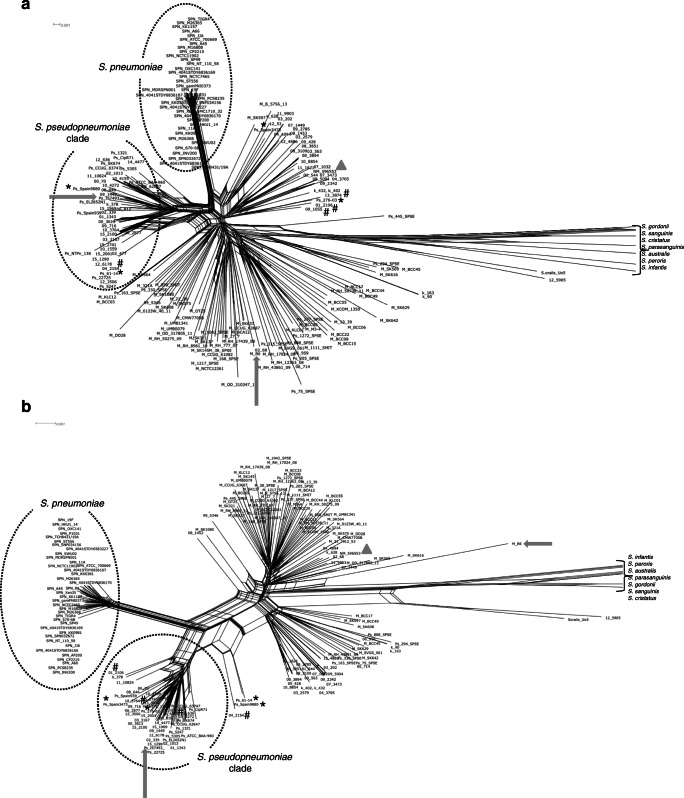
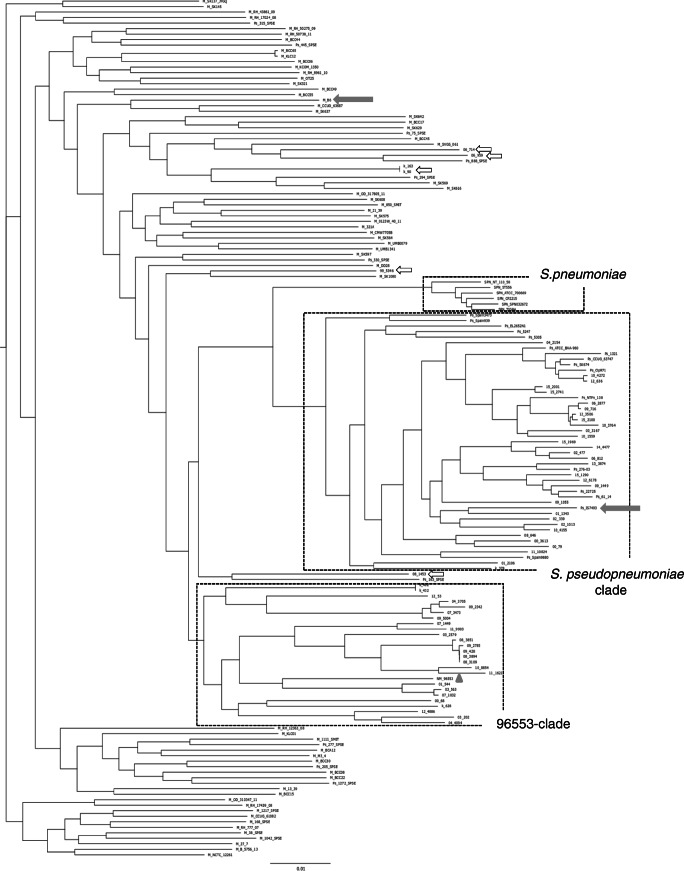
The aim of our study was to investigate phenotypic and genotypic features of streptococci misidentified (misID) as Streptococcus pneumoniae, obtained over 20 years from hospital patients in Poland. Sixty-three isolates demonstrating microbiological features typical for pneumococci (optochin susceptibility and/or bile solubility) were investigated by phenotypic tests, lytA and 16S rRNA gene polymorphism and whole-genome sequencing (WGS). All isolates had a 6-bp deletion in the lytA 3' terminus, characteristic for Mitis streptococc and all but two isolates lacked the pneumococcal signature cytosine at nucleotide position 203 in the 16S rRNA genes. The counterparts of psaA and ply were present in 100% and 81.0% of isolates, respectively; the spn9802 and spn9828 loci were characteristic for 49.2% and 38.1% of isolates, respectively. Phylogenetic trees and networks, based on the multilocus sequence analysis (MLSA) scheme, ribosomal multilocus sequence typing (rMLST) scheme and core-genome analysis, clearly separated investigated isolates from S. pneumoniae and demonstrated the polyclonal character of misID streptococci, associated with the Streptococcus pseudopneumoniae and Streptococcus mitis groups. While the S. pseudopneumoniae clade was relatively well defined in all three analyses, only the core-genome analysis revealed the presence of another cluster comprising a fraction of misID streptococci and a strain proposed elsewhere as a representative of a novel species in the Mitis group. Our findings point to complex phylogenetic and taxonomic relationships among S. mitis-like bacteria and support the notion that this group may in fact consist of several distinct species.
我们的研究目的是调查过去 20 年来从波兰医院患者中获得的被错误鉴定(misID)为肺炎链球菌的链球菌的表型和基因型特征。对 63 株表现出肺炎球菌典型微生物学特征(对新霉素敏感和/或胆汁溶解度)的分离株进行了表型试验、lytA 和 16S rRNA 基因多态性和全基因组测序(WGS)研究。所有分离株在 lytA 3'末端均有 6 个碱基缺失,这是米蒂斯链球菌的特征,除了两个分离株之外,所有分离株在 16S rRNA 基因的核苷酸位置 203 处都缺乏肺炎链球菌特征性的胞嘧啶。psaA 和 ply 的对应物分别存在于 100%和 81.0%的分离株中;spn9802 和 spn9828 基因座分别是 49.2%和 38.1%的分离株的特征。基于多位点序列分析(MLSA)方案、核糖体多位点序列分型(rMLST)方案和核心基因组分析的系统发育树和网络清楚地将研究分离株与肺炎链球菌区分开来,并证明了与肺炎链球菌相关的被misID链球菌的多克隆特征。虽然在所有三种分析中,假肺炎链球菌群都得到了相对明确的定义,但只有核心基因组分析揭示了另一个包含一部分 misID 链球菌和一个菌株的簇的存在,该菌株在其他地方被提议为米蒂斯群中一个新种的代表。我们的研究结果表明,米蒂斯样细菌之间存在复杂的系统发育和分类关系,并支持这样一种观点,即该群实际上可能由几个不同的种组成。