Lier Elisabeth Jacomine, van den Beukel Barend A W, Gawria Larsa, van der Wees Philip J, van den Hil Leontine, Bouvy Nicole D, Cheong Ying, de Wilde Rudy-Leon, van Goor Harry, Stommel Martijn W J, Ten Broek Richard P G
Department of Surgery, Radboud University Medical Center, Geert Grooteplein Zuid 10, 6525 GA, Nijmegen, The Netherlands.
IQ Healthcare, Radboud University Medical Center, Nijmegen, The Netherlands.
Surg Endosc. 2021 May;35(5):2159-2168. doi: 10.1007/s00464-020-07621-5. Epub 2020 May 14.
Adhesions are a major cause of long-term postsurgical complications in abdominal and pelvic surgery. Existing adhesion scores primarily measure morphological characteristics of adhesions that do not necessarily correlate with morbidity. The aim of this study was to develop a clinical adhesion score (CLAS) measuring overall clinical morbidity of adhesion-related complications in abdominal and pelvic surgery.
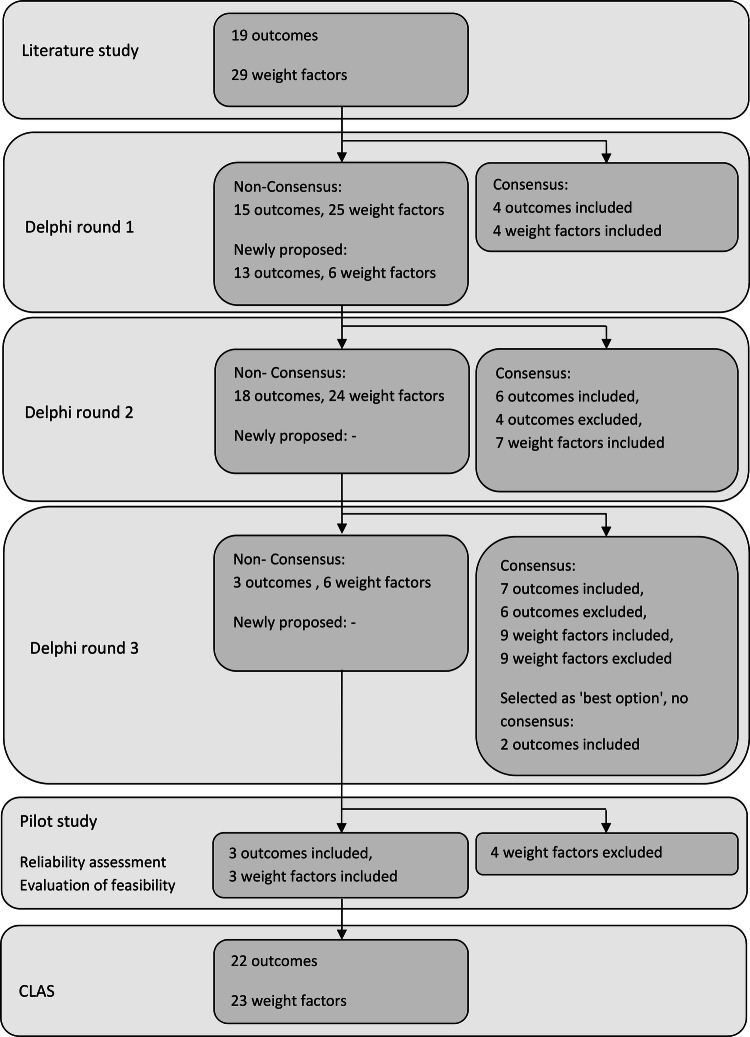
An international Delphi study was performed to identify relevant score items for adhesion-related complications, including small bowel obstruction, female infertility, chronic abdominal or pelvic pain, and difficulties at reoperation. The CLAS includes clinical outcomes, related to morbidity of adhesions, and weight factors, to correct the outcome scores for the likelihood that symptoms are truly caused by adhesions. In a pilot study, two independent researchers retrospectively scored the CLAS in 51 patients to evaluate inter-observer reliability, by calculating the Intraclass correlation coefficient. During a feasibility assessment, we evaluated whether the CLAS completely covered different clinical scenarios of adhesion-related morbidity.
Three Delphi rounds were performed. 43 experts agreed to participate, 38(88%) completed the first round, and 32 (74%) the third round. Consensus was reached on 83.4% of items. Inter-observer reliability for the CLAS was 0.95 (95% CI 0.91-0.97). During feasibility assessment, six items were included. As a result, the CLAS includes 22 outcomes and 23 weight factors.
The CLAS represents a promising scoring system to measure and monitor the clinical morbidity of adhesion-related complications. Further studies are needed to confirm its utility in clinical practice.
粘连是腹部和盆腔手术后长期并发症的主要原因。现有的粘连评分主要衡量粘连的形态特征,而这些特征不一定与发病率相关。本研究的目的是开发一种临床粘连评分(CLAS),用于衡量腹部和盆腔手术中粘连相关并发症的总体临床发病率。
进行了一项国际德尔菲研究,以确定粘连相关并发症的相关评分项目,包括小肠梗阻、女性不孕、慢性腹部或盆腔疼痛以及再次手术困难。CLAS包括与粘连发病率相关的临床结果以及权重因子,以校正症状真正由粘连引起的可能性的结果评分。在一项试点研究中,两名独立研究人员对51例患者的CLAS进行了回顾性评分,通过计算组内相关系数来评估观察者间的可靠性。在可行性评估中,我们评估了CLAS是否完全涵盖了粘连相关发病率的不同临床情况。
进行了三轮德尔菲研究。43名专家同意参与,38名(88%)完成了第一轮,32名(74%)完成了第三轮。83.4%的项目达成了共识。CLAS的观察者间可靠性为0.95(95%CI 0.91 - 0.97)。在可行性评估中,纳入了六个项目。结果,CLAS包括22个结果和23个权重因子。
CLAS是一种有前景的评分系统,用于测量和监测粘连相关并发症的临床发病率。需要进一步研究以证实其在临床实践中的效用。