• 文献检索
  • 文档翻译
  • 深度研究
  • 学术资讯
  • Suppr Zotero 插件Zotero 插件
  • 邀请有礼
  • 套餐&价格
  • 历史记录
应用&插件
Suppr Zotero 插件Zotero 插件浏览器插件Mac 客户端Windows 客户端微信小程序
定价
高级版会员购买积分包购买API积分包
服务
文献检索文档翻译深度研究API 文档MCP 服务
关于我们
关于 Suppr公司介绍联系我们用户协议隐私条款
关注我们

Suppr 超能文献

核心技术专利:CN118964589B侵权必究
粤ICP备2023148730 号-1Suppr @ 2026

文献检索

告别复杂PubMed语法,用中文像聊天一样搜索,搜遍4000万医学文献。AI智能推荐,让科研检索更轻松。

立即免费搜索

文件翻译

保留排版,准确专业,支持PDF/Word/PPT等文件格式,支持 12+语言互译。

免费翻译文档

深度研究

AI帮你快速写综述,25分钟生成高质量综述,智能提取关键信息,辅助科研写作。

立即免费体验

严重发热伴血小板减少综合征布尼亚病毒聚集性病例的流行病学和遗传学调查。

Epidemiological and genetic investigation of a cluster of cases of severe fever with thrombocytopenia syndrome bunyavirus.

机构信息

Liaoning Province Center for Disease Control and Prevention, Shenyang, Liaoning Province, China.

Department of Infectious Diseases, The First Affiliated Hospital, China Medical University, Shenyang, Liaoning Province, China.

出版信息

BMC Infect Dis. 2020 May 14;20(1):346. doi: 10.1186/s12879-020-05072-w.

DOI:10.1186/s12879-020-05072-w
PMID:32410583
原文链接:https://pmc.ncbi.nlm.nih.gov/articles/PMC7227288/
Abstract

BACKGROUND

To analyze and discuss the transmission route of a cluster of cases of severe fever with thrombocytopenia syndrome bunyavirus (SFTSV).

METHOD

We performed an epidemiological investigation and a genetic analysis of patients with severe fever with thrombocytopenia syndrome (SFTS) caused by SFTSV, their close contacts and the surrounding population.

RESULTS

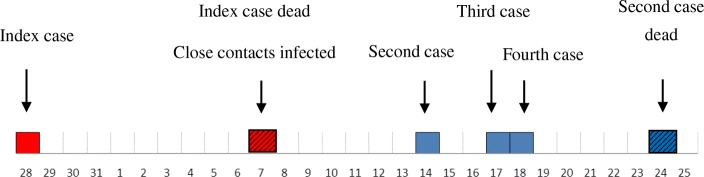
We found that all patients had contact with the blood of the first patient. The comparison of gene sequences in the three isolated SFTSV strains showed that the strains were closely related. Six close contacts and nine individuals in the surrounding population were positive for SFTSV IgM antibody.

CONCLUSION

We suspect that the cluster outbreak was transmitted via blood and that the natural reservoir host of SFTSV exists in the patients' environment.

摘要

背景

分析并讨论一组严重发热伴血小板减少综合征布尼亚病毒(SFTSV)感染病例的传播途径。

方法

对 SFTSV 引起的严重发热伴血小板减少综合征(SFTS)患者、其密切接触者及周围人群进行流行病学调查和基因分析。

结果

我们发现所有患者均与首例患者的血液有接触。对 3 株分离的 SFTSV 基因序列比较显示,株间亲缘关系密切。6 名密切接触者和 9 名周围人群 SFTSV IgM 抗体阳性。

结论

我们怀疑该聚集性疫情是通过血液传播的,SFTSV 的自然储存宿主存在于患者的环境中。
https://cdn.ncbi.nlm.nih.gov/pmc/blobs/156d/7227288/7fa078258998/12879_2020_5072_Fig2_HTML.jpg
https://cdn.ncbi.nlm.nih.gov/pmc/blobs/156d/7227288/cf9aa1ed1b3c/12879_2020_5072_Fig1_HTML.jpg
https://cdn.ncbi.nlm.nih.gov/pmc/blobs/156d/7227288/7fa078258998/12879_2020_5072_Fig2_HTML.jpg
https://cdn.ncbi.nlm.nih.gov/pmc/blobs/156d/7227288/cf9aa1ed1b3c/12879_2020_5072_Fig1_HTML.jpg
https://cdn.ncbi.nlm.nih.gov/pmc/blobs/156d/7227288/7fa078258998/12879_2020_5072_Fig2_HTML.jpg

相似文献

1
Epidemiological and genetic investigation of a cluster of cases of severe fever with thrombocytopenia syndrome bunyavirus.严重发热伴血小板减少综合征布尼亚病毒聚集性病例的流行病学和遗传学调查。
BMC Infect Dis. 2020 May 14;20(1):346. doi: 10.1186/s12879-020-05072-w.
2
A cluster of cases of severe fever with thrombocytopenia syndrome bunyavirus infection in China, 1996: A retrospective serological study.中国 1996 年严重发热伴血小板减少综合征布尼亚病毒感染的聚集性病例:回顾性血清学研究。
PLoS Negl Trop Dis. 2018 Jun 25;12(6):e0006603. doi: 10.1371/journal.pntd.0006603. eCollection 2018 Jun.
3
Severe fever with thrombocytopenia syndrome and its pathogen SFTSV.发热伴血小板减少综合征及其病原体 SFTSV。
Microbes Infect. 2015 Feb;17(2):149-54. doi: 10.1016/j.micinf.2014.12.002. Epub 2014 Dec 11.
4
Ecology of the Tick-Borne Phlebovirus Causing Severe Fever with Thrombocytopenia Syndrome in an Endemic Area of China.中国某流行地区传播导致严重发热伴血小板减少综合征的蜱传静脉病毒的生态学
PLoS Negl Trop Dis. 2016 Apr 1;10(4):e0004574. doi: 10.1371/journal.pntd.0004574. eCollection 2016 Apr.
5
Two confirmed cases of severe fever with thrombocytopenia syndrome with pneumonia: implication for a family cluster in East China.两例伴有肺炎的严重发热伴血小板减少综合征确诊病例:对中国东部一个家庭聚集性病例的启示
BMC Infect Dis. 2017 Aug 3;17(1):537. doi: 10.1186/s12879-017-2645-9.
6
Isolation, characterization, and phylogenic analysis of three new severe fever with thrombocytopenia syndrome bunyavirus strains derived from Hubei Province, China.从中国湖北省分离的三种新型发热伴血小板减少综合征布尼亚病毒株的分离、鉴定及系统进化分析。
Virol Sin. 2017 Feb;32(1):89-96. doi: 10.1007/s12250-017-3953-3. Epub 2017 Feb 24.
7
The world first two cases of severe fever with thrombocytopenia syndrome: An epidemiological study in Nagasaki, Japan.世界首例两例严重发热伴血小板减少综合征:日本长崎的一项流行病学研究。
J Infect Chemother. 2016 Jul;22(7):461-5. doi: 10.1016/j.jiac.2016.04.001. Epub 2016 Apr 30.
8
Detection of SFTS virus RNA and antibodies in severe fever with thrombocytopenia syndrome surveillance cases in endemic areas of China.在中国发热伴血小板减少综合征流行地区监测病例中检测 SFTS 病毒 RNA 和抗体。
BMC Infect Dis. 2019 May 28;19(1):476. doi: 10.1186/s12879-019-4068-2.
9
Apodemus agrarius is a potential natural host of severe fever with thrombocytopenia syndrome (SFTS)-causing novel bunyavirus.黑线姬鼠是导致严重发热伴血小板减少综合征(SFTS)的新型布尼亚病毒的潜在自然宿主。
J Clin Virol. 2015 Oct;71:82-8. doi: 10.1016/j.jcv.2015.08.006. Epub 2015 Aug 18.
10
Estimation of the incidence of severe fever with thrombocytopenia syndrome in high endemic areas in China: an inpatient-based retrospective study.中国高流行地区重症发热伴血小板减少综合征发病率的估计:一项基于住院患者的回顾性研究。
BMC Infect Dis. 2018 Feb 5;18(1):66. doi: 10.1186/s12879-018-2970-7.

引用本文的文献

1
Epidemiological characteristics of human-to-human transmission of severe fever with thrombocytopenia syndrome in China from 1996 to 2023.1996年至2023年中国发热伴血小板减少综合征人际传播的流行病学特征
PLoS Negl Trop Dis. 2025 Jul 24;19(7):e0013283. doi: 10.1371/journal.pntd.0013283. eCollection 2025 Jul.
2
Transmission and mortality risk assessment of severe fever with thrombocytopenia syndrome in China: results from 11-years' study.中国发热伴血小板减少综合征的传播和病死率评估:11 年研究结果。
Infect Dis Poverty. 2022 Sep 4;11(1):93. doi: 10.1186/s40249-022-01017-4.
3
Factors and outcomes in Severe Fever with Thrombocytopenia Syndrome (SFTS): A systematic review.

本文引用的文献

1
A cluster of cases of severe fever with thrombocytopenia syndrome bunyavirus infection in China, 1996: A retrospective serological study.中国 1996 年严重发热伴血小板减少综合征布尼亚病毒感染的聚集性病例:回顾性血清学研究。
PLoS Negl Trop Dis. 2018 Jun 25;12(6):e0006603. doi: 10.1371/journal.pntd.0006603. eCollection 2018 Jun.
2
Current status of severe fever with thrombocytopenia syndrome in China.中国发热伴血小板减少综合征的现状。
Virol Sin. 2017 Feb;32(1):51-62. doi: 10.1007/s12250-016-3931-1. Epub 2017 Feb 27.
3
Genetic Susceptibility Is One of the Determinants for Severe Fever with Thrombocytopenia Syndrome Virus Infection and Fatal Outcome: An Epidemiological Investigation.
严重发热伴血小板减少综合征(SFTS)的相关因素及预后:一项系统综述。
Ann Med Surg (Lond). 2021 Jun 11;67:102501. doi: 10.1016/j.amsu.2021.102501. eCollection 2021 Jul.
遗传易感性是发热伴血小板减少综合征病毒感染及致死结局的决定因素之一:一项流行病学调查
PLoS One. 2015 Jul 24;10(7):e0132968. doi: 10.1371/journal.pone.0132968. eCollection 2015.
4
[Epidemiological investigation on an outbreak of severe fever with thrombocytopenia syndrome in northwest Zhejiang province].[浙江省西北部严重发热伴血小板减少综合征暴发的流行病学调查]
Zhonghua Liu Xing Bing Xue Za Zhi. 2015 Apr;36(4):364-7.
5
A national assessment of the epidemiology of severe fever with thrombocytopenia syndrome, China.中国严重发热伴血小板减少综合征流行病学的全国性评估。
Sci Rep. 2015 Apr 23;5:9679. doi: 10.1038/srep09679.
6
Human-to-human transmission of severe fever with thrombocytopenia syndrome bunyavirus through contact with infectious blood.严重发热伴血小板减少综合征布尼亚病毒通过接触感染性血液在人与人之间传播。
J Infect Dis. 2013 Mar 1;207(5):736-9. doi: 10.1093/infdis/jis748. Epub 2012 Dec 6.
7
A cluster of cases of human-to-human transmission caused by severe fever with thrombocytopenia syndrome bunyavirus.由发热伴血小板减少综合征布尼亚病毒引起的人传人聚集性病例。
Int J Infect Dis. 2013 Mar;17(3):e206-8. doi: 10.1016/j.ijid.2012.11.006. Epub 2012 Dec 6.
8
Person-to-person transmission of severe fever with thrombocytopenia syndrome bunyavirus through blood contact.通过血液接触发生人感染发热伴血小板减少综合征病毒的人际传播。
Clin Infect Dis. 2012 Jan 15;54(2):249-52. doi: 10.1093/cid/cir776. Epub 2011 Nov 17.
9
A family cluster of infections by a newly recognized bunyavirus in eastern China, 2007: further evidence of person-to-person transmission.2007 年中国东部一种新发现的布尼亚病毒引起的家庭聚集性感染:人际传播的进一步证据。
Clin Infect Dis. 2011 Dec;53(12):1208-14. doi: 10.1093/cid/cir732. Epub 2011 Oct 25.
10
Person-to-person transmission of severe fever with thrombocytopenia syndrome virus.严重发热伴血小板减少综合征病毒的人际传播。
Vector Borne Zoonotic Dis. 2012 Feb;12(2):156-60. doi: 10.1089/vbz.2011.0758. Epub 2011 Sep 28.