Department of Psychiatry, College of Health and Medical Science, Dilla University, Dilla, Ethiopia.
Bio-Medical Department, College of Health and Medical Science, Dilla University, Dilla, Ethiopia.
BMC Public Health. 2020 May 14;20(1):689. doi: 10.1186/s12889-020-08800-8.
Common mental disorders are frequent psychiatric comorbid conditions among people with HIV/AIDS. The presence of such psychiatric disorders negatively affects the treatment adherence, viral load suppression, quality of life, treatment outcomes and functionality of people with HIV/AIDS. However, available studies in Ethiopia have a great variation and inconsistency of reported results have been observed regarding the magnitude and associated factors of common mental disorder. Thus, conducting a systematic review and meta-analysis of existing literatures can have a paramount importance to show its summarized figure.
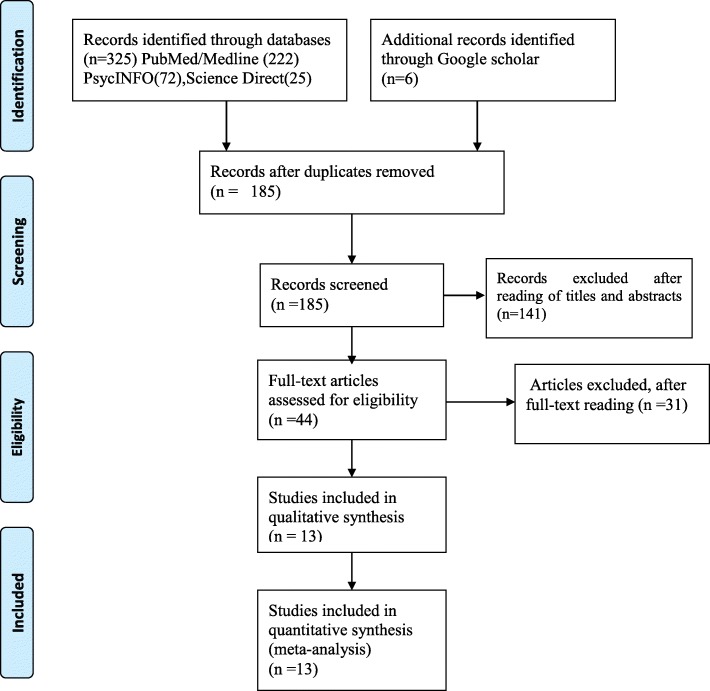
Literatures search was performed using databases (PubMed/Medline, Science Direct and PsycINFO. Grey literatures were also searched from Google and Google Scholar. Data were extracted from primary studies using a data extraction format prepared in Microsoft Excel and exported to STATA-version 14 statistical software for analysis. The I test was used to assess the heterogeneity of primary articles. The result of the test showed that there was heterogeneity between primary studies. This leads us to execute a random effect meta-analysis to estimate the pooled prevalence of common mental disorder with corresponding 95% confidence interval.
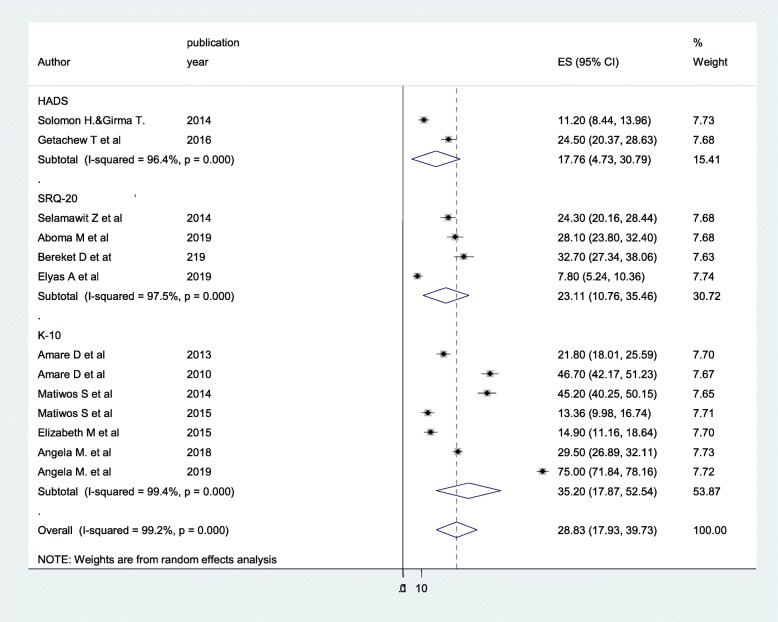
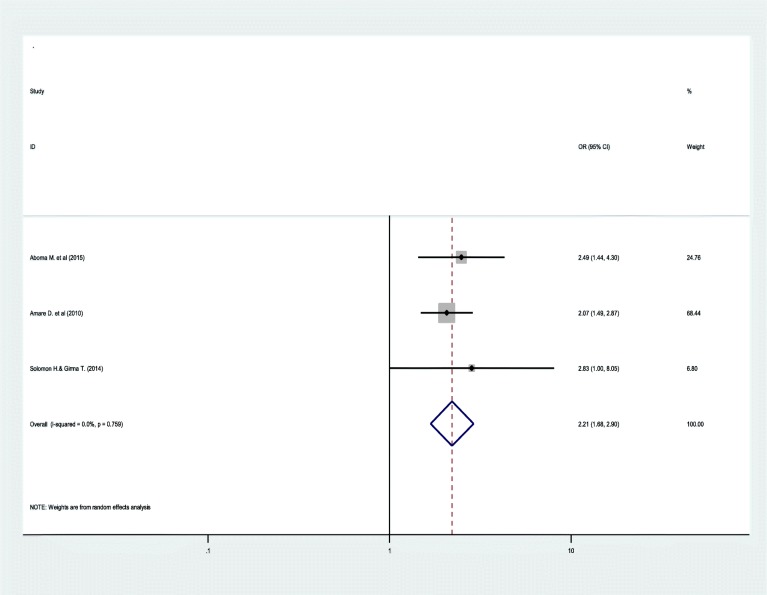
A total of 13 primary studies comply with the inclusion criteria were included in this systematic review. The pooled prevalence of common mental disorder was found to be 28.83% (95% CI: 17.93, 39.73) among people with HIV/AIDS in Ethiopia. The highest prevalence of common mental disorder (35.20%) was observed among studies in which Kessler-10 was used as a screening tool. Single marital status (OR = 1.83; 95%CI: 1.03, 3.27), HIV/AIDS-related stigma (OR = 2.21; 95%CI: 1.68, 2.90) and current job unavailability (OR = 1.38; 95%CI: 1.01, 1.88) had statistically significant association with common mental disorder.
The result of this review showed that nearly one among three individuals with HIV/AIDS is suffering from common mental disorder in Ethiopia. This calls a need to integrate the mental health and psycho-social support into the HIV/AIDS care.
PROSPERO- CRD42019132402. Registered on 05/08/2019.
常见精神障碍是艾滋病毒/艾滋病患者常见的精神共病。此类精神障碍的存在会对治疗依从性、病毒载量抑制、生活质量、治疗结果和艾滋病毒/艾滋病患者的功能产生负面影响。然而,埃塞俄比亚的现有研究结果差异很大,观察到常见精神障碍的严重程度和相关因素报告结果不一致。因此,对现有文献进行系统综述和荟萃分析具有重要意义,可以显示其汇总结果。
使用数据库(PubMed/Medline、Science Direct 和 PsycINFO)进行文献检索。还从 Google 和 Google Scholar 搜索灰色文献。使用 Microsoft Excel 准备的数据提取格式从原始研究中提取数据,并将其导出到 STATA 版本 14 统计软件进行分析。使用 I 检验评估原始文章的异质性。检验结果表明,原始研究之间存在异质性。这导致我们执行随机效应荟萃分析,以估计常见精神障碍的合并患病率及其相应的 95%置信区间。
共有 13 项符合纳入标准的原始研究被纳入本系统综述。结果显示,埃塞俄比亚艾滋病毒/艾滋病患者中常见精神障碍的合并患病率为 28.83%(95%CI:17.93,39.73)。使用 Kessler-10 作为筛查工具的研究中观察到的常见精神障碍患病率最高(35.20%)。单一婚姻状况(OR=1.83;95%CI:1.03,3.27)、艾滋病毒/艾滋病相关耻辱感(OR=2.21;95%CI:1.68,2.90)和当前无工作(OR=1.38;95%CI:1.01,1.88)与常见精神障碍有统计学显著关联。
本综述结果表明,埃塞俄比亚近三分之一的艾滋病毒/艾滋病患者患有常见精神障碍。这呼吁需要将心理健康和心理社会支持纳入艾滋病毒/艾滋病护理中。
PROSPERO-CRD42019132402。注册于 2019 年 5 月 8 日。