Departamento de Producción Agraria, Universidad Politécnica de Madrid, ETS Ingeniería Agronómica Alimentaria y de Biosistemas, 28040 Madrid, Barcelona, Spain.
Lucta S.A., Innovation Division, UAB Research Park, Edifici Eureka, 08193 Bellaterra, Barcelona, Spain.
Poult Sci. 2020 Jan;99(1):2-10. doi: 10.3382/ps/pez467. Epub 2019 Dec 30.
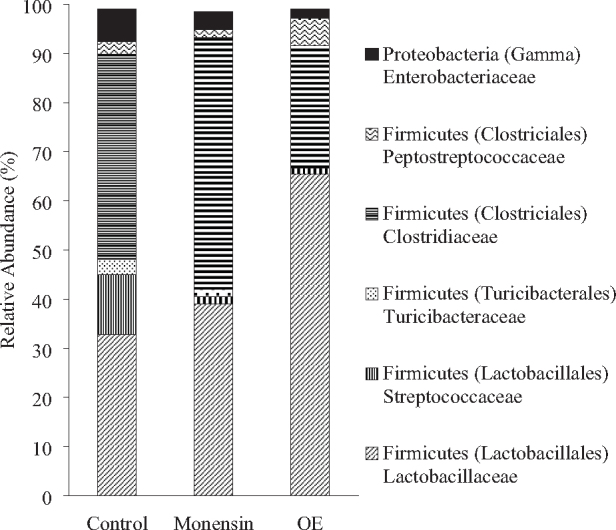
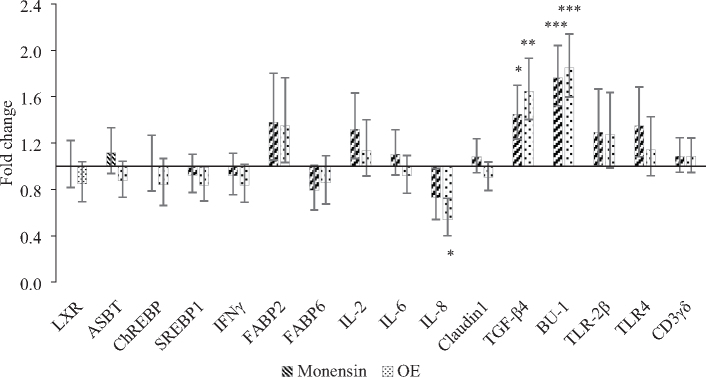
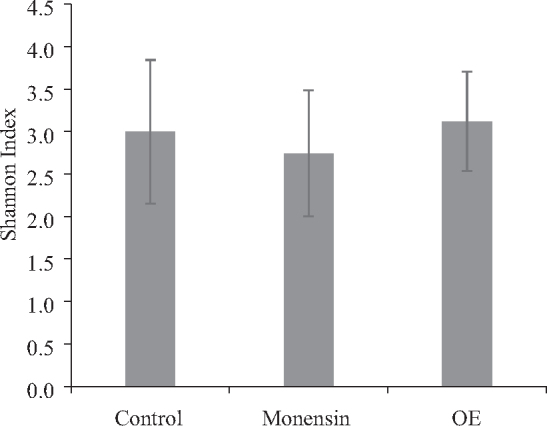
The present study aims to investigate the effects of supplementing broiler diets with a bioactive olive pomace extract (OE) from Olea europaea on growth performance, digestibility, gut microbiota, bile acid composition, and immune response. To this end, three hundred and six 1-day-old broiler chickens (Ross 308) were housed in floor pens (6 pens/treatment, with 17 birds/pen). Animals were fed with a standard non-medicated starter diet for 21 D, and from 22 to 42 D of age with their respective experimental diet: a negative control with no additives (Control), a positive control with 100 ppm of monensin (Monensin) and the basal diet supplemented with 750 ppm of an OE (Lucta S.A., Spain). Feed intake and growth rate were monitored weekly throughout the trial. From 21 to 42 D of age, no significant differences in feed intake were observed among dietary treatments; however, lower average daily gain and higher feed conversion ratio (P < 0.05) was observed in birds fed the Control compared to Monensin and OE groups. Performance of birds fed OE or Monensin was similar throughout the trial. The apparent ileal digestibility of crude protein was higher in birds fed Monensin than Control treatment (P < 0.05). No significant changes on bacterial composition at a family level were observed in the caeca of birds fed the experimental diets. Moreover, no significant differences on plasma and intestinal bile acid composition were observed among treatments. Birds fed the OE showed a significant decrease of IL-8 expression in the ileum (P < 0.05). Additionally, the expression of TGF-β4, and Bu-1 was significantly upregulated (P < 0.01) in broilers fed the OE and Monensin diets compared to those fed the Control. In conclusion, the inclusion of 750 ppm of a bioactive olive pomace extract from Olea europaea in broiler chicken diets improved animal growth likely as result of its anti-inflammatory properties.
本研究旨在探讨在肉鸡日粮中添加一种来自油橄榄(Olea europaea)的生物活性橄榄渣提取物(OE)对生长性能、消化率、肠道微生物群、胆汁酸组成和免疫反应的影响。为此,将 306 只 1 日龄肉鸡(罗斯 308)饲养在地板笼中(6 个笼/处理,每个笼 17 只鸡)。动物在 21 天龄前饲喂标准无药 starters 日粮,22-42 天龄时饲喂各自的实验日粮:无添加剂的阴性对照(Control)、添加 100 ppm 莫能菌素的阳性对照(Monensin)和基础日粮添加 750 ppm OE(Lucta S.A.,西班牙)。整个试验期间每周监测采食量和生长速度。在 21-42 天龄期间,日粮处理之间的采食量没有显著差异;然而,与 Monensin 和 OE 组相比,饲喂 Control 的鸡的平均日增重较低,饲料转化率较高(P < 0.05)。整个试验期间,饲喂 OE 或 Monensin 的鸡的性能相似。饲喂 Monensin 的鸡的粗蛋白表观回肠消化率高于 Control 处理(P < 0.05)。饲喂实验日粮的鸡盲肠的细菌组成在科水平上没有显著变化。此外,处理之间的血浆和肠道胆汁酸组成没有显著差异。饲喂 OE 的鸡的回肠中 IL-8 的表达显著降低(P < 0.05)。此外,与饲喂 Control 的鸡相比,饲喂 OE 和 Monensin 日粮的鸡的 TGF-β4 和 Bu-1 的表达显著上调(P < 0.01)。综上所述,在肉鸡日粮中添加 750 ppm 来自油橄榄的生物活性橄榄渣提取物可改善动物生长,这可能是由于其抗炎特性。