Chen Zhenghao, Liu Yaxiao, Zhao Mengmeng, Zu Shulu, Li Yan, Shi Benkang, Wang Shaoyong, Zhang Xiulin
Department of Urology, Second Hospital of Shandong University, Jinan 250000, China.
Department of Urology, Qilu Hospital of Shandong University, Jinan 250000, China.
Transl Androl Urol. 2020 Apr;9(2):284-294. doi: 10.21037/tau.2020.02.18.
Urothelial cells release ATP into the urine in response to bladder stretch. Urinary ATP concentration in benign prostatic hyperplasia (BPH) patients was higher compared with asymptomatic controls. In this study, we aimed to explore the possibility that the urinary ATP level could be a non-invasive biomarker for bladder outlet obstruction (BOO) and its severity in BPH patients.
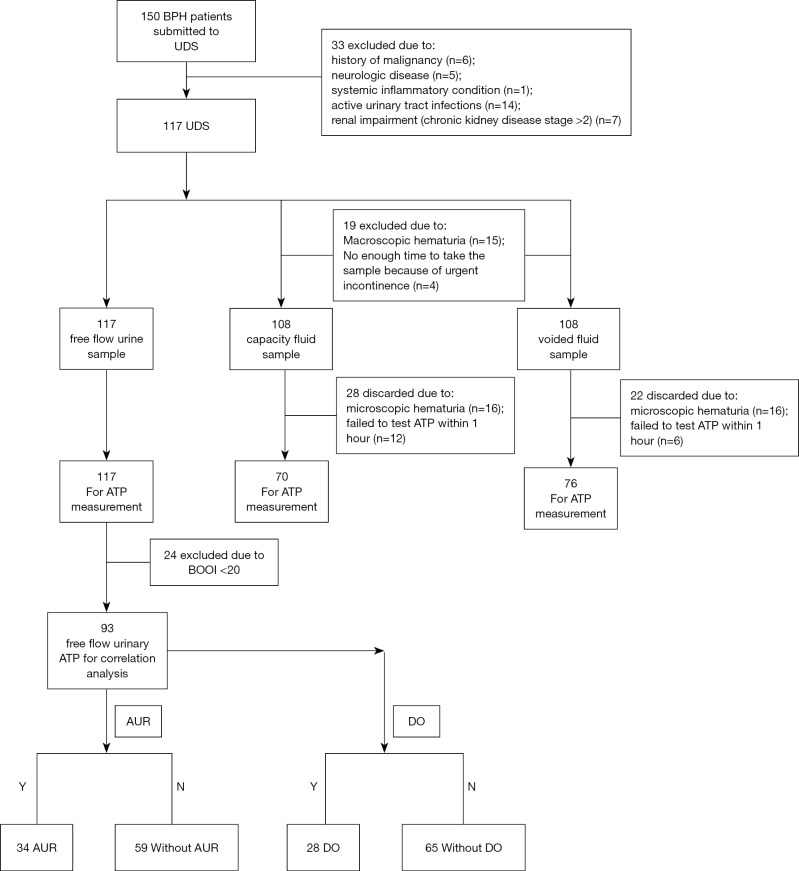
We included 117 BPH patients who underwent urodynamic studies and 109 asymptomatic controls. Urine samples at normal desire (from patients and controls), instilled fluids at maximum cystometric capacity (capacity fluid), and voided fluids during a pressure-flow study (only from patients) were collected. The ATP concentration in collected samples was measured using a luciferin-luciferase bioluminescence assay and normalized to urine creatinine (ATP/Cr). The degree of BOO was quantified using the BOO index (BOOI). Correlation between urodynamic parameters and urinary ATP concentration was analyzed in BPH patients.
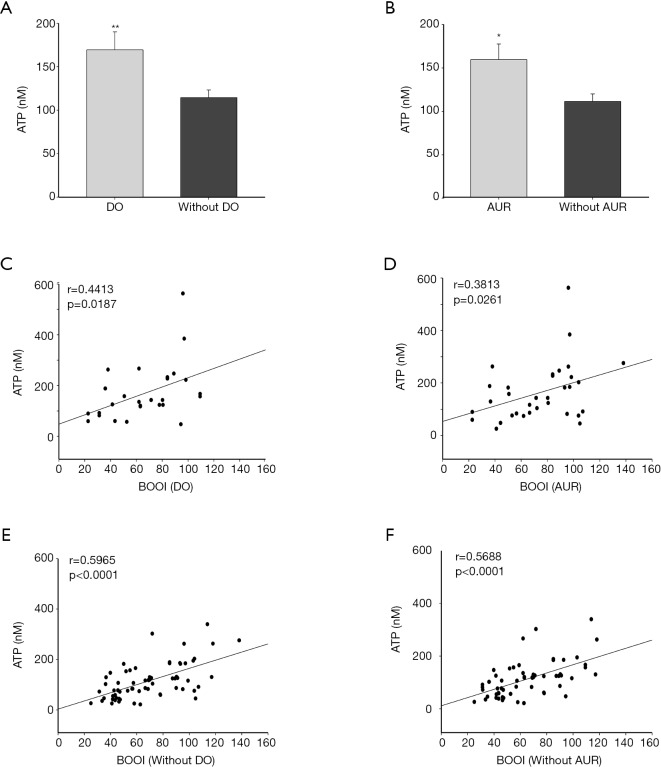
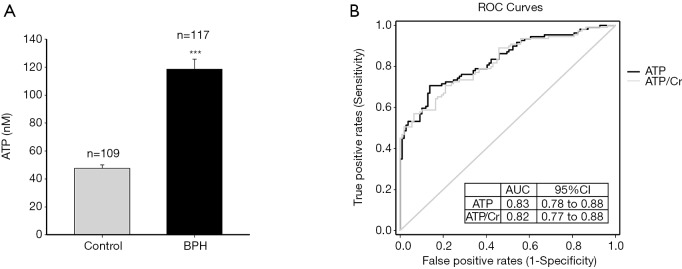
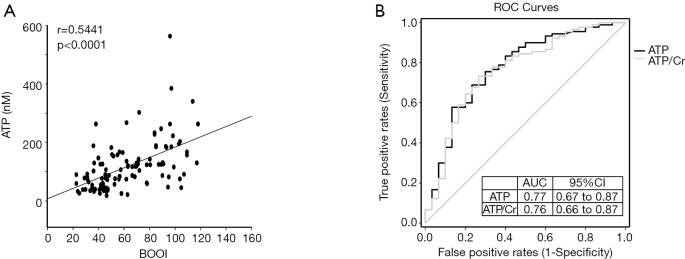
Urinary ATP concentration of BPH patients was significantly higher compared with controls (P<0.001). For BPH patients, a significant positive correlation was found between urinary ATP concentration and BOOI (P<0.0001). Although BPH patients with detrusor overactivity or a history of acute urinary retention had increased urinary ATP, a significant positive correlation between ATP and BOOI was also observed in these patients. When BOOI >40 was set as a cutoff point to differentiate BOO from non-BOO patients, the area under the receiver operating characteristic (ROC) curve was 0.77 (P<0.001).
BPH patients with BOO released higher amounts of ATP into the urine. Urinary ATP can be used as a non-invasive biomarker of BOO, and its level may also have a predictive value for the degree of obstruction.
膀胱上皮细胞在膀胱扩张时会向尿液中释放三磷酸腺苷(ATP)。与无症状对照组相比,良性前列腺增生(BPH)患者尿液中的ATP浓度更高。在本研究中,我们旨在探讨尿液ATP水平能否作为BPH患者膀胱出口梗阻(BOO)及其严重程度的非侵入性生物标志物。
我们纳入了117例接受尿动力学检查的BPH患者和109例无症状对照组。收集正常排尿意愿时的尿液样本(来自患者和对照组)、膀胱测压最大容量时注入的液体(容量液体)以及压力-流率研究期间排出的液体(仅来自患者)。使用荧光素-荧光素酶生物发光测定法测量收集样本中的ATP浓度,并将其标准化为尿肌酐(ATP/Cr)。使用BOO指数(BOOI)对BOO程度进行量化。分析BPH患者尿动力学参数与尿液ATP浓度之间的相关性。
BPH患者的尿液ATP浓度显著高于对照组(P<0.001)。对于BPH患者,尿液ATP浓度与BOOI之间存在显著正相关(P<0.0001)。尽管逼尿肌过度活动或有急性尿潴留病史的BPH患者尿液ATP升高,但在这些患者中也观察到ATP与BOOI之间存在显著正相关。当将BOOI>40设定为区分BOO与非BOO患者的截断点时,受试者操作特征(ROC)曲线下面积为0.77(P<0.001)。
患有BOO的BPH患者向尿液中释放的ATP量更高。尿液ATP可作为BOO的非侵入性生物标志物,其水平可能对梗阻程度也具有预测价值。