Zhang Fangyuan, Wu Pengjie, Wang Yalong, Zhang Mengxian, Wang Xiaodan, Wang Ting, Li Shengwen, Wei Dong
School of Clinical Medicine, Tsinghua University, Beijing 100084, China.
Department of Urology, Beijing Hospital, National Center of Gerontology, Beijing 100730, China.
Transl Androl Urol. 2020 Apr;9(2):452-461. doi: 10.21037/tau.2020.02.11.
Clear cell renal cell carcinoma (ccRCC) is the most common malignant tumor of kidney with high mortality. The pathogenesis of ccRCC is complicated and effective prognostic predictors for clinical practice are still limited. This study aimed to identify significant genes with prognostic influence in ccRCC via bioinformatics analysis.
Four gene expression profiles were acquired from the Gene Expression Omnibus (GEO) database, including 168 ccRCC tissues and 143 normal tissues. Common differentially expressed genes (DEGs) between ccRCC tissues and normal kidney tissues were screened out. Then gene ontology (GO) enrichment analysis and Kyoto Encyclopedia of Genes and Genomes (KEGG) pathway analysis were investigated. Protein-protein interaction (PPI) network of the common DEGs was diagrammed and analyzed. Kaplan-Meier analysis was conducted to identify genes with prognostic influence in ccRCC. Gene Expression Profiling Interactive Analysis (GEPIA) was finally applied to validating differential expression of genes.
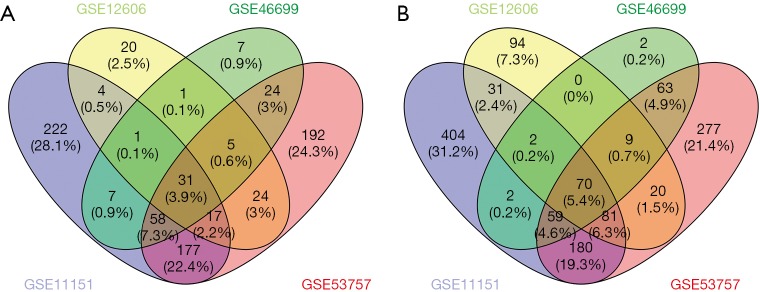
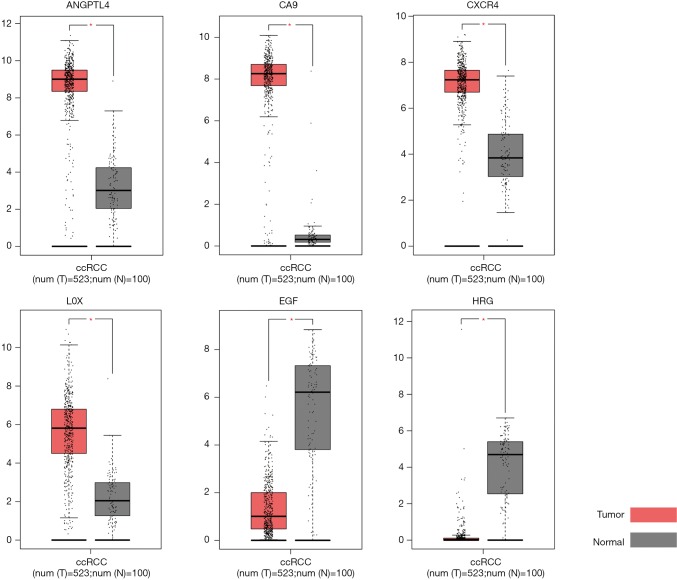
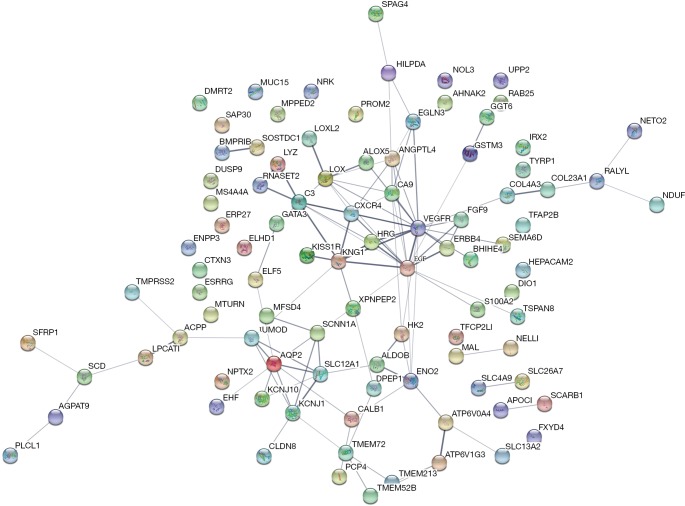
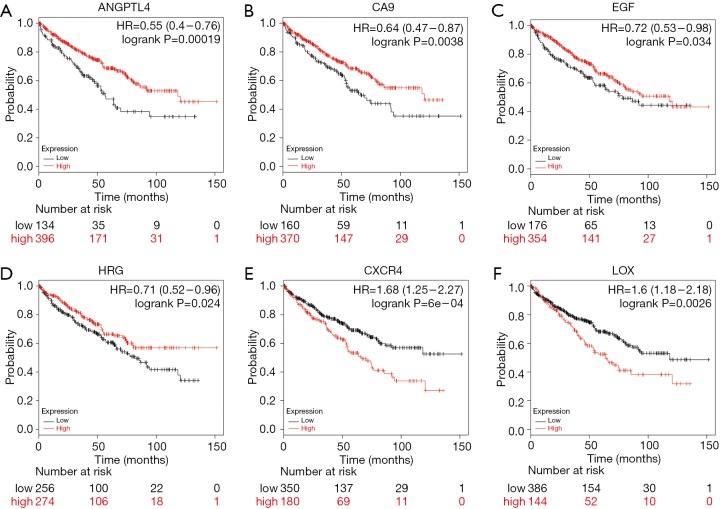
Ninety-nine common DEGs between ccRCC tissues and normal kidney tissues were eventually screened out (P<0.05, |log FC| >2). GO functional analysis showed that the down-regulated genes were enriched in excretion, negative regulation of cell proliferation, heparin binding and cellular response to BMP stimulus, etc. KEGG pathway analysis indicated that the common DEGs were particularly enriched in HIF-1 signaling pathway and aldosterone-regulated sodium reabsorption. Seven core DEGs were distinguished through PPI network analysis, of which 6 core genes , , , , and showed significantly prognostic difference in patients with ccRCC by Kaplan-Meier analysis (P<0.05). And GEPIA confirmed these genes were expressed differentially between tumor and normal tissues (P<0.05). High expression of was correlated with good OS in ccRCC patients. Specifically, was commonly down-regulated in ccRCC tissues compared with normal tissues according to GEPIA.
Our study shows that high expression of denotes a better prognosis in ccRCC patients. is down-regulated in ccRCC tissues compared with normal kidney tissues. The selective expression pattern suggests that could be a novel prognostic predictor and potential therapeutic target for ccRCC patients.
透明细胞肾细胞癌(ccRCC)是最常见的肾脏恶性肿瘤,死亡率高。ccRCC的发病机制复杂,临床实践中有效的预后预测指标仍然有限。本研究旨在通过生物信息学分析确定在ccRCC中具有预后影响的重要基因。
从基因表达综合数据库(GEO)中获取四个基因表达谱,包括168例ccRCC组织和143例正常组织。筛选出ccRCC组织与正常肾组织之间的常见差异表达基因(DEGs)。然后进行基因本体(GO)富集分析和京都基因与基因组百科全书(KEGG)通路分析。绘制并分析常见DEGs的蛋白质-蛋白质相互作用(PPI)网络。进行Kaplan-Meier分析以确定在ccRCC中具有预后影响的基因。最后应用基因表达谱交互式分析(GEPIA)验证基因的差异表达。
最终筛选出ccRCC组织与正常肾组织之间的99个常见DEGs(P<0.05,|log FC|>2)。GO功能分析表明,下调基因富集于排泄、细胞增殖的负调控、肝素结合和细胞对BMP刺激的反应等。KEGG通路分析表明,常见DEGs特别富集于HIF-1信号通路和醛固酮调节的钠重吸收。通过PPI网络分析鉴别出7个核心DEGs,其中6个核心基因,,,,和通过Kaplan-Meier分析显示在ccRCC患者中具有显著的预后差异(P<0.05)。并且GEPIA证实这些基因在肿瘤组织和正常组织之间表达存在差异(P<0.05)。在ccRCC患者中,的高表达与良好的总生存期相关。具体而言,根据GEPIA,与正常组织相比,在ccRCC组织中通常下调。
我们的研究表明,在ccRCC患者中高表达表示预后较好。与正常肾组织相比,在ccRCC组织中下调。这种选择性表达模式表明,可能是ccRCC患者一种新 的预后预测指标和潜在的治疗靶点。