Lee So-Ryoung, Choi Eue-Keun, Lee Seo-Young, Lee Euijae, Han Kyung-Do, Cha Myung-Jin, Kwon Woon Yong, Shin Sang Do, Oh Seil, Lip Gregory Y H
Department of Internal Medicine, Seoul National University Hospital, Seoul 03080, Korea.
Department of Internal Medicine, Seoul National University College of Medicine, Seoul 03080, Korea.
J Clin Med. 2020 May 14;9(5):1485. doi: 10.3390/jcm9051485.
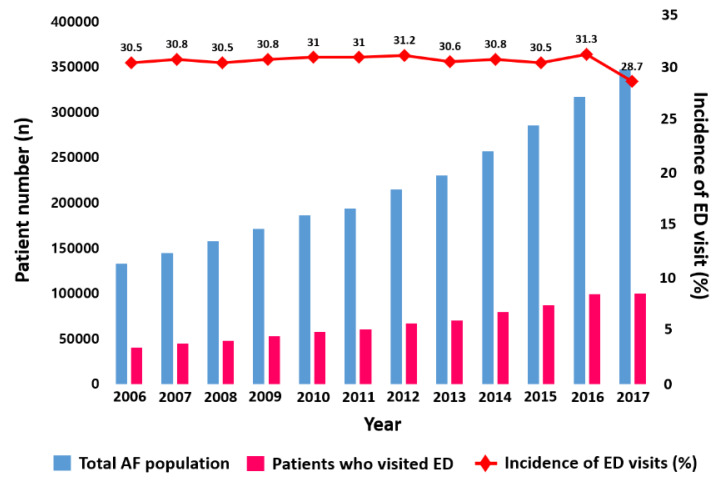
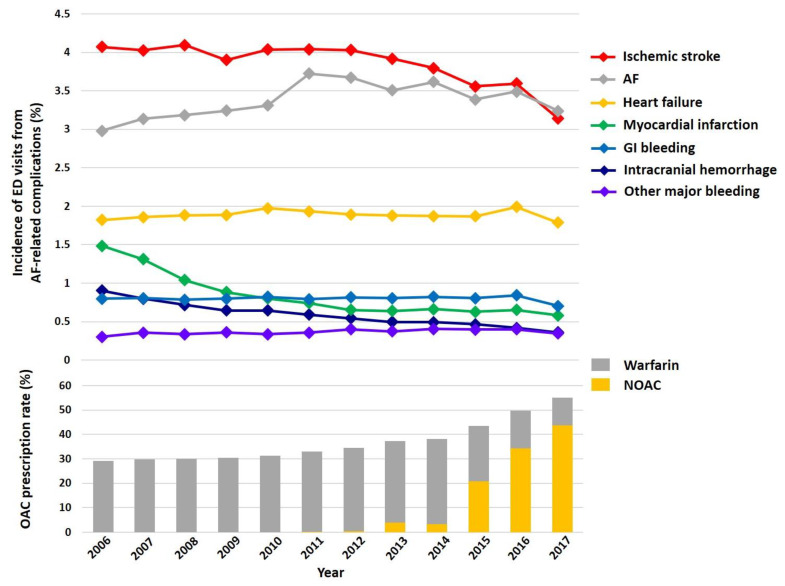
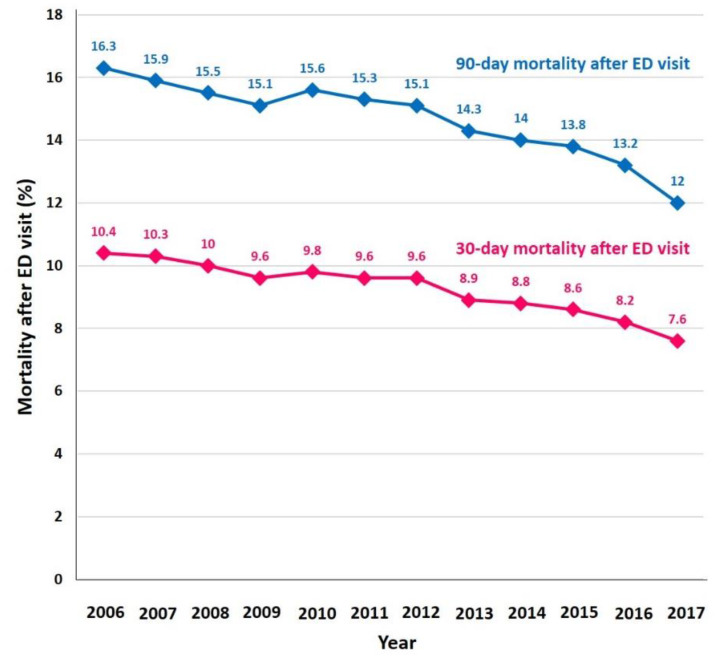
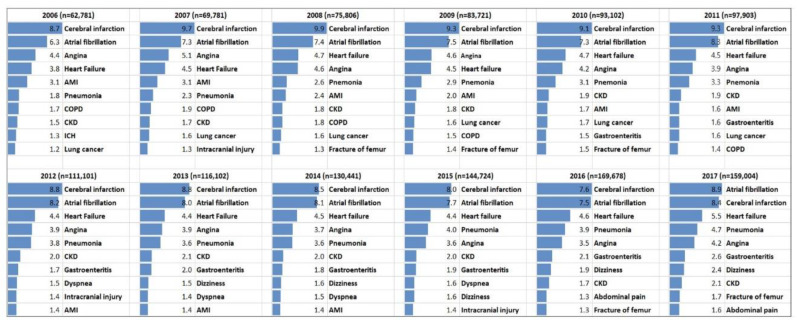
We aimed to describe temporal trends in emergency department (ED) visits of patients with atrial fibrillation (AF) over 12 years. A repeated cross-sectional analysis of ED visits in AF patients using the Korean nationwide claims database between 2006 and 2017 were conducted. We identified AF patients who had ≥1 ED visits. The incidence of ED visits among total AF population, cause of ED visit, and clinical outcomes were evaluated. During 12 years, the annual numbers of AF patients who attended ED at least once a year continuously increased (40,425 to 99,763). However, the annual incidence of ED visits of AF patients was stationary at about 30% because the number of total AF patients also increased during the same period. The most common cause of ED visits was cerebral infarction. Although patients had a higher risk profile over time, the 30-day and 90-day mortality after ED visit decreased over time. ED visits due to ischemic stroke, intracranial hemorrhage, and myocardial infarction decreased, whereas ED visits due to AF, gastrointestinal bleeding, and other major bleeding slightly increased among total AF population over 12 years. A substantial proportion of AF patients attended ED every year, and the annual numbers of AF patients who visited the ED significantly increased over 12 years. Optimized management approaches in a holistic and integrated manner should be provided to reduce ED visits of AF patients.
我们旨在描述12年间心房颤动(AF)患者急诊就诊的时间趋势。利用韩国全国索赔数据库对2006年至2017年间AF患者的急诊就诊情况进行了重复横断面分析。我们确定了有≥1次急诊就诊的AF患者。评估了总AF人群中急诊就诊的发生率、急诊就诊原因及临床结局。在12年期间,每年至少就诊一次急诊的AF患者数量持续增加(从40425例增至99763例)。然而,AF患者急诊就诊的年发生率稳定在约30%,因为同期AF患者总数也在增加。急诊就诊最常见的原因是脑梗死。尽管随着时间推移患者的风险特征更高,但急诊就诊后30天和90天死亡率随时间下降。在12年期间,总AF人群中因缺血性卒中、颅内出血和心肌梗死导致的急诊就诊减少,而因AF、胃肠道出血和其他大出血导致的急诊就诊略有增加。相当一部分AF患者每年都去急诊就诊,且12年间去急诊就诊的AF患者数量显著增加。应提供全面综合的优化管理方法以减少AF患者的急诊就诊。