Liverpool Centre for Cardiovascular Science, University of Liverpool, L7 8TX, United Kingdom.
Eur Heart J Qual Care Clin Outcomes. 2022 Nov 17;8(8):892-898. doi: 10.1093/ehjqcco/qcac005.
Atrial Fibrillation (AF) is the most common sustained heart arrhythmia and a major preventable cause of stroke. Stroke accounts for a large amount of health and social care funding and over the coming years is likely to place an increasing cost burden on the wider UK health care system. We therefore need to understand how an opportunistic AF screening programme would impact on healthcare costs of AF (and AF-related stroke) for the NHS.
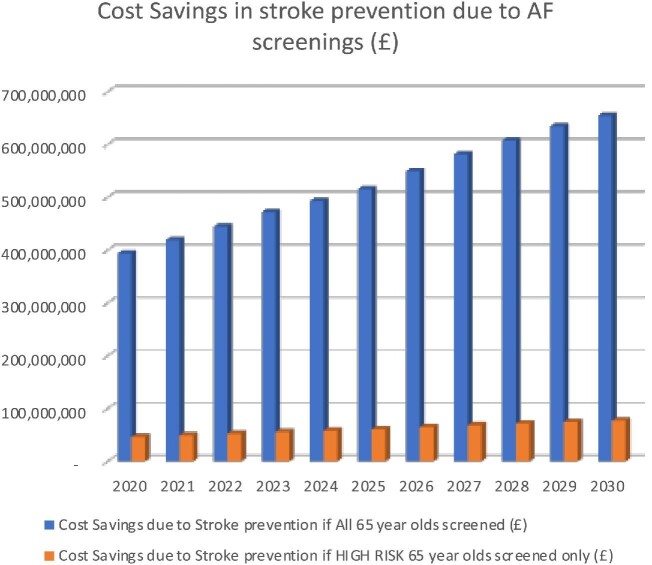
Using UK population forecasts and prior published data we initially calculated the number of people to be screened, newly-diagnosed and treated for Atrial Fibrillation (AF), and the associated costs of such a programme for all 65 year olds and for just a 'high risk' group. The reduction in the number of stroke cases recorded and the associated cost savings were subsequently calculated, for 2020 and the projected estimates over the following decade. The number of newly diagnosed AF patients at 65 years old for the two groups (all 65 year olds and for just a 'high risk' group) would be in 6754 and 797 in 2020, rising to 9200 and 1086 in 2030, respectively. In 2020 the cost of the screening programme for the two options would be £14.3m and £1.7m. If AF is medicated and monitored then there would be a subsequent reduction in the number of stroke cases in 2020 by 4323 or 510 depending on the group screened, with associated savings of £394.2m and £46.5m, respectively. Focussing on 2030 and should opportunistic screenings for AF be introduced at age 65, with subsequent treatment, it is predicted to reduce the number of stroke cases over the decade by 5888 if all 65 year olds are screened and 695 if just the high risk group are screened. If the number of strokes can be reduced by treating these screened AF patients, we would substantially reduce the health and social care costs of stroke by £654.6m and £77.3m, respectively.
The number of newly diagnosed AF patients at age 65 will rise over the decade between 2020 and 2030. Screening and treatment of AF will substantially reduce the health and social care costs of AF-related stroke in the NHS.
心房颤动(AF)是最常见的持续性心律失常,也是中风的主要可预防原因。中风占大量的医疗保健支出,在未来几年内,它可能会给英国更广泛的医疗保健系统带来越来越大的成本负担。因此,我们需要了解机会性房颤筛查计划如何影响 NHS 房颤(和房颤相关中风)的医疗成本。
使用英国人口预测和之前发表的数据,我们最初计算了筛查、新诊断和治疗房颤的人数,以及为所有 65 岁及仅高危人群进行此类计划的相关成本。随后计算了 2020 年及未来十年记录的中风病例数量减少和相关成本节约。对于两个组(所有 65 岁及仅高危人群),2020 年新诊断的房颤患者人数将分别为 6754 人和 797 人,到 2030 年将分别上升至 9200 人和 1086 人。2020 年,这两种选择的筛查计划成本分别为 1430 万英镑和 170 万英镑。如果对房颤进行药物治疗和监测,那么 2020 年筛查组中风病例数量将分别减少 4323 例或 510 例,分别节省 3.942 亿英镑和 4650 万英镑。如果在 2030 年左右,如果在 65 岁时对房颤进行机会性筛查,并进行后续治疗,可以预测,如果对所有 65 岁人群进行筛查,这十年中风病例数将减少 5888 例,如果仅对高危人群进行筛查,将减少 695 例。如果通过治疗这些筛查的房颤患者可以减少中风病例,我们将分别减少 NHS 中风相关房颤的健康和社会保健成本 6.546 亿英镑和 7730 万英镑。
到 2030 年,65 岁新诊断的房颤患者人数将在 2020 年至 2030 年的十年间上升。房颤的筛查和治疗将大大降低 NHS 房颤相关中风的健康和社会保健成本。