Karampatakis Georgios Dimitrios, Patel Nilesh, Stretch Graham, Ryan Kath
School of Pharmacy, University of Reading, Whiteknights Campus, PO Box 226, Reading, RG6 6AP, UK.
Ealing GP Federation, 179C Bilton Road, Perivale, Greenford, Middlesex, UB6 7HQ, UK.
BMC Health Serv Res. 2020 May 18;20(1):431. doi: 10.1186/s12913-020-05245-y.
In England, since 2015, there has been a formal drive to integrate pharmacists into general practice as a new healthcare service. Research efforts have offered insights into how general practice-based professionals and patients view the service, however, they took no account of community pharmacy teams' opinions. There have been anecdotal statements about opposition from community pharmacies to the service, due to fears of losing business. The aim of the current study was to identify the experiences and perceptions of community pharmacy teams regarding pharmacists' presence in general practice.
The National Health Service Choices website was used to identify community pharmacies within a radius of two miles from eight West London general practices. The search resulted in 104 community pharmacies which were all contacted via telephone. Pharmacy staff who verbally expressed their interest to participate were then provided with the study's documents. Qualitative, face-to-face, semi-structured interviews were conducted inside the pharmacy from which each participant was recruited. Interviews lasted 30 to 45 min and were audio-recorded. Audio-recordings were transcribed verbatim and transcripts analysed thematically.
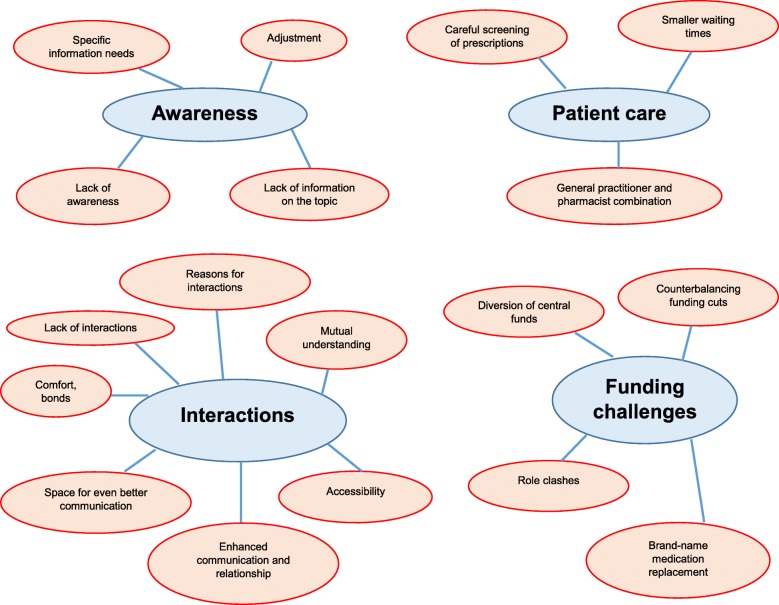
Forty-eight community pharmacy staff participated. Four themes were discerned: awareness ("I knew that [pharmacists] have already been implemented [in general practice] but I haven't really followed it … where does the pharmacist role come?"); interactions ("I'm just so pleased that there's a pharmacist professional in the general practice … because we speak the same language!"); patient care ("if I was a patient knowing that there is a general practitioner and a pharmacist [in general practice], I would … think 'nothing can go wrong at the moment'"); and funding challenges ("if general practices take on the extra responsibility of stop smoking or flu vaccination campaigns … financially, this would affect this pharmacy").
The current study revealed the perceived impact of general practice-based pharmacists on community pharmacies would be improved communication between pharmacies and practices. Findings will inform policy so that any future framing of pharmacists' presence in general practice considers the needs of community pharmacies.
在英国,自2015年以来,一直在推动将药剂师纳入全科医疗作为一项新的医疗服务。研究工作已经深入了解了全科医疗专业人员和患者对这项服务的看法,然而,这些研究没有考虑社区药房团队的意见。有传闻称社区药房因担心失去业务而反对这项服务。本研究的目的是确定社区药房团队对药剂师在全科医疗中存在的经验和看法。
利用国民保健服务选择网站确定伦敦西部8家全科诊所两英里范围内的社区药房。搜索结果为104家社区药房,均通过电话联系。口头表示有兴趣参与的药房工作人员随后收到了研究文件。在药房内进行定性、面对面、半结构化访谈,从这些访谈中招募每位参与者。访谈持续30至45分钟,并进行了录音。录音逐字转录,转录本进行主题分析。
48名社区药房工作人员参与。识别出四个主题:认知(“我知道[药剂师]已经在[全科医疗中]实施了,但我没有真正关注……药剂师的角色从何而来?”);互动(“我很高兴全科医疗中有药剂师专业人员……因为我们说同一种语言!”);患者护理(“如果我是一名患者,知道全科医疗中有一名全科医生和一名药剂师,我会……想‘目前不会有任何问题’”);以及资金挑战(“如果全科诊所承担起戒烟或流感疫苗接种活动的额外责任……在财务上,这会影响这家药房”)。
本研究表明,全科医疗中的药剂师对社区药房的影响将是改善药房与诊所之间的沟通。研究结果将为政策提供参考,以便未来任何关于药剂师在全科医疗中存在的规划都能考虑到社区药房的需求。