Stone Edwin M, Andorf Jeaneen L, Whitmore S Scott, DeLuca Adam P, Giacalone Joseph C, Streb Luan M, Braun Terry A, Mullins Robert F, Scheetz Todd E, Sheffield Val C, Tucker Budd A
Department of Ophthalmology and Visual Sciences, University of Iowa Carver College of Medicine, Iowa City, Iowa; Stephen A. Wynn Institute for Vision Research, the University of Iowa, Iowa City, Iowa.
Department of Ophthalmology and Visual Sciences, University of Iowa Carver College of Medicine, Iowa City, Iowa; Stephen A. Wynn Institute for Vision Research, the University of Iowa, Iowa City, Iowa.
Ophthalmology. 2017 Sep;124(9):1314-1331. doi: 10.1016/j.ophtha.2017.04.008. Epub 2017 May 27.
To devise a comprehensive multiplatform genetic testing strategy for inherited retinal disease and to describe its performance in 1000 consecutive families seen by a single clinician.
Retrospective series.
One thousand consecutive families seen by a single clinician.
The clinical records of all patients seen by a single retina specialist between January 2010 and June 2016 were reviewed, and all patients who met the clinical criteria for a diagnosis of inherited retinal disease were included in the study. Each patient was assigned to 1 of 62 diagnostic categories, and this clinical diagnosis was used to define the scope and order of the molecular investigations that were performed. The number of nucleotides evaluated in a given subject ranged from 2 to nearly 900 000.
Sensitivity and false genotype rate.
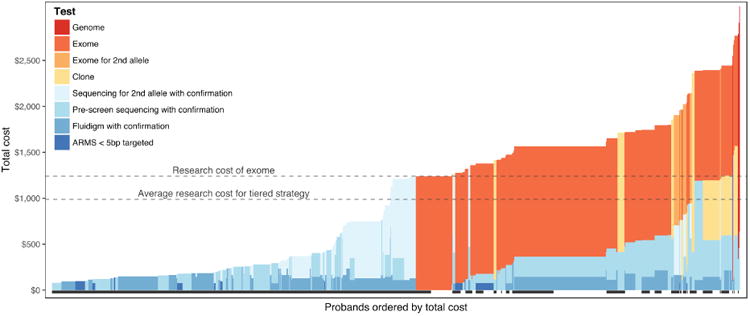
Disease-causing genotypes were identified in 760 families (76%). These genotypes were distributed across 104 different genes. More than 75% of these 104 genes have coding sequences small enough to be packaged efficiently into an adeno-associated virus. Mutations in ABCA4 were the most common cause of disease in this cohort (173 families), whereas mutations in 80 genes caused disease in 5 or fewer families (i.e., 0.5% or less). Disease-causing genotypes were identified in 576 of the families without next-generation sequencing (NGS). This included 23 families with mutations in the repetitive region of RPGR exon 15 that would have been missed by NGS. Whole-exome sequencing of the remaining 424 families revealed mutations in an additional 182 families, and whole-genome sequencing of 4 of the remaining 242 families revealed 2 additional genotypes that were invisible by the other methods. Performing the testing in a clinically focused tiered fashion would be 6.1% more sensitive and 17.7% less expensive and would have a significantly lower average false genotype rate than using whole-exome sequencing to assess more than 300 genes in all patients (7.1% vs. 128%; P < 0.001).
Genetic testing for inherited retinal disease is now more than 75% sensitive. A clinically directed tiered testing strategy can increase sensitivity and improve statistical significance without increasing cost.
设计一种针对遗传性视网膜疾病的综合多平台基因检测策略,并描述其在一位临床医生诊治的1000个连续家庭中的表现。
回顾性系列研究。
一位临床医生诊治的1000个连续家庭。
回顾了一位视网膜专科医生在2010年1月至2016年6月期间诊治的所有患者的临床记录,所有符合遗传性视网膜疾病诊断临床标准的患者均纳入研究。每位患者被分配到62个诊断类别中的1个,该临床诊断用于确定所进行分子检测的范围和顺序。给定受试者评估的核苷酸数量范围为2至近900000。
敏感性和假基因型率。
在760个家庭(76%)中鉴定出致病基因型。这些基因型分布在104个不同的基因中。这104个基因中超过75%的编码序列足够小,能够有效地包装到腺相关病毒中。ABCA4基因的突变是该队列中最常见的致病原因(173个家庭),而80个基因的突变导致疾病的家庭数为5个或更少(即0.5%或更低)。在没有进行二代测序(NGS)的家庭中,有576个家庭鉴定出致病基因型。这包括23个家庭,其RPGR外显子15重复区域的突变会被NGS遗漏。对其余424个家庭进行全外显子测序,又发现了182个家庭的突变,对其余242个家庭中的4个进行全基因组测序,发现了另外2种其他方法无法检测到的基因型。以临床为重点的分层方式进行检测,敏感性将提高6.1%,成本降低17.7%,并且平均假基因型率将显著低于对所有患者使用全外显子测序评估300多个基因的情况(7.1%对128%;P<0.001)。
遗传性视网膜疾病的基因检测敏感性现在超过75%。临床指导的分层检测策略可以提高敏感性并改善统计学意义,而不增加成本。